
Non-FictionBusiness BriefLegal Procedure
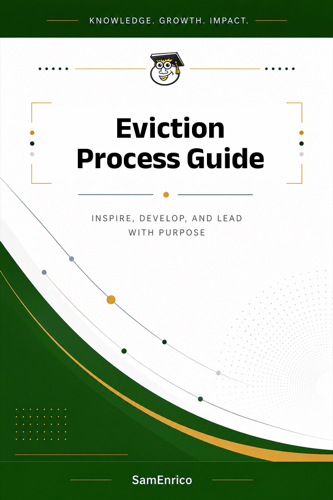
Eviction Process Guide eBook
Follows legal steps to remove non paying tenants.
Follows legal steps to remove non paying tenants.
Formats
Free sample
Chapter 1: The 2AM Truth--–- The first time you lie awake at 2 AM wondering how you will pay your mortgage because your tenant stopped paying rent three months ago, you will make a mistake. You will fantasize about changing the locks. You will imagine throwing their belongings onto the curb. You will rehearse the speech you want to give them—the one where you explain, with perfect clarity, why they are a bad person and you are a victim. Do not make that speech.
Do not change those locks. Do not touch their belongings. Everything you are about to read in this book is designed to redirect that 2 AM desperation into a cold, methodical, legally unassailable process. The eviction process is not about justice. It is not about fairness.
It is about procedure. And procedure is the only thing that will get your property back.This chapter establishes the legal and psychological framework for every action you will take in the remaining eleven chapters. It begins with the most important truth in eviction law: you have moral rights, but the legal system does not care about morality. The legal system cares about paperwork, deadlines, service of process, and verified statements signed under penalty of perjury. You can be the most ethically wronged landlord in the history of property law, and if your three-day notice was posted on a Sunday when your state excludes Sundays, you lose.
You can be a slumlord who never fixed a single leaky pipe, and if your paperwork is perfect, you win. The law is not a mirror of morality. It is a machine. Your job is to feed it the correct inputs.The Catastrophic Mistakes Landlords Make Before we discuss what you should do, we must discuss what you should never do. Every year, thousands of landlords lose eviction cases not because they were wrong about the unpaid rent, but because they committed one of the "self-help" evictions that every state has made illegal.
Self-help eviction means taking the law into your own hands. It means physically removing the tenant or making the property uninhabitable so the tenant leaves voluntarily. It is a shortcut that leads to a dead end.Illegal lockouts are the most common self-help mistake. A landlord changes the locks while the tenant is at work. The tenant returns, cannot enter, and calls the police.
The police arrive. The landlord shows the lease. The tenant shows a receipt for last month's partial payment. The police do not care who is right. They care about one thing: does the tenant have a legal right to possess the property?
If there is no court order saying otherwise, the tenant has that right. The police will order the landlord to let the tenant back in. In many jurisdictions, the landlord can be arrested for unlawful eviction. In California, for example, illegal lockout is a misdemeanor punishable by up to one year in jail and a $10,000 fine. The tenant can also sue the landlord for damages: three times the actual damages plus attorney fees.
A landlord who changes locks to collect $5,000 in unpaid rent can easily end up owing $15,000 or more.Utility shutoffs are equally dangerous. A landlord who cuts off electricity, water, gas, or heat is committing constructive eviction—making the property uninhabitable so the tenant is forced to leave. The legal consequences are severe. In most states, utility shutoff is a violation of the implied warranty of habitability, which exists in every residential lease whether written or not. The tenant can sue for damages, withhold all future rent, and in some states, recover attorney fees.
A landlord who shuts off the heat in winter is not solving a problem. They are creating a much larger problem.Removing doors is another classic mistake. A landlord takes the front door off its hinges, thinking this will motivate the tenant to leave. Instead, the tenant calls code enforcement, which cites the landlord for violating building codes. The landlord now faces fines from the city while still not having collected rent.
Physical force—pushing, shoving, or threatening a tenant—crosses the line from civil to criminal. A landlord who pushes a tenant can be charged with assault, and the eviction case becomes irrelevant because the landlord is now defending against criminal charges.The common thread in all these mistakes is emotion. The landlord is angry, frustrated, and desperate. The landlord wants to feel powerful. Self-help eviction provides an illusion of power.
But the illusion shatters the moment the police arrive. The legal system punishes self-help precisely because it is extra-judicial. The law insists that eviction happen through the courts, not through the landlord's fists or tools.The Moral Right Versus the Legal Right Here is a sentence that will save you thousands of dollars: being right is not enough. You can be morally right. You can be factually right.
You can have a signed lease, a ledger showing zero payments, and a photograph of the tenant admitting they spent the rent money on a vacation. None of that matters if you violated a procedural rule.Consider two hypothetical landlords. Landlord A has a tenant who stopped paying rent eight months ago. The tenant has destroyed the property, threatened the landlord, and ignored every communication. Landlord A, in a fit of rage, changes the locks and throws the tenant's belongings onto the lawn.
Landlord B has a tenant who is three days late on rent for the first time. Landlord B follows every procedure: a properly formatted notice, personal service, a correctly filed complaint, a verified proof of service, a timely default judgment, and a sheriff-coordinated lockout. Who wins? Landlord B wins. Landlord A is now the defendant in a lawsuit for illegal eviction.
Landlord B has possession of the property within thirty days. The moral weight of the situation—eight months of unpaid rent versus three days—is irrelevant to the judge. The only thing the judge looks at is procedure.This is the hardest lesson for new landlords to accept. The legal system does not have a "but they really deserved it" exception. The legal system has rules.
You follow the rules, you win. You break the rules, you lose. The tenant's bad behavior does not excuse your procedural errors. The judge will not say, "Well, the tenant was awful, so I will overlook your defective notice." The judge will dismiss your case and tell you to start over.The concept of moral right versus legal right becomes especially painful when tenants raise defenses that seem obviously false. A tenant claims the heat was broken for three months, but you have photographs showing the thermostat set at seventy-two degrees.
You want the judge to see that the tenant is lying. But if your notice was defective, you will never get to show those photographs. The case will be dismissed before you ever present evidence. The tenant's lie will never be exposed because your procedural error gave them an escape hatch.State-Specific Laws: The Map Is Not the Territory If you read only one sentence in this chapter, read this one: eviction laws vary dramatically by state, and assuming your state's rules are the same as a neighboring state…
This is the end of the free sample. Get the eBook to keep going. Buy now
About this book
Details
- Author
- Zielinski Ellie
- Publisher
- SamEnrico
- Language
- English
- Genre
- Non-Fiction, Business Brief, Legal Procedure
- Released
- 2026-06-06
- Pages (approx.)
- 135
- Available as
- eBook, Audiobook

Read better in the ZLOADR app
Your eBooks on your phone or tablet. Sign in with your SamEnrico account and start reading.
More by Zielinski Ellie
 The Executive Chef Stress GuideZielinski Ellie$11.99
 Micronutrients For Nail Health GuideZielinski Ellie$11.99
 The Frozen Lake StillnessZielinski Ellie$11.99
 The Award Acceptance SpeechZielinski Ellie$11.99
 The IBS Research UpdateZielinski Ellie$11.99
 Alt Comic ConfessionsZielinski Ellie$11.99
 Caregiver Financial Stress GuideZielinski Ellie$11.99
 Hildegard of Bingen: The Prophetess of the RhineZielinski Ellie$11.99
 Anansi's Golden Web: The Trickster’s Grand DesignZielinski Ellie$11.99
 The Last Broadcast of Radio EcoshockZielinski Ellie$11.99
 Prompting for Lookbook and Style CreationZielinski Ellie$11.99
 International Crisis PR GuideZielinski Ellie$12.99
You may also like
 Hong Kong Handover 1997Dunn Johnnie$11.99
 Zumba For Postnatal Recovery CourseNeal Christian$11.99
 Zumba for BeginnersLadner Nikia$11.99
 YouTube Comment Mining GuideHumes Pandora$12.99
 Worry Box MeditationCarlin Rudy$11.99
 Workplace Stress MeditationNguyen Lynn$11.99
 Workplace Stress and Sleep RepairHawley Ivory$11.99
 Workplace Perfectionism CureDelaney Jeffry$11.99
 Workplace Injustice Anger GuideWallen Isabelle$11.99
 Work Addiction and Burnout LinkGreenwood Ester$11.99
 Women in Yoga and WellnessBeattie Galina$11.99
 Women in Stand Up ComedyChun Evangeline$11.99