
Non-FictionSelf-HelpJournaling
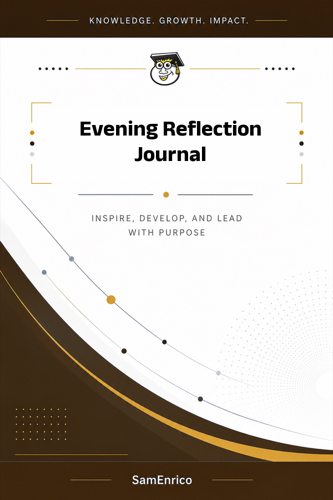
Evening Reflection Journal eBook
Writes daily wins and improvements.
by Meade Rosana
Writes daily wins and improvements.
Formats
Free sample
Chapter 1: The 2 AM Spiral--–- The clock on her nightstand read 2:17 AM. Sarah had been staring at it for forty-seven minutes, watching the red digits blur and sharpen, blur and sharpen, as her eyes burned with exhaustion she could no longer feel. Her husband slept soundly beside her, his breathing deep and rhythmic, a cruel counterpoint to the chaos in her head. She had tried everything: counting backward from one thousand, the military method (relax your face, drop your shoulders, exhale slowly), even the sleep-cast podcast where a British man describes walking through a meadow. Nothing worked.
Because the problem was not her body. The problem was her brain, and the problem had a name: the 2 AM Spiral.Sarah was thirty-four years old, held a senior marketing position at a mid-sized tech company, had two children under the age of six, and by every external metric, was successful. Her performance reviews were excellent. Her children were healthy. Her marriage was solid.
And yet, here she was, at two in the morning, replaying the day like a film director obsessing over a single bad frame. She had arrived ten minutes late to the 9:30 AM stand-up meeting. Not fired. Not even reprimanded. But late.
Her daughter had cried during drop-off, clinging to her leg while the daycare teacher pried her loose. Normal separation anxiety, the teacher had said. But Sarah heard failure. She had forgotten to reply to an email from a client—a client who had not followed up, who likely had not even noticed. But Sarah imagined them sitting in their office, shaking their heads, thinking, "Unprofessional." She had yelled at her son for spilling juice on the couch.
She had apologized immediately. She had hugged him. But the image of his startled face replayed on a loop, each time cutting deeper.This was not a bad day by any objective standard. It was, in fact, an utterly ordinary Tuesday. And that was the most terrifying part.
If an ordinary Tuesday could reduce her to this—this sweating, heart-pounding, 2 AM witness to her own perceived failures—then what hope was there for the real crises? The ones that would inevitably come: a layoff, an illness, a true emergency. She would shatter.Sarah did not know it yet, but she was not broken. She was not weak. She was not uniquely flawed.
Her brain was doing exactly what evolution had designed it to do. And that was the problem.The Ancient Alarm Bell That Won't Shut Off The human brain weighs about three pounds, consumes roughly twenty percent of your body's energy despite being only two percent of your mass, and contains approximately eighty-six billion neurons. It is the most complex structure in the known universe. And it is terrified.Not of anything specific. Not of the saber-toothed tiger that no longer exists or the predator hiding in the tall grass that has been replaced by suburban lawns.
The modern human brain is terrified of ambiguity, social rejection, and the gap between what it expected and what actually happened. This is not a malfunction. It is a feature—an ancient feature that was never upgraded for the world of email, performance reviews, daycare drop-offs, and silent judgment.The technical term is negativity bias. It was first identified by psychologists Roy Baumeister and his colleagues in a landmark 2001 paper titled "Bad Is Stronger Than Good," which reviewed decades of research and concluded that negative events are processed more thoroughly, remembered more vividly, and influence behavior more powerfully than positive events. A single criticism stings more than a dozen compliments warm you.
One betrayal erodes trust more than years of loyalty build it. The memory of a near-miss car accident stays with you for years while the memory of a hundred uneventful commutes vanishes by the time you unlock your front door.Why? Because your ancestors who assumed the rustle in the bushes was a predator and ran—even when it was just the wind—survived to reproduce. Your ancestors who assumed the rustle was nothing and stayed—even when it was a predator—did not. The brain that erred on the side of caution, that scanned for threats first and celebration second, was the brain that won the evolutionary lottery.
You are the descendant of worriers. You are the child of people who saw danger everywhere because danger really was everywhere.But here is the catch: the saber-toothed tiger is gone. The predator in the grass is a lawn ornament. The threats you face today are not physical; they are social, professional, and internal. And your ancient alarm system cannot tell the difference between a lion and a passive-aggressive email.
It treats both as existential threats, flooding your body with cortisol and adrenaline, preparing you to fight or flee. Except you cannot fight an email and you cannot flee from a memory. So the cortisol sits in your bloodstream, the adrenaline buzzes in your chest, and you lie awake at 2 AM, convinced that being ten minutes late to a meeting is a sign of catastrophic failure.The Asymmetry of Memory To understand why Sarah could not sleep, we need to understand how memory works. The brain encodes positive and negative experiences using different neurochemical pathways. Negative experiences are tagged with a "high priority" flag by the amygdala, the brain's threat-detection center.
This flag instructs the hippocampus (where memories are stored) to file the experience deeply, with multiple cross-references, so it can be retrieved instantly if a similar threat appears. This is why you remember exactly where you were when you received harsh criticism, but you cannot remember what you had for lunch three days ago when everything went fine.Positive experiences, by contrast, receive a much lower priority flag. They are stored as single-entry files, easily overwritten, rarely cross-referenced. The brain assumes that if something was safe and pleasant, there is no urgent need to remember it in high fidelity. You do not need to run away from a compliment.
You do not need to fight a moment of joy. So the memory fades, sometimes within hours, while the negative memory crystallizes into something that feels permanent.This is not a design flaw. It is a design trade-off. The brain has limited storage and processing capacity, so it allocates resources based on survival value. Negative experiences have high survival value (avoid this threat again).
Positive experiences have low survival value (enjoy that feeling, but no need to obsess over it). The problem is that in the modern world, the "threats" your brain is flagging are not life-threatening. They are merely unpleasant. But your brain does not know the difference.Sarah's brain had flagged "arrived ten minutes late to meeting" as a high-priority threat. It had cross-referenced this memory with every other time she had been late, every reprimand she had ever received, every judgmental glance she had ever noticed.
By 2 AM, the single event had been magnified into evidence of a fundamental character flaw: "I am the kind of person who is late." "I am unreliable." "I am failing." The brain had done exactly what it was supposed to do. And it was destroying her.The Myth of the "Problem Seeker"Here is…
This is the end of the free sample. Get the eBook to keep going. Buy now
About this book
Details
- Author
- Meade Rosana
- Publisher
- SamEnrico
- Language
- English
- Genre
- Non-Fiction, Self-Help, Journaling
- Released
- 2026-06-05
- Pages (approx.)
- 112
- Available as
- eBook, Audiobook

Read better in the ZLOADR app
Your eBooks on your phone or tablet. Sign in with your SamEnrico account and start reading.
More by Meade Rosana
 Alcoholism Withdrawal Management PrimerMeade Rosana$11.99
 Self Esteem for Re entrantsMeade Rosana$11.99
 Evening Self Talk ReflectionMeade Rosana$11.99
 Anki For Data ScienceMeade Rosana$11.99
 Notion for Personal KnowledgeMeade Rosana$11.99
 Meditation for NeuropathyMeade Rosana$11.99
 Colombian Emerald MinesMeade Rosana$11.99
 The Plague That Walked Like a Man: The 1918 Flu’s Hidden Super-SpreadersMeade Rosana$11.99
 Isandlwana: The Day the Earth Shook in Zulu FuryMeade Rosana$11.99
 White Clover: Dutch CloverMeade Rosana$11.99
 The Essential Guide to Regional MexicanoMeade Rosana$11.99
 How to Start a Mackintoshes for Men and Boys Business (Beginners Guide)Meade Rosana$11.99
You may also like
 Hong Kong Handover 1997Dunn Johnnie$11.99
 Zumba For Postnatal Recovery CourseNeal Christian$11.99
 Zumba for BeginnersLadner Nikia$11.99
 YouTube Comment Mining GuideHumes Pandora$12.99
 Worry Box MeditationCarlin Rudy$11.99
 Workplace Stress MeditationNguyen Lynn$11.99
 Workplace Stress and Sleep RepairHawley Ivory$11.99
 Workplace Perfectionism CureDelaney Jeffry$11.99
 Workplace Injustice Anger GuideWallen Isabelle$11.99
 Work Addiction and Burnout LinkGreenwood Ester$11.99
 Women in Yoga and WellnessBeattie Galina$11.99
 Women in Stand Up ComedyChun Evangeline$11.99