
Non-FictionForecast & OutlookBattery Recycling
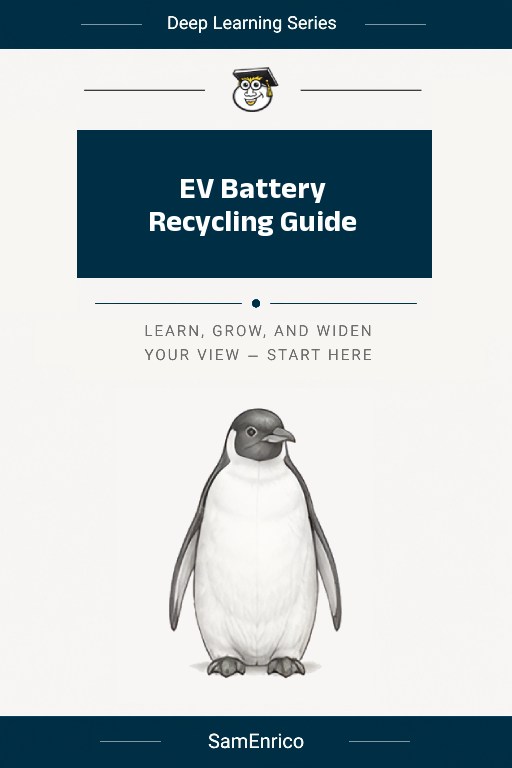
EV Battery Recycling Guide
Discover hydrometallurgical and direct recycling t
Discover hydrometallurgical and direct recycling technologies for lithium, cobalt, and nickel recovery.
Formats
About this book
Free sample
Chapter 1: The 50x Cliff...---- The year is 2035. You are standing in a warehouse the size of four football fields, somewhere outside Hamburg, Germany. Before you, stacked in twenty-foot-high rows, are thirty thousand tons of spent electric vehicle batteries. They arrived last week from twelve different countries. By next Tuesday, fifty more trucks will arrive.
By the end of the year, this single facility will process more lithium, cobalt, and nickel than a medium-sized mine in the Democratic Republic of Congo. And here is the detail that keeps executives awake at night: this facility does not exist yet. Not fully. Not at the scale required. Not even close.This is the 50x cliff.
By 2035, the world will need fifty times more battery recycling capacity than it has today. Not ten times. Not twenty times. Fifty. That number appears in every industry projection, every government white paper, every investor pitch deck.
And yet, when you ask recycling plant operators how they will bridge that gap, most will give you a version of the same answer: "We don't know yet. We're figuring it out as we go."This chapter is about why that answer is both terrifying and hopeful. Terrifying because the waste is coming whether we are ready or not. Hopeful because the technology, the economics, and the policy environment are finally aligning to turn a looming environmental disaster into the most valuable industrial opportunity of the next decade.The Arithmetic of Obsolescence Let us start with simple math. A modern electric vehicle battery lasts between eight and fifteen years, depending on chemistry, driving conditions, climate, and charging habits.
The first mass-market EVs—the Nissan Leaf, the Tesla Model S, the Chevrolet Bolt—began appearing on roads in significant numbers around 2012 to 2015. Those batteries are now reaching end-of-life. By 2025, the first wave of retirement will hit: approximately 500,000 tons of spent EV batteries annually. By 2030, that number rises to 3 million tons. By 2035, the figure exceeds 7 million tons per year.To put seven million tons in perspective: that is the weight of seventy aircraft carriers.
That is enough battery mass to fill the Great Pyramid of Giza three times over. That is, by any measure…
This is the end of the free sample. Get the eBook to keep going. Buy now
Contents
- Chapter 1
- Chapter 2
- Chapter 3
- Chapter 4
- Chapter 5
- Chapter 6
- Chapter 7
- Chapter 8
- Chapter 9
- Chapter 10
- Chapter 11
- Chapter 12
Details
- Author
- Roderick Conchita
- Publisher
- SamEnrico
- Language
- English
- Genre
- Non-Fiction, Forecast & Outlook, Battery Recycling
- Released
- 2026-05-29
- Pages (approx.)
- 155
- Available as
- eBook, Audiobook

Read better in the ZLOADR app
Your eBooks on your phone or tablet. Sign in with your SamEnrico account and start reading.
More by Roderick Conchita
 The Self Esteem for Immigrants GuideRoderick Conchita$11.99
 Pet Loss and NatureRoderick Conchita$11.99
 Long Term Travel Career PivotRoderick Conchita$11.99
 Flirting Nonverbal Signals GuideRoderick Conchita$11.99
 John Chrysostom AccountRoderick Conchita$11.99
 The Bone Collector of the Black ForestRoderick Conchita$11.99
 Understanding KyphosisRoderick Conchita$17.99
 How to Start a Steam and Air-Conditioning Supply BusinessRoderick Conchita$11.99
 Interview Question Generator HandbookRoderick Conchita$12.99
 Barback TrainingRoderick Conchita$11.99
You may also like
 Hong Kong Handover 1997Dunn Johnnie$11.99
 Zumba For Postnatal Recovery CourseNeal Christian$11.99
 Zumba for BeginnersLadner Nikia$11.99
 YouTube Comment Mining GuideHumes Pandora$12.99
 Worry Box MeditationCarlin Rudy$11.99
 Workplace Stress MeditationNguyen Lynn$11.99
 Workplace Stress and Sleep RepairHawley Ivory$11.99
 Workplace Perfectionism CureDelaney Jeffry$11.99
 Workplace Injustice Anger GuideWallen Isabelle$11.99
 Work Addiction and Burnout LinkGreenwood Ester$11.99
 Women in Yoga and WellnessBeattie Galina$11.99
 Women in Stand Up ComedyChun Evangeline$11.99