
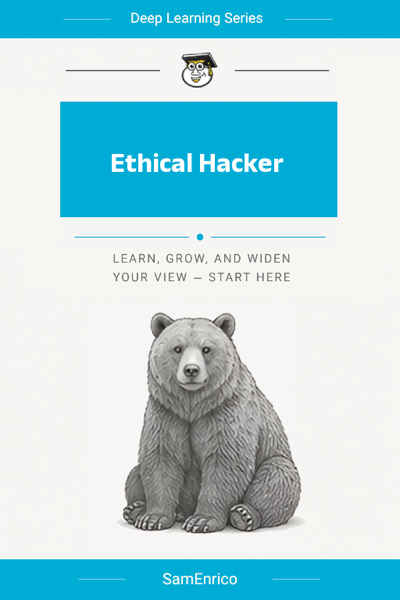
Ethical Hacker eBook
A Coursebook on Ethical Hacker
A Coursebook on Ethical Hacker
Formats
Free sample
Chapter 1: The Permission Slip--–- In 2019, a junior penetration tester named Maya sat in a windowless conference room across from three lawyers and her new boss. She had just returned from her first solo engagement – a two-week test of a regional hospital’s network. The lead attorney slid a single sheet of paper across the table. It was the Rules of Engagement document Maya had signed before starting. “You scanned beyond the agreed-upon subnet,” the attorney said, tapping a line of text.
“The MRI machine in the east wing rebooted during your scan. A patient was rescheduled. Their family is considering legal action.”Maya’s face went pale. She had run a full port scan on what she thought was the entire hospital network. But buried on page seven of the twenty-page contract was a single sentence: “The radiology subnet (10.22.40.0/24) is excluded from testing.” She had missed it.
The hospital’s insurance company demanded a formal apology, a full root cause analysis, and – worst of all – Maya’s OSCP certification was put under review by her employer. She wasn’t fired. But she spent the next six months on “administrative duties” – which meant watching other pentesters work while she paid off the forty-thousand-dollar liability deductible out of her own pocket.This book exists to make sure that never happens to you.Ethical hacking is not about being the smartest hacker in the room. It is not about knowing the most obscure exploits or having the fastest GPU cracking rig. Ethical hacking is about professionalism, discipline, and – above all – permission.
You can know every vulnerability in the CVE database. You can write your own zero-day exploits. But if you run a single scan without written authorization, you are not an ethical hacker. You are a criminal. And the law does not care about your intentions.Part One: The Anatomy of a Hacker – Types, Shades, and Consequences Before you type a single command in Kali Linux, you must understand where you stand on the spectrum of hacking.
The popular media loves to portray hackers as hoodie-wearing geniuses who type furiously while green text scrolls down a black screen. Reality is both more mundane and more dangerous.The Hat Classification System The cybersecurity industry has adopted a simple color-based system to distinguish between different types of hackers:White Hat Hackers – These are the protagonists of our story. White hats operate with explicit, written permission from the target organization. They follow a defined scope, respect Rules of Engagement, and deliver detailed reports at the conclusion of their testing. White hats are employed as penetration testers, security consultants, red team members, and bug bounty hunters (on authorized programs).
Their actions are legal protected because they have a contract.Black Hat Hackers – These are the criminals. Black hats break into systems without permission, steal data, deploy ransomware, or sell access on dark web markets. Their motivations vary – financial gain, political activism (hacktivism), espionage, or sheer malice. Regardless of motive, their actions violate laws like the Computer Fraud and Abuse Act (CFAA) in the United States, the Computer Misuse Act in the United Kingdom, and similar legislation worldwide. Prison sentences for black hat activity range from months to decades.Grey Hat Hackers – This is where things get complicated.
Grey hats operate in the ambiguous space between white and black. They might discover a vulnerability in a company’s website, exploit it to prove it exists, and then notify the company – without ever having asked for permission. Some people call this “responsible disclosure.” The law calls it unauthorized access. Grey hat activity has led to job offers, yes. It has also led to FBI raids, lawsuits, and bankruptcy.
The ethical hacker’s golden rule: never assume good intentions will protect you from prosecution. If you do not have written authorization, you are guessing.Other Shades – You may also encounter terms like “blue hat” (employed by organizations for internal security testing, often with a narrower scope), “red hat” (hackers who actively pursue black hats, sometimes using illegal methods themselves – a vigilante archetype), and “green hat” (beginners who are still learning but have not yet caused damage). For the purposes of this book, we will focus exclusively on the white hat path: legal, authorized, professional.Part Two: The Evolution of Hacking – From Phreaks to APTs Understanding where hacking came from helps explain why the rules exist today. The history of unauthorized access is not a story of criminals – at first, it was a story of curiosity.The Phone Phreaking Era (1960s-1970s)Before personal computers, there were telephones. Phone phreaks – the term “phreak” combining “phone” and “freak” – discovered that the Bell telephone system could be manipulated using audio tones.
A blind teenager named Joe Engressia discovered that whistling a specific frequency (2600 Hz) reset trunk lines. Another phreak, John Draper (known as “Captain Crunch”), realized that a toy whistle included in boxes of Cap’n Crunch cereal produced the exact same tone. With that whistle, he could make free long-distance calls anywhere in the world.Were these hackers? They were certainly exploring systems without permission. But at the time, no specific laws prohibited tone manipulation.
The phone companies responded by suing Draper and others, eventually leading to the first computer fraud laws. The lesson: what is not explicitly illegal today may become illegal tomorrow – and you do not want to be the test case.The Early Computer Hacking Era (1980s)The rise of personal computers and modems created a new playground. Bulletin Board Systems (BBS) allowed users to share files, messages, and – increasingly – stolen passwords. Groups like the “414s” (named after their area code in Milwaukee) broke into dozens of computer systems, including Los Alamos National Laboratory. When the FBI arrested them, the public was shocked.
These were teenagers, not spies. But the damage was real: the 414s had accidentally deleted files and crashed systems.The response was the Computer Fraud and Abuse Act of 1986 (CFAA) in the United States – the law that still governs hacking today. The CFAA made it a federal crime to access a computer “without authorization” or “exceeding authorized access.” Penalties ranged from fines to twenty years in prison, depending on the severity.The Hacker Manifesto and the Rise of the White Hat (1990s)In 1986, a hacker named “The Mentor” (Loyd Blankenship) published “The Hacker Manifesto” after his arrest. Its opening lines became legendary: “Yes, I am a criminal. My crime is that of curiosity.” This document framed hacking as an intellectual pursuit, not a criminal enterprise.
It resonated with a generation of programmers and system administrators.By the mid-1990s, companies began realizing that the same skills used to break in could be used to defend. The first professional penetration testing firms emerged. IBM hired its “ethical hacking” team in 1995. The term “ethical hacker” entered the mainstream vocabulary.The APT Era (2000s – Present)Today, hacking is no longer the domain of curious teenagers. Advanced Persistent Threats (APTs) are nation-state sponsored hacking teams with budgets in the millions of dollars.
APT28 (Fancy Bear), APT29 (Cozy Bear), and dozens of others conduct espionage, election interference, and critical infrastructure attacks. They do not break in with a single exploit. They use years-long campaigns involving spear-phishing, zero-day exploits, and supply…
This is the end of the free sample. Get the eBook to keep going. Buy now
About this book
Details
- Author
- Brandenburg Eveline
- Publisher
- SamEnrico
- Language
- English
- Genre
- Non-Fiction, Informative, Educational
- Released
- 2026-05-09
- Pages (approx.)
- 149
- Available as
- eBook, Audiobook

Read better in the ZLOADR app
Your eBooks on your phone or tablet. Sign in with your SamEnrico account and start reading.
More by Brandenburg Eveline
 School Environmental ToxinsBrandenburg Eveline$11.99
 Family Gathering ConversationBrandenburg Eveline$11.99
 Latin American Gamers ReportBrandenburg Eveline$11.99
 Body Scan For Public SpeakingBrandenburg Eveline$11.99
 Mindful Movement Yoga MBSRBrandenburg Eveline$11.99
 Black Ice: Africa’s Winter Olympic PioneersBrandenburg Eveline$11.99
 A Beginners Guide to Great Train Robbery (Volume 1)Brandenburg Eveline$11.99
 Express Entry Application FeesBrandenburg Eveline$12.99
 B2B Marketing One Page PlanBrandenburg Eveline$12.99
 Understanding Pterygium Syndrome AntecubitalBrandenburg Eveline$17.99