
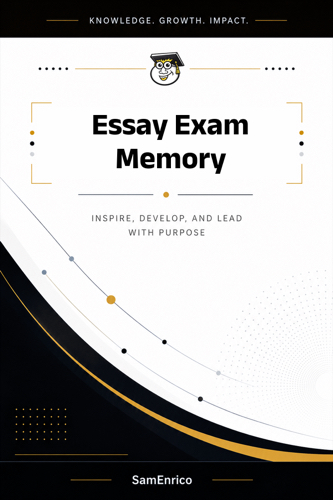
Essay Exam Memory eBook
undefined
undefined
Formats
Free sample
Chapter 1: The 47-Second Freeze--It happens somewhere between the moment you read the prompt and the moment your pen touches the paper. Forty-seven seconds of absolute nothing. Your pulse is climbing. The clock is ticking. You studied for fourteen hours—highlighted every chapter, reviewed every slide, explained the material to a friend who understood nothing.
You know this information. You could explain it right now, in normal conversation, without breaking a sweat. But here, in this silent room with its flickering fluorescent lights and the sound of thirty other pens scratching, your brain has become a locked safe. The combination is somewhere inside your head, but the dial won't turn.This is not a failure of intelligence. This is not a sign that you are bad at tests or that you should have studied harder.
This is a failure of retrieval architecture—and it is entirely fixable.Welcome to the first chapter of The Essay Exam Memory. Before we build a single mnemonic or construct a single Memory Palace, we must understand exactly what goes wrong inside your brain during the first five minutes of an exam. Because once you understand the enemy, the battle is already half won. This chapter will walk you through the neuroscience of panic, the difference between knowing and recalling, and the three specific cognitive bottlenecks that turn prepared students into frozen statues. By the end, you will have a clear diagnosis of your own personal weak points and a roadmap for the rest of this book.The Anatomy of Blank Page Panic Let us begin with a story.
Her name is Maya. She is a junior majoring in political science. For the past ten days, she has been studying for her midterm in International Relations. She has read every chapter twice. She has highlighted key passages.
She has made flashcards for every major treaty, every conflict, every theoretical framework. The night before the exam, she quizzes herself and gets 90 percent of the flashcards correct. She feels ready.The exam begins. Professor Chen has written three essay prompts on the board. Maya reads the first one: "Analyze the relationship between the Treaty of Versailles and the rise of fascism in Europe during the interwar period."Maya knows this material.
She wrote a seven-page paper on this exact topic six weeks ago. She received an A-. The information is in her head. And yet, for forty-seven seconds, she stares at the page and sees nothing. She knows that the Treaty of Versailles had something to do with Germany.
She knows that fascism is associated with Mussolini and Hitler. But the connection—the specific causal chain she could have recited yesterday—has vanished.This is Blank Page Panic. It is not a memory problem. It is a retrieval problem. And it follows a predictable physiological sequence.When you first encounter an essay prompt, your brain performs a rapid threat assessment.
The amygdala—your brain's smoke detector—scans for danger. If it perceives the prompt as threatening (and what could be more threatening than a question that might expose your ignorance in front of a professor who controls your grade?), it triggers the sympathetic nervous system. Cortisol floods your system. Your heart rate increases. Your breathing becomes shallow.
Your prefrontal cortex—the part of your brain responsible for complex reasoning, planning, and, crucially, memory retrieval—begins to shut down.In plain English: your brain mistakes an essay prompt for a predator. And when faced with a predator, your brain does not want you to write a thoughtful analysis. Your brain wants you to run. When you cannot run (you are sitting in a desk), your brain settles for freezing. The blank page is not a sign of ignorance.
It is a sign that your nervous system has activated the wrong survival program.Recognition Versus Recall: The Crucial Distinction To understand why essay exams feel so much harder than multiple-choice exams, you must understand the fundamental difference between two types of memory: recognition and recall.Recognition is what happens when you see a correct answer among a set of options. You do not need to produce anything from scratch. You only need to identify which of the four presented answers looks familiar. This is why multiple-choice tests feel easier. The answer is right there on the page.
Your brain just has to say, "Yes, that one." Recognition relies on a relatively shallow level of processing. The information has to be familiar enough to distinguish from distractors, but it does not have to be fully retrievable on command.Recall is what happens when you have to produce information from scratch with no cues. This is what essay exams demand. You are not shown four options. You are given a blank page and a prompt.
Your brain must search through its vast networks of stored information, locate the relevant data, and assemble it into a coherent response—all while the clock is running and your amygdala is screaming.Here is the brutal truth that most students never learn: you can have perfect recognition without having functional recall. You can look at your highlighted notes and feel a warm glow of familiarity. You can reread a chapter and think, "Yes, I remember this." That feeling—that fluency illusion—is dangerously misleading. It tells you that you know the material when, in fact, you have only trained your brain to recognize it. You have not trained your brain to retrieve it.The difference between recognition and recall is the difference between being able to recognize a song when it plays on the radio and being able to sing the entire song from memory, a cappella, in front of an audience, without the radio.
One requires passive familiarity. The other requires active construction. Essay exams require the latter. And most students spend their entire study time building the former.Cognitive Load Theory: Why Your Working Memory Has a Tiny Desk Let us talk about working memory. Imagine a small desk.
On this desk, you can place the thoughts and information you are actively using at any given moment. This desk is your working memory. And here is the problem: the desk is very small.Psychologists have known since the 1950s that working memory has a limited capacity. George Miller famously proposed that the average person can hold about seven items (plus or minus two) in working memory at once. More recent research has revised that number downward to about four items for complex information.
Four items. That is all the space you have.When you sit down to write an essay, your working memory desk is already crowded. You are thinking about the prompt. You are thinking about the clock. You are thinking about the fact that the person next to you is already on their second page.
You are thinking about whether your handwriting is legible. You are thinking about your breathing because now you are thinking about your breathing. That is four items already. There is no room left for the Treaty of Versailles, the rise of fascism, or any of the actual content you studied.Cognitive Load Theory, developed by John Sweller in the 1980s, divides this load into three types. Intrinsic load…
This is the end of the free sample. Get the eBook to keep going. Buy now
About this book
Details
- Author
- Wiggins Marquetta
- Publisher
- SamEnrico
- Language
- English
- Genre
- essays, Self-Help
- Released
- 2026-06-06
- Pages (approx.)
- 136
- Available as
- eBook, Audiobook

Read better in the ZLOADR app
Your eBooks on your phone or tablet. Sign in with your SamEnrico account and start reading.
More by Wiggins Marquetta
 Conversation Starters for Job InterviewsWiggins Marquetta$11.99
 Roam Research RemindersWiggins Marquetta$11.99
 ADHD Distraction Management GuideWiggins Marquetta$11.99
 CrossFit Box BusinessWiggins Marquetta$11.99
 The Abandonment FearWiggins Marquetta$11.99
 Bipolar Journaling WorkbookWiggins Marquetta$11.99
 Child Loss And NatureWiggins Marquetta$11.99
 Emotional Resilience EQ WorkbookWiggins Marquetta$11.99
 The Art of the Steal: How a Billion-Dollar Art Scam Laundered Money Through the EliteWiggins Marquetta$11.99
 The Exile of the Sun King: Louis XIV’s Lost HeirWiggins Marquetta$11.99
 The Iron Discipline: Prussia’s March to Military and Administrative MasteryWiggins Marquetta$11.99
 The Mineral Guide to KampfiteWiggins Marquetta$11.99
You may also like
 YouTube Video Essay DepthLeon Lala$11.99
 TOEFL Independent Essay GuideMintz Alex$11.99
 Music Theory Essay GuideWilkinson Maisha$11.99
 Expository Essay AI PromptsApplegate Dalia$11.99
 Exam Essay MemorizationMcgovern Johna$11.99
 Compare Contrast Essay PromptsOntiveros Marx$11.99
 College Application Essay GuideSisson Aimee$11.99College Application Essay GuideSisson Aimee$11.99
 The 100 Word Essay ChallengeAli Luciana$11.99
 Journalism Essay PromptsThatcher Williemae$11.99
 Finance Essay PromptsShrader Lamont$11.99
 Cause Effect Essay GPT GuideBland Jacelyn$11.99