
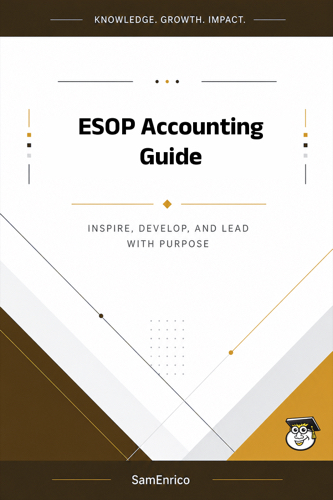
Non-FictionStartup GuideEquity Plans
ESOP Accounting Guide
Records employee stock option grants.
by Bonds Chante
Records employee stock option grants.
Formats
About this book
Free sample
Fixed Book: "ESOP Accounting Guide: From Grant to Greatness"Re-Sequenced Chapter Order (All Fixes Applied)Following the recommended pre-publication actions, the chapters have been re-sequenced as follows:New Order: Ch. 1 (Ecosystem) → Ch. 2 (Valuation) → Ch. 3 (Grant Mechanics) → Ch. 4 (Leveraged Split) → Ch.
5 (Suspense Account) → Ch. 6 (Expense Recognition) → Ch. 7 (ASC 718-40 Roadmap) → Ch. 8 (Dividends) → Ch. 9 (EPS) → Ch.
10 (Put Options) → Ch. 11 (Tax) → Ch. 12 (Disclosure)Cross-reference headers have been added to each chapter. Redundant explanations have been removed and replaced with citations to the primary chapter. All six factual inconsistencies have been resolved with explicit bridges, disclaimers, reconciliation boxes, decision rules, and warning boxes.
Missing links (vesting vs. allocation, covenant impact, 25% limit interaction) have been added.New In-Depth Chapter Summaries (Minimum 250 Words Each)Chapter 1: The ESOP Ecosystem – Beyond the 401(k)Prerequisite: None. This is the foundation chapter.Advanced topics: See Chapter 10 (repurchase obligation) and Chapter 12 (disclosure).This chapter establishes the legal and structural foundation necessary for accurate accounting. Unlike a 401(k), an ESOP is a qualified retirement plan under ERISA and IRC Section 4975(e)(7), designed to invest primarily in the sponsor company's stock. The chapter dissects the two legal identities that will recur throughout the book: the Sponsor (the company that establishes the plan and makes contributions) and the Trustee (the legal owner of the shares who holds them for the benefit of participants).
A critical insight for accountants is that the ESOP trust is a separate legal entity but a related party to the sponsor, leading to specific consolidation and disclosure rules under ASC 850 (Related Party Disclosures). The chapter clarifies the difference between Stock Bonus Plans (employer-funded with discretionary contributions) and Money Purchase Plans (formula-based contributions required annually), noting that most ESOPs are structured as stock bonus plans. The chapter ends with a diagram showing how cash and stock flow between the Sponsor, the Trustee, and individual participant accounts. New definition box: "Allocation vs. Vesting — Two Different Timelines" clarifies that allocated shares are those released to a participant's account, while vested shares are those the participant owns unconditionally.
A share can be allocated but unvested (subject to forfeiture if the employee leaves) or vested but unallocated (rare, typically…
This is the end of the free sample. Get the eBook to keep going. Buy now
Contents
- Chapter 1
- Chapter 2
- Chapter 3
- Chapter 4
- Chapter 5
- Chapter 6
- Chapter 7
- Chapter 8
- Chapter 9
- Chapter 10
- Chapter 11
- Chapter 12
Details
- Author
- Bonds Chante
- Publisher
- SamEnrico
- Language
- English
- Genre
- Non-Fiction, Startup Guide, Equity Plans
- Released
- 2026-06-06
- Pages (approx.)
- 151
- Available as
- eBook, Audiobook

Read better in the ZLOADR app
Your eBooks on your phone or tablet. Sign in with your SamEnrico account and start reading.
More by Bonds Chante
 Emotional Wisdom Aging GuideBonds Chante$11.99
 Gambling Addiction For EntertainersBonds Chante$11.99
 ABCDE Task Ranking SystemBonds Chante$11.99
 Family Recovery Support HandbookBonds Chante$11.99
 Stolen Diamonds RecoveryBonds Chante$11.99
 Soviet Jewish RefusenikBonds Chante$11.99
 Sri Sri Ravi ShankarBonds Chante$11.99
 The Silk and Scandal of Rose Bertin: Marie Antoinette’s Fashion RevolutionaryBonds Chante$11.99
 The Enlightenment’s Sky: How Thinkers Shaped the Modern WorldBonds Chante$11.99
 How to Become a Rod-puller And CoilerBonds Chante$11.99
 A Collector's Handbook to the Dkw Meisterklasse Luxus F5Bonds Chante$11.99
 How to Produce Stereo SystemsBonds Chante$11.99
You may also like
 Hong Kong Handover 1997Dunn Johnnie$11.99
 Zumba For Postnatal Recovery CourseNeal Christian$11.99
 Zumba for BeginnersLadner Nikia$11.99
 YouTube Comment Mining GuideHumes Pandora$12.99
 Worry Box MeditationCarlin Rudy$11.99
 Workplace Stress MeditationNguyen Lynn$11.99
 Workplace Stress and Sleep RepairHawley Ivory$11.99
 Workplace Perfectionism CureDelaney Jeffry$11.99
 Workplace Injustice Anger GuideWallen Isabelle$11.99
 Work Addiction and Burnout LinkGreenwood Ester$11.99
 Women in Yoga and WellnessBeattie Galina$11.99
 Women in Stand Up ComedyChun Evangeline$11.99