
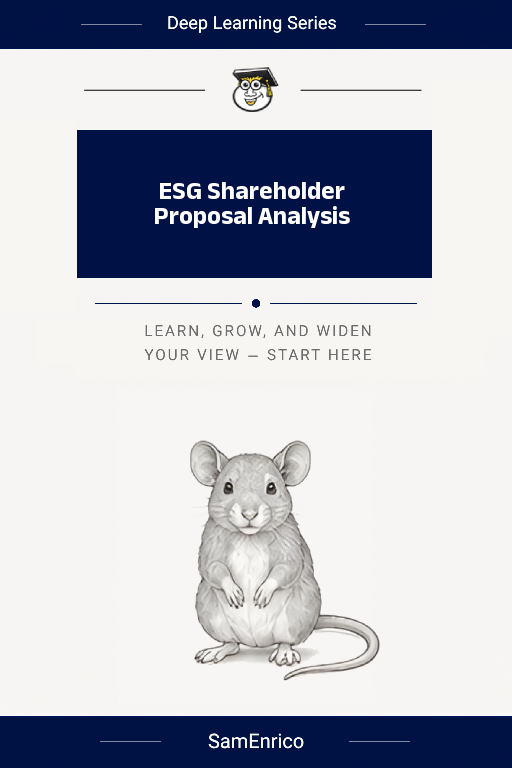
Non-FictionStrategic AtlasShareholder Activism
ESG Shareholder Proposal Analysis
Compares public firms on shareholder proposal vote
by Windham Jona
Compares public firms on shareholder proposal votes for climate, DEI, and governance issues, analyzing management responses.
Formats
About this book
Free sample
Chapter 1: The $2,000 Loophole--–- The nun arrived at the Chevron shareholder meeting with a cardboard sign and twenty-two cents worth of stock. Not twenty-two dollars. Twenty-two cents. Her name was Sister Patricia Daly, a Dominican sister of Caldwell, New Jersey, and she had been filing shareholder proposals against Chevron for nearly a decade using a Depression-era SEC rule that allows any shareholder—anyone at all—to force a multibillion-dollar corporation to put a question to a vote of all owners. The year was 2019, and her proposal was simple: Chevron must disclose its lobbying expenditures related to climate policy.
Chevron’s lawyers spent 47,000opposingit.Chevron’sboardrecommendedavoteagainstit.Institutional Shareholder Servicesrecommendedagainstit.Sister Patriciasatinthethirdrow,smiledasthevotewasannounced,andlost.Butshelostwith28percentsupport.Thefollowingyear,shefiledagain.Chevronspentanother47,000 opposing it. Chevron’s board recommended a vote against it. Institutional Shareholder Services recommended against it. Sister Patricia sat in the third row, smiled as the vote was announced, and lost. But she lost with 28 percent support.
The following year, she filed again. Chevron spent another 47,000opposingit.Chevron’sboardrecommendedavoteagainstit.Institutional Shareholder Servicesrecommendedagainstit.Sister Patriciasatinthethirdrow,smiledasthevotewasannounced,andlost.Butshelostwith28percentsupport.Thefollowingyear,shefiledagain.Chevronspentanother50,000. This time, she got 42 percent. The year after that, Chevron negotiated a withdrawal, agreeing to everything she had asked for, because 42 percent in year two meant majority support in year three. A nun with twenty-two cents forced the fifth-largest corporation in America to change its climate lobbying disclosure practices.
That is the power of Rule 14a-8. This is the story of how that rule works, how it is being systematically dismantled, and why you—even you, with a few thousand dollars in a brokerage account—can still use it to change corporate behavior.The Architecture of Influence begins not with billion-dollar campaigns or celebrity activists. It begins with a legal text, Rule 14a-8 of the Securities Exchange Act of 1934, buried in the federal register like a forgotten key. The rule states, in language that has not substantially changed in ninety years, that a company must include a shareholder’s proposal in its proxy statement if the shareholder has held at least $2,000 (or 1 percent) of the company’s securities for at least one year. That…
This is the end of the free sample. Get the eBook to keep going. Buy now
Contents
- Chapter 1
- Chapter 2
- Chapter 3
- Chapter 4
- Chapter 5
- Chapter 6
- Chapter 7
- Chapter 8
- Chapter 9
- Chapter 10
- Chapter 11
- Chapter 12
Details
- Author
- Windham Jona
- Publisher
- SamEnrico
- Language
- English
- Genre
- Non-Fiction, Strategic Atlas, Shareholder Activism
- Released
- 2026-06-01
- Pages (approx.)
- 152
- Available as
- eBook, Audiobook

Read better in the ZLOADR app
Your eBooks on your phone or tablet. Sign in with your SamEnrico account and start reading.
More by Windham Jona
 Gender Differences Nonverbal GuideWindham Jona$11.99
 Peg System for Bedtime RoutineWindham Jona$11.99
 Remote Review AI Tool AssistanceWindham Jona$11.99
 Battery Storage Capital GuideWindham Jona$11.99
 Peterson Home Forensics Deep DiveWindham Jona$11.99
 The Banshee's Lament: Ireland's Wailing SpiritWindham Jona$11.99
 How to Start a Hunting and Trapping BusinessWindham Jona$11.99
 Dot Africa Domain Registration GuideWindham Jona$12.99
 Understanding Partial Agenesis of Corpus CallosumWindham Jona$17.99
 In Home Sales RepresentativeWindham Jona$11.99
You may also like
 Hong Kong Handover 1997Dunn Johnnie$11.99
 Zumba For Postnatal Recovery CourseNeal Christian$11.99
 Zumba for BeginnersLadner Nikia$11.99
 YouTube Comment Mining GuideHumes Pandora$12.99
 Worry Box MeditationCarlin Rudy$11.99
 Workplace Stress MeditationNguyen Lynn$11.99
 Workplace Stress and Sleep RepairHawley Ivory$11.99
 Workplace Perfectionism CureDelaney Jeffry$11.99
 Workplace Injustice Anger GuideWallen Isabelle$11.99
 Work Addiction and Burnout LinkGreenwood Ester$11.99
 Women in Yoga and WellnessBeattie Galina$11.99
 Women in Stand Up ComedyChun Evangeline$11.99