
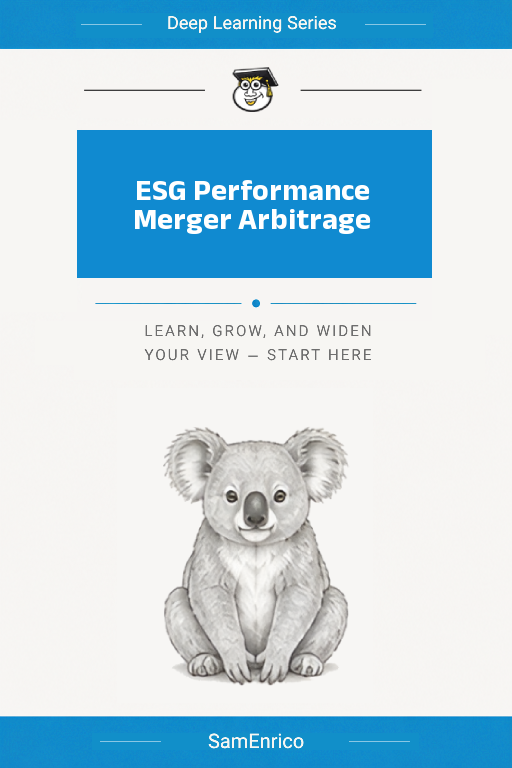
Non-FictionStrategic AtlasM&A Intelligence
ESG Performance Merger Arbitrage
Compare ESG scores of acquisition targets and acqu
Compare ESG scores of acquisition targets and acquirers to predict deal success and regulatory scrutiny.
Formats
About this book
Free sample
Chapter 1: The $2 Billion Typo--–- It was 3:47 PM on a Thursday in late September when the email hit every arbitrage desk on Wall Street. The spread on a 12billionmergerhadjustwidenedby400basispointsinelevenminutes.Nonewantitrustfiling.Nocompetingbid.Noearningssurprise.Justasinglepressreleasefromasmall NGOthatmosttradershadneverheardof,announcingthattheyhad"respectfullyrequested"thatthe Federal Trade Commissionextenditsreview.Therequestwasnon−binding.The NGOhadnoregulatoryauthority.Andyet,themarkethadjustwiped12 billion merger had just widened by 400 basis points in eleven minutes. No new antitrust filing. No competing bid. No earnings surprise.
Just a single press release from a small NGO that most traders had never heard of, announcing that they had "respectfully requested" that the Federal Trade Commission extend its review. The request was non-binding. The NGO had no regulatory authority. And yet, the market had just wiped 12billionmergerhadjustwidenedby400basispointsinelevenminutes.Nonewantitrustfiling.Nocompetingbid.Noearningssurprise.Justasinglepressreleasefromasmall NGOthatmosttradershadneverheardof,announcingthattheyhad"respectfullyrequested"thatthe Federal Trade Commissionextenditsreview.Therequestwasnon−binding.The NGOhadnoregulatoryauthority.Andyet,themarkethadjustwiped480 million off the deal's implied value.The traders who lost money that afternoon had done everything right by the old playbook. They had calculated the spread – a healthy 7.2% annualized.
They had modeled the time to close – 118 days based on comparable transactions. They had priced the antitrust risk – low, given that the two companies operated in non-overlapping geographies. By every traditional metric, this was a textbook merger arbitrage trade. But the traditional model had a blind spot the size of a corporate jet. The NGO that issued that press release represented a coalition of the target company's own employees.
And those employees had something the traders had not bothered to check: an ESG score that had been flashing red for six consecutive quarters.This book is about that blind spot. It is about the systematic failure of traditional merger arbitrage to account for the single most volatile variable in modern M&A – the perception of the deal by non-financial stakeholders. And it is about the proprietary framework that turns that blind spot into a source of alpha.The Death of the Pure Financial Deal For decades, merger arbitrage operated on a simple and largely accurate assumption: deals were financial transactions between boards of directors, and the only stakeholders who mattered were shareholders. If the price was right and the…
This is the end of the free sample. Get the eBook to keep going. Buy now
Contents
- Chapter 1
- Chapter 2
- Chapter 3
- Chapter 4
- Chapter 5
- Chapter 6
- Chapter 7
- Chapter 8
- Chapter 9
- Chapter 10
- Chapter 11
- Chapter 12
Details
- Author
- Pauley Lavonia
- Publisher
- SamEnrico
- Language
- English
- Genre
- Non-Fiction, Strategic Atlas, M&A Intelligence
- Released
- 2026-05-29
- Pages (approx.)
- 142
- Available as
- eBook, Audiobook

Read better in the ZLOADR app
Your eBooks on your phone or tablet. Sign in with your SamEnrico account and start reading.
More by Pauley Lavonia
 Solar Temple Conspiracy Theories HandbookPauley Lavonia$11.99
 Stay Home Parent IsolationPauley Lavonia$11.99
 Free Creator Hashtag Stack GuidePauley Lavonia$11.99
 LBO Model Error DatabasePauley Lavonia$11.99
 Mindfulness for Emotional EatingPauley Lavonia$11.99
 The Coral Cure: The Mysterious Healing Stones of the Indian OceanPauley Lavonia$11.99
 Echoes of the Ice: The Unsinkable Story of the Endurance ExpeditionPauley Lavonia$11.99
 Understanding Cerebelloparenchymal Disorder 3Pauley Lavonia$17.99
 Back Brace FitterPauley Lavonia$11.99
 Emirati Arabic Language GuidePauley Lavonia$12.99
 How to Become a Ingot HeaderPauley Lavonia$11.99
You may also like
 Hong Kong Handover 1997Dunn Johnnie$11.99
 Zumba For Postnatal Recovery CourseNeal Christian$11.99
 Zumba for BeginnersLadner Nikia$11.99
 YouTube Comment Mining GuideHumes Pandora$12.99
 Worry Box MeditationCarlin Rudy$11.99
 Workplace Stress MeditationNguyen Lynn$11.99
 Workplace Stress and Sleep RepairHawley Ivory$11.99
 Workplace Perfectionism CureDelaney Jeffry$11.99
 Workplace Injustice Anger GuideWallen Isabelle$11.99
 Work Addiction and Burnout LinkGreenwood Ester$11.99
 Women in Yoga and WellnessBeattie Galina$11.99
 Women in Stand Up ComedyChun Evangeline$11.99