
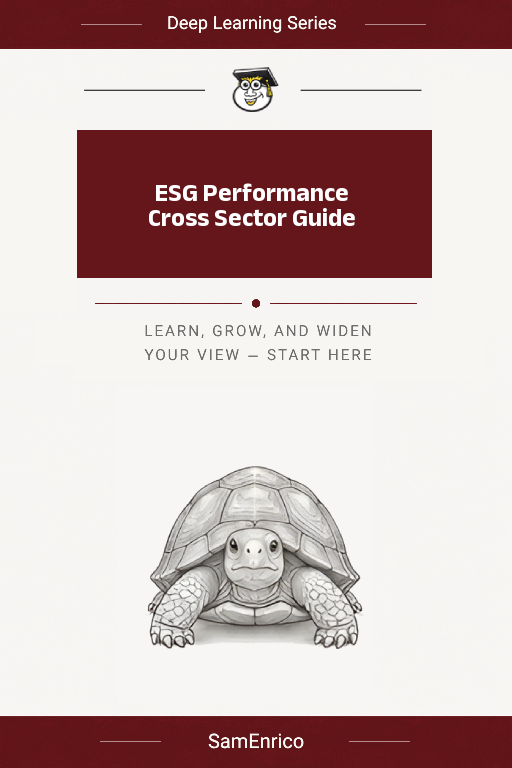
Non-FictionStrategic AtlasCross Sector
ESG Performance Cross Sector Guide
Compare best-in-class ESG practices across sectors
by Ladd Assunta
Compare best-in-class ESG practices across sectors to identify cross-industry learning opportunities for public firms.
Formats
About this book
Free sample
Chapter 1: The Mirror Trap--Every year, the world’s largest mining company spends approximately $50 million on ESG benchmarking. They hire consultants. They run surveys. They compare themselves to other mining companies—their direct competitors, their peers, their industry neighbors. They ask: Are we better than Freeport?
Than BHP? Than Glencore? And every year, the answer is the same: A little better. A little worse. About average.Then, on a rainy afternoon in southeastern Brazil, their tailings dam collapsed.The dam had been monitored using the best practices of the mining industry.
Sensors were in place. Inspections were conducted. The board had signed off on the risk register. And yet, 11 million cubic meters of mining waste—thick, toxic, unforgiving—surged downhill, burying a community, poisoning a river, and destroying a century of trust. The company’s ESG rating, which had been “above average” just weeks before, plummeted overnight.
Shareholders fled. Regulators descended. The CEO resigned.In the aftermath, an engineer from the company made a strange observation. She had been reading about pharmaceutical manufacturing—specifically, how drug companies monitor sterile environments for contamination. In pharma, the tolerance for error is zero.
A single particle of dust can ruin a $10 million batch of vaccines. So pharma companies use monitoring systems that detect anomalies at parts per billion. They use statistical process control. They use real-time alerting. They use closed-loop feedback.Mining companies, by contrast, used monitoring systems designed for… mining companies.
They had borrowed from construction. They had borrowed from civil engineering. They had never thought to borrow from pharma.The engineer asked a question that no one in her industry had thought to ask: What if we monitored tailings dams the way pharma monitors sterile manufacturing?That question became the seed of a $2 billion safety overhaul. The company eventually adopted pharma-style monitoring—not because they wanted to, but because the regulator forced them to. And when they did, their tailings dam incident rate dropped by 87 percent.But here is the tragedy: they could have done it ten years earlier, for a fraction of the cost, if only they had looked outside their own industry.The…
This is the end of the free sample. Get the eBook to keep going. Buy now
Contents
- Chapter 1
- Chapter 2
- Chapter 3
- Chapter 4
- Chapter 5
- Chapter 6
- Chapter 7
- Chapter 8
- Chapter 9
- Chapter 10
- Chapter 11
- Chapter 12
Details
- Author
- Ladd Assunta
- Publisher
- SamEnrico
- Language
- English
- Genre
- Non-Fiction, Strategic Atlas, Cross Sector
- Released
- 2026-05-30
- Pages (approx.)
- 135
- Available as
- eBook, Audiobook

Read better in the ZLOADR app
Your eBooks on your phone or tablet. Sign in with your SamEnrico account and start reading.
More by Ladd Assunta
 MBSR for Cancer Patients GuideLadd Assunta$11.99
 Dementia Caregiver IsolationLadd Assunta$11.99
 Order Solar Telescope Starlight Cult CourseLadd Assunta$11.99
 Emotional Regulation for TraumaLadd Assunta$11.99
 Free Creator Course Platform StackLadd Assunta$11.99
 The Bakhshali Manuscript: The Ancient Code of PrimesLadd Assunta$11.99
 Pixel Pioneers: The Untold Story of Sega's Sonic BoomLadd Assunta$11.99
 How to Become a Mixer OperatorLadd Assunta$11.99
 Dubai Student Health RulesLadd Assunta$12.99
 Understanding Cerebral Calcification Cerebellar HypoplasiaLadd Assunta$17.99
 Building Maintenance WorkerLadd Assunta$11.99
You may also like
 Hong Kong Handover 1997Dunn Johnnie$11.99
 Zumba For Postnatal Recovery CourseNeal Christian$11.99
 Zumba for BeginnersLadner Nikia$11.99
 YouTube Comment Mining GuideHumes Pandora$12.99
 Worry Box MeditationCarlin Rudy$11.99
 Workplace Stress MeditationNguyen Lynn$11.99
 Workplace Stress and Sleep RepairHawley Ivory$11.99
 Workplace Perfectionism CureDelaney Jeffry$11.99
 Workplace Injustice Anger GuideWallen Isabelle$11.99
 Work Addiction and Burnout LinkGreenwood Ester$11.99
 Women in Yoga and WellnessBeattie Galina$11.99
 Women in Stand Up ComedyChun Evangeline$11.99