
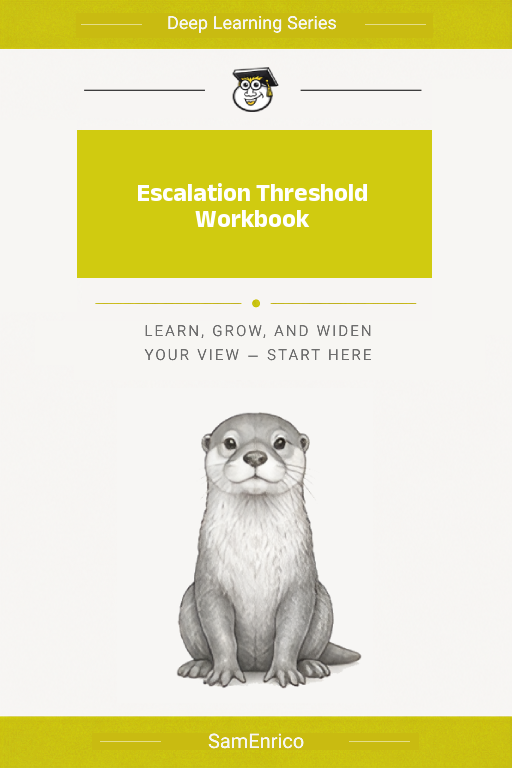
Non-FictionAI OperatorSupport OperationsWorkbook
Escalation Threshold Workbook eBook
Define when AI agents should hand off to human rep
Define when AI agents should hand off to human reps based on sentiment, complexity, or value at risk. Includes rule configuration, supervisor alerts, and seamless transfer protocols.
Formats
Free sample
Chapter 1: The $47,000 Mistake...--–- The ticket arrived at 2:17 AM on a Tuesday. No one noticed until 9:43 AM, when the finance team ran their daily fraud check.The customer had typed: "My dog ate my phone. Refund please lol."The AI chatbot responded: "I understand you need a refund. Please confirm the amount: $47,000."The customer typed: "sure why not lol"The AI responded: *"Refund approved. Your $47,000 will be returned within 5-7 business days."*No human saw it.
No escalation triggered. No supervisor alert fired. The AI simply… trusted a stranger who was clearly joking, because no one had bothered to define where automation should stop and a human should take over.That company lost $47,000. They also lost their head of support, two senior agents who quit after cleaning up the mess, and any chance of launching AI-driven support again for eighteen months.The post-mortem revealed a single root cause: no escalation threshold.The AI had no instruction for when to say "I need help." It had no rule for detecting absurdity, no trigger for high-value transactions, no protocol for handoff to a human. It was autonomous in the worst possible way—blindly obedient, confidently wrong, and completely unsupervised.This book exists because that story is not rare.
It happens every single day, at companies of every size, in every industry. A chatbot approves a refund for a product the customer never bought. Another blocks a cancer patient from rescheduling a critical appointment because "sentiment score neutral." A third escalates 12,000 tickets in one hour because a seasonal employee typed "I quit" and the AI interpreted it as a customer complaint pattern.Escalation is not a failure of automation. It is the most important feature you are not configuring.The False Promise of Full Autonomy The AI industry has sold us a dangerous dream: the fully autonomous agent that never needs human help. It appears in glossy product demos, where a chatbot solves every problem with cheerful efficiency.
It appears in vendor marketing, where "human-in-the-loop" is treated as a temporary crutch rather than a deliberate architectural choice. It appears in executive strategy decks, where "100% automation" is the goal and any handoff is a bug to be fixed.This is wrong. Dangerously, expensively wrong.Consider the fundamental asymmetry of automation risk. When your AI makes a mistake, the cost is not symmetrical. There are two kinds of errors:False positive escalation: The AI hands off to a human unnecessarily.
Cost? A few minutes of an agent's time. Maybe a slightly longer wait for the customer. Frustrating, yes. But rarely catastrophic.False negative escalation: The AI should have handed off but didn't.
Cost? A fraudulent refund. A blocked account. A regulatory violation. A viral social media complaint.
A lawsuit.The second category is typically 10 to 100 times more expensive than the first.Yet most organizations configure their escalation systems backward. They optimize for low escalation rates—celebrating when the AI handles more conversations—without ever measuring what happens to the conversations it should have escalated but didn't. They treat every handoff as a failure, when in fact, the failure is the handoff that never happens.This book reframes escalation entirely. An escalation is not a defeat. It is a control mechanism—a deliberate, configurable, measurable transfer of authority from machine to human, triggered by a specific set of conditions that you define.Think of it like a nuclear reactor.
A reactor that never shuts down is not a good reactor. It is a bomb waiting to happen. The safety systems that trigger automatic shutdowns are not failures of the reactor—they are the very things that make the reactor safe to operate. Your AI is no different. The escalation threshold is your control rod.
Pull it too late, and you melt down.The Trust Boundary: Where AI Stops and Humans Start Every AI system has a Trust Boundary—the invisible line beyond which the cost of a mistake exceeds the value of automation. Inside the boundary, the AI can operate freely. Outside it, a human must take over.The problem is that most organizations never explicitly define this boundary. They launch their AI with vague instructions like "escalate when the customer asks for an agent" or "escalate on negative sentiment." These single-factor triggers are the equivalent of drawing a boundary with a crayon during an earthquake.A proper Trust Boundary is defined by three signals, which form the backbone of every escalation decision in this book:Signal 1: Sentiment (S)Not just "positive" or "negative," but calibrated frustration. A customer who says "I have a quick question" is different from one who says "I've already tried that three times" is different from one who types in ALL CAPS with expletives.
Your AI needs to distinguish between mild confusion and genuine fury, because the appropriate response—and the escalation threshold—is different for each.We will spend all of Chapter 3 on this. For now, understand that sentiment is not a binary switch. It is a sliding scale from calm to hostile, and your escalation rules must reflect that gradient.Signal 2: Complexity (C)Some problems are simple: "What are your hours?" "Reset my password." "Where is my order?"Some problems are not: "I need to merge three accounts, each with different email addresses and payment methods, and also apply a retroactive discount that expired last month, and also my legal name changed due to marriage, and also I'm calling from my spouse's account."The AI can handle the first set. It should escalate the second. But "complexity" is not just a feeling—it can be quantified.
How many back-and-forth turns has the conversation taken? How many API calls has the AI attempted and failed? What is the AI's own confidence score in its ability to solve? These are measurable, configurable thresholds.We will quantify complexity in Chapter 4.Signal 3: Value at Risk (VAR)This is the most important signal and the one most commonly ignored. What is at stake financially, legally, or reputationally in this interaction?A customer asking for a $5 refund on a late pizza?
Low VAR. Let the AI handle it, even if it makes a small mistake.A customer asking to close their account of 10 years with a $50,000 lifetime value? High VAR. A human should probably be involved.A customer using the words "lawyer," "lawsuit," or "GDPR Article 17"? Extremely high VAR.
The AI should not only escalate but escalate to a specific tier of human (legal or compliance) with a mandatory audit trail.VAR is the signal that justifies the entire escalation framework. It answers the question: Why are we even having this conversation? Because the cost of a mistake is too high to trust to automation alone.Chapter 5 will teach you to calculate VAR for every interaction type in your business.The Formula That Changes Everything These three signals do not operate independently. A furious customer (high Sentiment) with a simple problem (low Complexity) and no financial exposure (low VAR) might still be safe for the AI to handle—perhaps with an apology script and a small discount.A mildly annoyed customer (moderate Sentiment) with a complex technical issue (high Complexity) and a high-value transaction (high VAR) should escalate immediately.The relationship is multiplicative, not additive. This is critical and…
This is the end of the free sample. Get the eBook to keep going. Buy now
About this book
Details
- Author
- Handley Zulma
- Publisher
- SamEnrico
- Language
- English
- Genre
- Non-Fiction, AI Operator, Support Operations, Workbook
- Released
- 2026-06-01
- Pages (approx.)
- 149
- Available as
- eBook, Audiobook

Read better in the ZLOADR app
Your eBooks on your phone or tablet. Sign in with your SamEnrico account and start reading.
More by Handley Zulma
 Therapeutic Leave Planning WorkbookHandley Zulma$11.99
 Mindfulness for IBS ReliefHandley Zulma$11.99
 Guru Nanak Founder AccountHandley Zulma$11.99
 SME AI Compliance ExemptionsHandley Zulma$11.99
 Self Esteem for Teens WorkbookHandley Zulma$11.99
 Black Gold and Blood: The Untold Tale of Henry Every, the Pirate Who Stole an EmpireHandley Zulma$11.99
 Understanding Klumpke ParalysisHandley Zulma$17.99
 How to Start a Omnibus Repair Depot Business (Beginners Guide)Handley Zulma$11.99
 Product Led Growth SaaS GuideHandley Zulma$12.99
 Aeronautical EngineerHandley Zulma$11.99
You may also like
 Hong Kong Handover 1997Dunn Johnnie$11.99
 Zumba For Postnatal Recovery CourseNeal Christian$11.99
 Zumba for BeginnersLadner Nikia$11.99
 YouTube Comment Mining GuideHumes Pandora$12.99
 Worry Box MeditationCarlin Rudy$11.99
 Workplace Stress MeditationNguyen Lynn$11.99
 Workplace Stress and Sleep RepairHawley Ivory$11.99
 Workplace Perfectionism CureDelaney Jeffry$11.99
 Workplace Injustice Anger GuideWallen Isabelle$11.99
 Work Addiction and Burnout LinkGreenwood Ester$11.99
 Women in Yoga and WellnessBeattie Galina$11.99
 Women in Stand Up ComedyChun Evangeline$11.99