
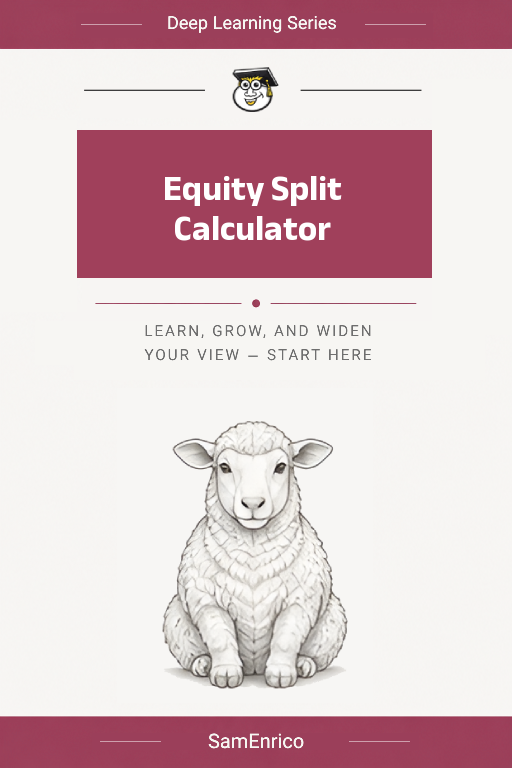
Equity Split Calculator eBook
Divide ownership based on cash invested, time comm
Divide ownership based on cash invested, time committed, and IP contributed using a simple formula.
Formats
Free sample
Chapter 1: The Fifty-Fifty Funeral--It was 2:00 AM on a Tuesday when my phone lit up with a text from someone I will call “Marcus.” Marcus and I had spoken maybe four times in the previous five years. We were not close. But he had my number because eight years earlier, I had invested a small amount of money in his first startup. That company had sold for something modest—not life-changing, but real. We had exchanged polite emails at the closing.
I thought that was the end of the story.The text read: “Can you talk? I made a terrible mistake.”I called him.What followed was a forty-five-minute monologue about his second startup, a software company he had built with his best friend, “David.” Marcus was the technical founder. David was the business founder. They had met in college, roomed together for two years, stood in each other’s weddings. When they decided to start the company, they sat down at a coffee shop, split a muffin, and agreed on the equity split in under thirty seconds.Fifty-fifty.“We trusted each other,” Marcus told me.
“We said, ‘We’ll figure it out later.’”For the first eighteen months, it worked. Marcus worked sixty-plus hours a week writing code. David worked twenty to twenty-five hours a week making introductions, building a pitch deck, and talking to potential customers. Neither tracked their time. Neither thought they needed to.
They were friends.Then the term sheet arrived. A small venture capital firm offered $3 million for 20 percent of the company. Overnight, their paper net worth went from zero to something very real. That was when the fighting started.David argued that his business development work had been more valuable because he had personally secured the first three customers. Marcus argued that the product would not exist without his code.
David pointed out that he had invested 40,000ofhissavingswhenthebankaccounthitzero.Marcuspointedoutthathehadturneddowna40,000 of his savings when the bank account hit zero. Marcus pointed out that he had turned down a 40,000ofhissavingswhenthebankaccounthitzero.Marcuspointedoutthathehadturneddowna180,000 per year job to work on the startup. David said that was a choice, not an investment. Marcus said that was absurd.They spent $60,000 on lawyers over the next eight months. Not to close the deal with the VC—they lost that term sheet after the delay—but to fight each other.
In the end, the company collapsed. A competitor launched a similar product and took their market. Marcus and David have not spoken in two years.“I would rather have given him seventy and kept thirty than end up with nothing,” Marcus said on that phone call. “But we didn’t have a system. We just had a handshake and a muffin.”This chapter is about why that handshake fails.
It is about the hidden mathematics of fairness, the quiet poison of equal splits, and the concept of dead equity—the ownership that stays in the hands of people who no longer contribute. And it is about why you need a formula before you need one.The Most Expensive Word in Business There is a word that has destroyed more startups than bad products, poor marketing, or unlucky timing combined. The word is not “failure.” It is not “bankruptcy.” It is not even “lawsuit.”The word is “fair.”When co-founders sit down to divide equity, they almost always start with the same question: “What feels fair?” And because they like each other, because they are excited about the idea, and because they have not yet done any work, the answer that feels fair is almost always the same.Fifty-fifty. Thirty-three–thirty-three–thirty-four. Equal splits.Equal splits feel good on day one.
They signal trust. They signal partnership. They signal that everyone is in this together. But here is the problem that no one talks about in the coffee shop: fair on day one is almost never fair on day three hundred.Consider what happens in those three hundred days. One founder works sixty hours a week.
Another works twenty. One founder invests 50,000incash.Anotherinvests50,000 in cash. Another invests 50,000incash.Anotherinvests5,000. One founder brings a provisional patent. Another brings enthusiasm.
One founder postpones a lucrative job offer. Another has no other options.By month ten, the contributions are wildly different. But the equity split is exactly the same as it was on day one. And that is when resentment begins to grow.Resentment is not loud. It does not announce itself.
It starts as a small voice in the back of your head: “I am working harder than him.” Then it becomes a quiet comment: “She is not pulling her weight.” Then it becomes a passive-aggressive email. Then it becomes a fight. Then it becomes a lawsuit. Then it becomes a funeral for a company that never had to die.The Case Studies That Should Make You Uncomfortable Let me share three real examples. The names and identifying details have been changed, but the economics are accurate.
Each of these companies raised outside money. Each had a promising product. Each died because of an equity split that felt fair at the start.Case Study A: The Ghost CTOA hardware startup with three co-founders. The CEO worked full-time. The CTO worked full-time.
The third founder, who handled operations, also worked full-time—for six months. Then he took a consulting gig that required twenty hours a week. He told the other founders it would be temporary. It was not. By month nine, he was contributing fewer than ten hours a week.
But he still owned 33 percent of the company.The CEO and CTO tried to buy him out. He refused. They tried to dilute him by raising money at a higher valuation. But investors saw the cap table and walked away. No one wanted to invest in a company where a non-contributor owned a third of the equity.The company ran out of cash and shut down.
The ghost CTO walked away with nothing. So did the two founders who did the work.Case Study B: The Cash Trap Two co-founders. One had 200,000insavings.Theotherhad200,000 in savings. The other had 200,000insavings.Theotherhad10,000. They agreed to a fifty-fifty split because “cash isn’t everything.” The founder with 200,000investeditall.Thefounderwith200,000 invested it all.
The founder with 200,000investeditall.Thefounderwith10,000 invested his savings and then worked full-time.Three years later, the company received an acquisition offer for 8million.Thefounderwiththecasharguedthatheshouldgethis8 million. The founder with the cash argued that he should get his 8million.Thefounderwiththecasharguedthatheshouldgethis200,000 back before any split. The founder who worked for three years argued that his sweat equity was worth far more than $200,000. Neither was wrong. Neither was right.
They just had no system for resolving the disagreement.They settled for a 60/40 split in favor of the cash founder, but only after 150,000inlegalfees.Theacquisitionfellthroughduringthedispute.Thecompanywaslatersoldfor150,000 in legal fees. The acquisition fell through during the dispute. The company was later sold for 150,000inlegalfees.Theacquisitionfellthroughduringthedispute.Thecompanywaslatersoldfor1.2 million.Case Study C: The Idea Man A mobile app startup. The “idea man” had the concept. The developer built the product.
They agreed to a fifty-fifty split. The developer worked two thousand hours over fourteen months. The idea man worked five hundred hours, mostly making introductions and “strategizing.”When the app gained traction, the developer asked to…
This is the end of the free sample. Get the eBook to keep going. Buy now
About this book
Details
- Author
- Charlton Octavia
- Publisher
- SamEnrico
- Language
- English
- Genre
- Non-Fiction, First 30 Days, Equity Math, Fair Division
- Released
- 2026-05-29
- Pages (approx.)
- 145
- Available as
- eBook, Audiobook

Read better in the ZLOADR app
Your eBooks on your phone or tablet. Sign in with your SamEnrico account and start reading.
More by Charlton Octavia
 Congo Independence CrisisCharlton Octavia$11.99
 Beta Cryptoxanthin Lung GuideCharlton Octavia$11.99
 From Anger To AssertivenessCharlton Octavia$11.99
 Tension Headache and MeditationCharlton Octavia$11.99
 Focus Habit FormationCharlton Octavia$11.99
 CAR T Cell SurvivorCharlton Octavia$11.99
 Anchoring Effect StrategiesCharlton Octavia$11.99
 Legal Courtroom Body LanguageCharlton Octavia$11.99
 Sandwich Generation Survival GuideCharlton Octavia$11.99
 The Day the Internet Broke: How a Single Bug Shut Down the WorldCharlton Octavia$11.99
 The Last Empress: How One Woman Ruled a Falling EmpireCharlton Octavia$11.99
 Quetzalcoatl’s Celestial Symphony: The Feathered Serpent’s Divine AnthemCharlton Octavia$11.99