
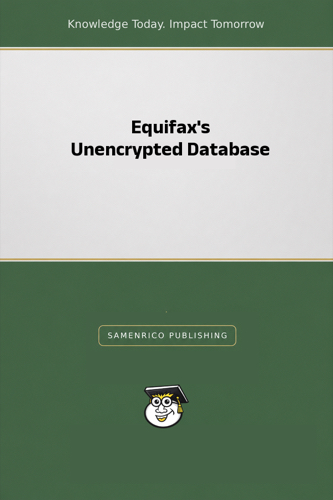
Non-FictionTrue CrimeSecurity Failure
Equifax's Unencrypted Database eBook
Reveals that the compromised data was stored in pl
Reveals that the compromised data was stored in plain text without basic encryption.
Formats
Free sample
Chapter 1: The 76-Day Heist...--–- The notification arrived at 2:17 PM on a Thursday. It was not a phone call, not a siren, not a SWAT team kicking down the door. It was an email. A single, unremarkable email from the Department of Homeland Security to Equifax's security team that read, in essence: "We have reason to believe your systems have been compromised. Please investigate."Inside the towering Equifax headquarters in Atlanta, Georgia, the C-suite was already gone for the day.
The Chief Financial Officer had left early. The CEO was preparing for a board presentation. The Chief Information Security Officer—a man whose formal education was in music, not cybersecurity—was in a meeting about next quarter's budget. The email landed in an inbox that would not be read for another 48 hours.By the time anyone at Equifax took it seriously, the attackers had already been inside for 76 days.This is the story of those 76 days. It is not a story of sophisticated nation-state hackers armed with zero-day exploits and quantum computing.
It is a story of lazy configuration management, expired security certificates, default passwords, and—most damning of all—a database containing 147 million Social Security numbers, stored in plain text, completely unencrypted, waiting to be taken.The attackers did not break into Equifax. They walked in.The Digital Perimeter To understand how the largest identity theft in human history unfolded, one must first understand what Equifax was—and what it stored. Equifax is one of three major credit bureaus in the United States, alongside Experian and Trans Union. These three companies collectively hold the financial DNA of virtually every American adult. Your credit history, your mortgage payments, your car loans, your credit card balances, your late payments, your bankruptcies, your addresses for the past twenty years, your employers, your Social Security number, your date of birth, and in some cases your driver's license number and passport information—all of it sits on servers owned by these three companies.Equifax alone stored data on approximately 800 million consumers worldwide, including 147 million in the United States.
That is more than the entire adult population of the country. Every American with a credit history was in that database. Every single one.The database in question was not some obscure backup server buried in a forgotten data center. It was the ACIS system—the Automated Consumer Interview System—the primary portal through which consumers disputed errors on their credit reports. It was, by definition, one of the most sensitive and heavily trafficked systems in the entire Equifax infrastructure.
And it was connected directly to the public internet.The attackers, who were later identified by cybersecurity researchers as operating out of a small apartment in Shenzhen, China, did not begin with a targeted attack on Equifax. They began with a tool called Shodan—often described as the "search engine for the internet of things." Shodan scans the entire public internet, cataloging every connected device, server, and web portal. Unlike Google, which indexes web pages, Shodan indexes the technical fingerprints of machines: open ports, running software versions, SSL certificate details, and default login pages.On an unremarkable day in early May 2017, a 22-year-old self-taught hacker typed a query into Shodan. He was looking for Apache Struts servers. Apache Struts is a popular open-source framework for building Java-based web applications.
It is used by thousands of companies, including government agencies, financial institutions, and yes, credit bureaus. The attacker was not specifically looking for Equifax. He was casting a wide net, searching for any vulnerable Struts server he could use to install cryptocurrency mining software. He was a small-time criminal, not a nation-state operative.Shodan returned thousands of results. One of them was an Equifax web portal.
The attacker noted the IP address and moved on.The Vulnerability That Wasn't a Secret The Apache Struts vulnerability that would bring Equifax to its knees had been publicly disclosed and patched on March 7, 2017. The vulnerability, designated CVE-2017-5638, allowed remote attackers to execute arbitrary code on a server by sending a specially crafted Content-Type header in an HTTP request. In plain English: a hacker could send a single malicious command to a vulnerable Struts server and take complete control of it.The patch was available for free. The vulnerability was widely publicized in cybersecurity circles. The U.S.
Department of Homeland Security issued an alert. The cybersecurity community circulated the details on mailing lists, Twitter, and security blogs. Any competent security team would have applied the patch within days, or at worst weeks.Equifax did not apply the patch. Not for 67 days.The reason, as later revealed in congressional testimony, was mundane almost to the point of absurdity. Equifax used an automated vulnerability scanner to check its servers for missing patches.
That scanner was configured to scan a specific range of IP addresses. The consumer dispute portal—the very server running Apache Struts—was not in that range. An administrator had accidentally excluded it. The scanner ran on schedule, found no vulnerabilities, and reported a clean bill of health. No human ever reviewed the configuration.This is what security professionals call IT debt: the accumulation of deferred maintenance, outdated software, and ignored security bulletins.
Every large organization has IT debt. Equifax's IT debt was measured in millions of dollars and billions of records.The First Day: May 13, 2017The attacker ran the exploit. It worked. Within seconds, he had a shell—a command-line interface—on an Equifax web server. From that shell, he could run any command he wanted.
He could browse files. He could install software. He could delete logs. He could use the server as a launchpad to explore the rest of Equifax's internal network.He began with simple reconnaissance. He typed whoami to see what privileges he had.
He typed ls to list files in the current directory. He typed ifconfig to see the server's network configuration. He was surprised by how easy it was. No alerts. No blocks.
No two-factor authentication. No intrusion detection system flagging his activity.What he found next would shock even a seasoned hacker. Browsing the file system on the web server, he discovered a mounted network drive—a shared file storage location accessible from multiple servers. On that shared drive was a file named passwords.txt. He opened it.
Inside were the usernames and passwords for dozens of internal Equifax systems, including the ACIS consumer database.He did not need to brute-force any passwords. He did not need to crack any hashes. He did not need to use any social engineering. The passwords were stored in a plain text file on a publicly accessible file share. Some of them were default credentials like "admin/admin." The password for the ACIS database was the name of the database itself: four lowercase letters.He copied the credentials.
Then he connected to the ACIS database directly.The Treasure Chest The ACIS database was not behind a firewall. It was not isolated from the web server. It was not protected by network segmentation. The attacker typed a simple SQL query: SELECT * FROM consumers LIMIT 100. The database returned 100 rows of consumer data.
He scanned the column headers: first_name, last_name, ssn, date_of_birth, address_line_1, address_line_2, city, state, zip_code, drivers_license_number, credit_card_number, credit_card_expiration, employer, annual_income.He stared…
This is the end of the free sample. Get the eBook to keep going. Buy now
About this book
Details
- Author
- Brubaker Cecil
- Publisher
- SamEnrico
- Language
- English
- Genre
- Non-Fiction, True Crime, Security Failure
- Released
- 2026-06-10
- Pages (approx.)
- 140
- Available as
- eBook, Audiobook

Read better in the ZLOADR app
Your eBooks on your phone or tablet. Sign in with your SamEnrico account and start reading.
More by Brubaker Cecil
 Shingles Vaccine for AdultsBrubaker Cecil$11.99
 TM Without Effort Technique WorkbookBrubaker Cecil$11.99
 Career Advancement AffirmationsBrubaker Cecil$11.99
 John Wayne Gacy Autopsy Report AnalysisBrubaker Cecil$11.99
 Tsushima: The Dawn of Japan's Naval SupremacyBrubaker Cecil$11.99
 Understanding Müllerian Derivatives, PersistentBrubaker Cecil$17.99
 AI Video Future TrendsBrubaker Cecil$12.99
 Remote Layoff and Restructuring ConflictBrubaker Cecil$12.99
 Recreational TherapyBrubaker Cecil$11.99
 How to Become a Nib FinisherBrubaker Cecil$11.99
You may also like
 Hong Kong Handover 1997Dunn Johnnie$11.99
 Zumba For Postnatal Recovery CourseNeal Christian$11.99
 Zumba for BeginnersLadner Nikia$11.99
 YouTube Comment Mining GuideHumes Pandora$12.99
 Worry Box MeditationCarlin Rudy$11.99
 Workplace Stress MeditationNguyen Lynn$11.99
 Workplace Stress and Sleep RepairHawley Ivory$11.99
 Workplace Perfectionism CureDelaney Jeffry$11.99
 Workplace Injustice Anger GuideWallen Isabelle$11.99
 Work Addiction and Burnout LinkGreenwood Ester$11.99
 Women in Yoga and WellnessBeattie Galina$11.99
 Women in Stand Up ComedyChun Evangeline$11.99