
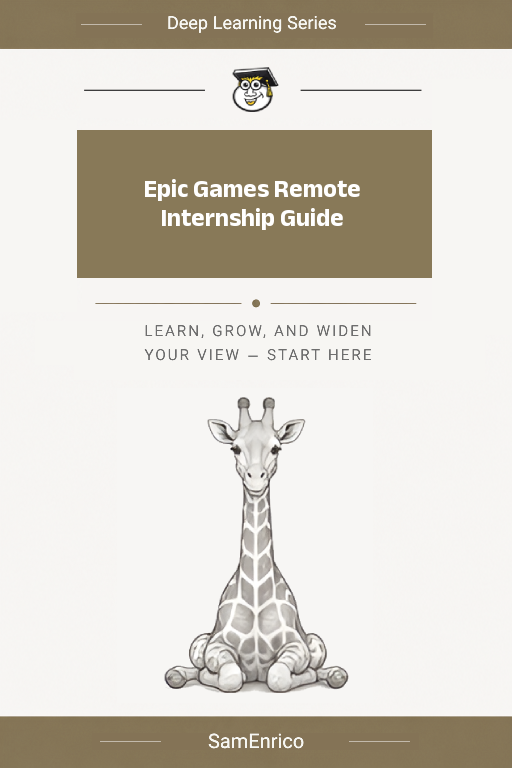
Non-FictionVirtual Work ExperienceGame Engine Guide
Epic Games Remote Internship Guide eBook
Land a virtual internship at Epic Games. Unreal En
Land a virtual internship at Epic Games. Unreal Engine, game design, and remote developer collaboration.
Formats
Free sample
Chapter 1: The Maker's Requisition--–- Every semester, thousands of students open their laptops, navigate to Epic Games' career page, and stare at the same blinking cursor. They have good grades. They have enthusiasm. They have a degree in computer science or game design or digital art. And they will be rejected within sixty seconds of their application landing in a recruiter's inbox.
Not because they are untalented. Not because they chose the wrong major. But because they fundamentally misunderstand what Epic Games is looking for in an intern. The company does not want students who completed coursework. It wants makers who have shipped something – anything – that proves they can survive the brutal, beautiful, humiliating process of turning an idea into a working feature that real humans can play.This chapter reverse-engineers Epic's actual internship job postings for three archetypal roles: Gameplay Design, UI Programmer, and Tools Programmer.
Rather than speculating about what Epic might want based on industry rumors or outdated advice forums, we will read the job descriptions the way a literary critic reads a poem – line by line, uncovering hidden meanings, unspoken requirements, and the difference between what the posting says and what it actually means. By the end of this chapter, you will know exactly which role fits your skills, what portfolio project you need to build in Chapter 2, and most importantly, whether you are approaching this process as a student or as a maker. Those two identities produce radically different outcomes.The Three Archetypes: Which Door Do You Open?Epic's internship program organizes applicants into three primary tracks. Each has its own job posting, its own interview process, its own technical screen, and its own portfolio expectations. Trying to apply to all three with a single generic application is a guaranteed rejection.
You must choose one door and walk through it with absolute conviction.Gameplay Design is the most visible and most competitive track. These interns own features from concept to playtest. They work in Blueprint and UEFN (Unreal Editor for Fortnite), write Verse scripts, and spend as much time in playtests as they do in the editor. They do not need to be expert C++ programmers, but they must be able to read C++ well enough to understand error messages and collaborate with engineers. The Gameplay Design intern is the "vision holder" for small features – a new movement ability, a weapon variant, a UI widget, a quest objective.
They write design documents, implement the feature in Blueprint, playtest with strangers, fix bugs based on feedback, and present their work to leadership at the end of the internship.UI Programmer is the least understood track and therefore the most undervalued by applicants. These interns build the interfaces that players interact with – health bars, inventory screens, settings menus, HUD elements, social panels, and storefronts. They work primarily in C++ and UMG (Unreal Motion Graphics), with deep knowledge of UPROPERTY specifiers (to prevent garbage collection from destroying UI elements mid-match), network replication (to ensure all players see the same UI state), and live-service processes (weekly patches, hotfixes, A/B testing). The UI Programmer intern does not need to be a visual designer, but they must be able to implement designs from a UI/UX artist with pixel-perfect accuracy and reasonable performance.Tools Programmer is the hidden gem of Epic's internship program. These interns build the software that other developers use – editor plugins, asset pipelines, automation scripts, content creation tools, and workflow optimizations.
They are force multipliers. A good gameplay designer makes one feature fun. A good tools programmer makes twenty features faster to build. Tools interns work in C++ and Python, writing code that artists and designers interact with daily. They must think about user experience differently than gameplay programmers – a tool that crashes or has confusing error messages costs the entire team time.
The Tools Programmer posting explicitly asks for experience in "graphics, tools, audio/video, networking, memory handling, script compilers, UI, rendering, optimization and performance" – but note that this is a wish list, not a requirement. No intern has all of those skills. The posting is telling you that the Tools team works across the entire engine stack, so curiosity and adaptability matter more than deep expertise in any single area.Before reading further, pause and ask yourself three questions. First, which of these roles makes you excited to open your laptop at 7 AM on a Saturday? Second, which role aligns with the skills you already have, not the skills you wish you had?
Third, which role would you be willing to fail at repeatedly for six months until you got better? Your honest answers to these questions determine your path through the rest of this book.Deconstructing the Job Posting: What They Write vs. What They Mean Epic's job postings are written by recruiters in collaboration with technical leads. They are honest but incomplete. Every phrase has a hidden meaning that only becomes clear when you have worked in professional game development.
Let us decode the most common phrases line by line."Experience through the entire development cycle" does not mean you have taken a course on agile methodology or can recite the Scrum guide from memory. It means you have felt the specific, visceral pain of a broken build at 11 PM the night before a deadline. It means you have fixed a bug that only appeared on a teammate's machine but never on yours, requiring fifteen screenshots and three screen recordings to isolate. It means you have playtested your own feature until you genuinely hated it – then fixed it anyway because the data showed players were still confused. Epic wants candidates who have survived the full emotional arc of making something: excitement, confusion, frustration, despair, breakthrough, polish, and delivery.
If you have never shipped anything, start with a game jam this weekend. A 48-hour jam project with known bugs and placeholder art counts as shipped. A half-finished class project does not."Strong C++ knowledge" means different things for different roles. For Gameplay Design applicants, it means you can read C++ well enough to understand error messages ("unresolved external symbol"), trace call stacks, and know when to ask an engineer for help versus when to debug on your own. For UI Programmer and Tools Programmer applicants, it means you can write C++ from scratch, manage memory with UPROPERTY specifiers, implement UFUNCTION Blueprint Callable methods, and debug garbage collection issues.
The job posting does not distinguish between these levels of proficiency, but the interview process absolutely does. If you apply as a UI Programmer and cannot write a simple UMG widget in C++ from memory, you will fail the technical screen. If you apply as a Gameplay Designer and stumble through a basic C++ reading exercise, you might still pass if your Blueprint and UEFN skills are exceptional."Experience with Blueprint and UEFN" is non-negotiable for Gameplay Design applicants. The posting explicitly requires UEFN experience because the Fortnite team uses it for rapid prototyping and live events. If you have not built at least one complete island with custom Verse scripting, you are not competitive.
The good news is that UEFN is newer than Unreal Engine itself, which means there are fewer experts. A few months…
This is the end of the free sample. Get the eBook to keep going. Buy now
About this book
Details
- Author
- Miller Marjorie
- Publisher
- SamEnrico
- Language
- English
- Genre
- Non-Fiction, Virtual Work Experience, Game Engine Guide
- Released
- 2026-06-01
- Pages (approx.)
- 124
- Available as
- eBook, Audiobook

Read better in the ZLOADR app
Your eBooks on your phone or tablet. Sign in with your SamEnrico account and start reading.
More by Miller Marjorie
 Hormonal Anger Trigger GuideMiller Marjorie$11.99
 Walking Meditation For New WalkersMiller Marjorie$11.99
 Walking Meditation for TherapistsMiller Marjorie$11.99
 Cooperative Registration UgandaMiller Marjorie$11.99
 The Assertiveness Journaling CourseMiller Marjorie$11.99
 The Sea Wolves of Erin: Celtic Navigators of the Iron AgeMiller Marjorie$11.99
 Understanding OneirophobiaMiller Marjorie$17.99
 Subscription Pricing Inflation ProtectionMiller Marjorie$12.99
 How to Start a Wet Corn Milling BusinessMiller Marjorie$11.99
 Head of UnderwritingMiller Marjorie$11.99
You may also like
 Hong Kong Handover 1997Dunn Johnnie$11.99
 Zumba For Postnatal Recovery CourseNeal Christian$11.99
 Zumba for BeginnersLadner Nikia$11.99
 YouTube Comment Mining GuideHumes Pandora$12.99
 Worry Box MeditationCarlin Rudy$11.99
 Workplace Stress MeditationNguyen Lynn$11.99
 Workplace Stress and Sleep RepairHawley Ivory$11.99
 Workplace Perfectionism CureDelaney Jeffry$11.99
 Workplace Injustice Anger GuideWallen Isabelle$11.99
 Work Addiction and Burnout LinkGreenwood Ester$11.99
 Women in Yoga and WellnessBeattie Galina$11.99
 Women in Stand Up ComedyChun Evangeline$11.99