
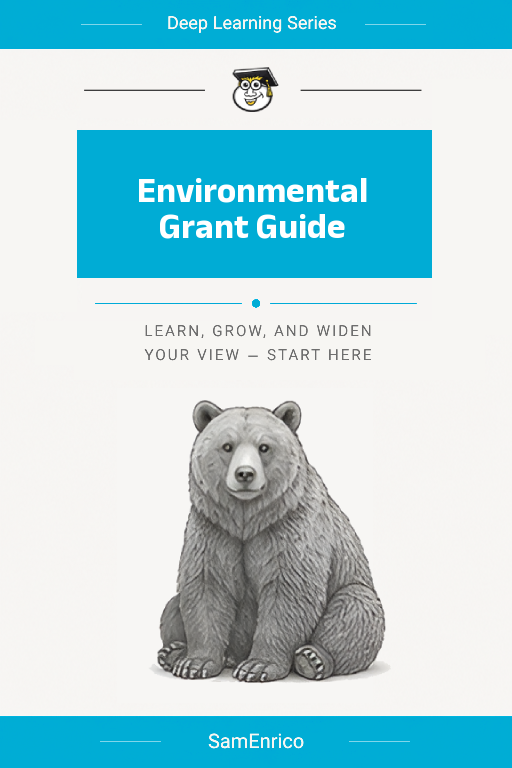
Non-FictionProfessional's Cheat SheetEnvironment
Environmental Grant Guide eBook
Access conservation and climate grants for environ
Access conservation and climate grants for environmental nonprofits in US, UK, and Kenya.
Formats
Free sample
Chapter 1: The Hidden Logic...–- In 2019, a small community-based organization in coastal Kenya planted 50,000 mangroves. They restored a dying fishery, protected a village from storm surges, and trained twelve women as nursery managers. Their grant proposal was rejected by seventeen funders. Meanwhile, a similar organization in the Scottish Highlands planted 5,000 trees, received £400,000 from the National Lottery Heritage Fund, and was featured on BBC Scotland. The difference was not the quality of the work.
The difference was the logic.This is the hidden truth that no one tells you when you enter the world of environmental grants: funders do not pay for trees, mangroves, solar panels, or wildlife corridors. They pay for proof. They pay for a specific kind of story—one that translates muddy boots and calloused hands into spreadsheets, metrics, and compliance frameworks. And if you do not learn that translation, your project will die in a program officer’s inbox, no matter how many mangroves you plant.This chapter is not about how to write a grant. That comes later.
This chapter is about something more fundamental: understanding the ecosystem of green money itself. Where does it come from? Why do different countries have completely different rules? And why does a funder in London care about “public benefit” while a funder in Nairobi cares about a chief’s stamp and a funder in San Francisco cares about additionality?If you are reading this book, you are likely one of three people. You are a nonprofit staff member in the United States, the United Kingdom, or Kenya, trying to keep your conservation or climate project alive.
You are a freelance grant writer who wants to specialize in environmental funding across borders. Or you are a community organizer in rural Kenya who has never written a grant before but knows that the water is running out and the only way to fix it is to find money you do not have.Whoever you are, this chapter will give you the map. The rest of the book will teach you how to walk the terrain.The Death of the Sad Story Fifteen years ago, environmental fundraising was simpler. A nonprofit would take a photograph of a dying polar bear or a deforested hillside, write a letter describing the tragedy, and mail it to a foundation that felt guilty. The foundation would write a check.
The nonprofit would plant some trees. No one asked hard questions about whether the trees survived, whether the community benefited, or whether the same outcome could have been achieved for half the cost.That era is over.Climate finance—the umbrella term that now covers most environmental grants—has professionalized rapidly. The shift began around 2015, when the Paris Agreement created international reporting requirements for climate action. Suddenly, funders needed to prove that their money was actually reducing emissions or building resilience, not just making donors feel good. The rise of impact investing and ESG (Environmental, Social, Governance) criteria for corporations accelerated the trend.
Today, even small family foundations expect to see a theory of change, a logical framework, and a monitoring and evaluation plan.This is not a bad thing. Professionalization means that good projects with strong logic win, while sentimental projects with weak logic lose. But it also means that you must learn a new language.Consider the difference between two ways of describing the same project:Old language: “We plant trees to save the planet.”New language: “This project will sequester an additional 2,000 metric tons of CO2e annually across 1,000 acres of degraded grassland through rotational grazing and reseeding, as verified by the USDA’s COMET-Farm tool. The intervention will generate additionality by restoring land that would otherwise remain unmanaged, with a deadweight estimate of 30% baseline sequestration.”The second sentence is longer, uglier, and harder to write. But it is the sentence that gets funded.The core argument of this chapter—and this entire book—is that grant writing for the environment is not storytelling.
It is structured argumentation. You are not asking for charity. You are presenting an investment thesis. And the first step in building that thesis is understanding where the money comes from and what it wants.The Three Streams of Green Money Environmental grants flow through three distinct channels, and each channel has its own logic, timeline, and compliance requirements. Confusing them is the fastest way to waste months of work.Stream One: Private Foundations Private foundations are the oldest source of environmental funding.
They are created by wealthy individuals or families who want to leave a legacy. In the United States, names like Mac Arthur, Packard, and Hewlett dominate. In the United Kingdom, the Wellcome Trust and Esmée Fairbairn Foundation are major players. In Kenya, the African Wildlife Foundation and local community trusts fill this role, though on a smaller scale.Private foundations are idiosyncratic. Each one has its own personality, and that personality is shaped by the founder.
Some foundations love innovation and will fund risky pilot projects. Others love permanence and will only fund land acquisition or legal protections. Some require matching funds. Others forbid overhead expenses. There is no universal rule.The advantage of private foundations is flexibility.
They are not bound by government procurement rules or corporate branding requirements. You can often get a decision in three to six months, and reporting is usually a simple narrative document. The disadvantage is competition. Private foundations receive thousands of proposals for every grant they award, and most have small staffs who screen out applications in the first thirty seconds.Stream Two: Government Grants Government grants are the largest source of environmental funding by dollar amount, but they are also the most bureaucratic. In the United States, agencies like the Environmental Protection Agency, the National Oceanic and Atmospheric Administration, and the Department of Agriculture distribute billions of dollars annually for conservation and climate work.
In the United Kingdom, the Department for Environment, Food and Rural Affairs (Defra) and its agencies control major streams like the Darwin Initiative and UK PACT. In Kenya, the National Environment Management Authority (NEMA) and the National Climate Change Fund allocate resources through county governments.Government grants require compliance. You will need to register in federal systems, submit audited financial statements, follow procurement rules for buying equipment, and report outcomes using standardized metrics. The application process can take six to twelve months, and funding is often released in installments based on milestones.The advantage of government grants is scale and stability. Once you are in the system, you can often renew funding for multiple years.
The disadvantage is that the paperwork is brutal, and one mistake—a late report, an unapproved budget change—can freeze your funding for months.Stream Three: Corporate ESG and Impact Funds Corporate environmental grants have exploded in the past decade, driven by pressure from investors and consumers. Large multinational companies now have dedicated ESG (Environmental, Social, Governance) departments that distribute grants as part of their sustainability commitments. A multinational oil company like Shell funds methane capture in the United States, energy access in Kenya, and nature-based solutions in the United Kingdom. A beverage company like Coca-Cola funds water replenishment everywhere, but the local partners look very different—large watershed NGOs in the United…
This is the end of the free sample. Get the eBook to keep going. Buy now
About this book
Details
- Author
- Calderon Liane
- Publisher
- SamEnrico
- Language
- English
- Genre
- Non-Fiction, Professional's Cheat Sheet, Environment
- Released
- 2026-05-30
- Pages (approx.)
- 152
- Available as
- eBook, Audiobook

Read better in the ZLOADR app
Your eBooks on your phone or tablet. Sign in with your SamEnrico account and start reading.
More by Calderon Liane
 Networking Small Talk HandbookCalderon Liane$11.99
 Distress Tolerance OvereatingCalderon Liane$11.99
 Loving Kindness For PerfectionismCalderon Liane$11.99
 Student Sleep MeditationCalderon Liane$11.99
 Parent Death and Step ParentCalderon Liane$11.99
 The Ballad of the Sky King: The Rise and Fall of Howard HughesCalderon Liane$11.99
 Orpheus: The Song That Moved the DeadCalderon Liane$11.99
 How to Start a Hobby in PapermakingCalderon Liane$11.99
 One Page Channel Strategy PrimerCalderon Liane$12.99
 Understanding GlycogenosisCalderon Liane$17.99
 Ordonezite MiningCalderon Liane$11.99
You may also like
 Hong Kong Handover 1997Dunn Johnnie$11.99
 Zumba For Postnatal Recovery CourseNeal Christian$11.99
 Zumba for BeginnersLadner Nikia$11.99
 YouTube Comment Mining GuideHumes Pandora$12.99
 Worry Box MeditationCarlin Rudy$11.99
 Workplace Stress MeditationNguyen Lynn$11.99
 Workplace Stress and Sleep RepairHawley Ivory$11.99
 Workplace Perfectionism CureDelaney Jeffry$11.99
 Workplace Injustice Anger GuideWallen Isabelle$11.99
 Work Addiction and Burnout LinkGreenwood Ester$11.99
 Women in Yoga and WellnessBeattie Galina$11.99
 Women in Stand Up ComedyChun Evangeline$11.99