
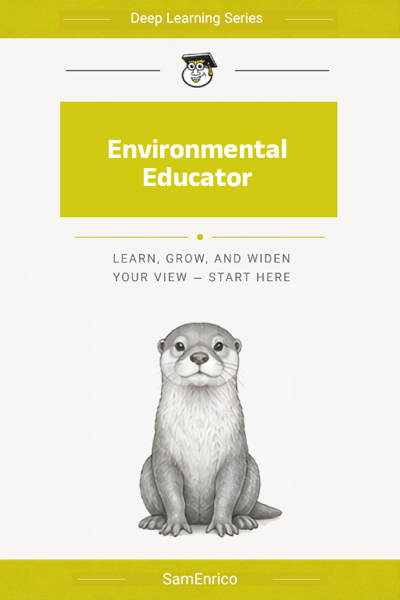
Environmental Educator eBook
A Coursebook on Environmental Educator
by Ybarra Nydia
A Coursebook on Environmental Educator
Formats
Free sample
Chapter 1: Beyond the Binoculars--–- The first time I watched a newly hired environmental educator lead a group of fourth graders to a pond, I felt hope. She had a master’s degree in ecology, a lifetime of camping experience, and a pair of very expensive binoculars. She knew the name of every bird, every plant, and every insect within a hundred meters. But twenty minutes into the program, the children were poking each other with sticks, throwing moss at a duck, and asking, with increasing desperation, “Can we go back to the bus now?” The educator turned to me, confused and defeated. “I love nature,” she said.
“Why don’t they?”That question is the reason this book exists. And the answer is not what she expected. She assumed that her passion for the natural world would be contagious—that simply being in her presence, witnessing her expertise, would spark the same fire in those nine-year-olds. But environmental education is not a virus. You cannot catch it by standing next to someone who has it.
Being a nature lover and being an environmental educator are two completely different skillsets, and confusing one for the other is the fastest path to burnout, disillusionment, and children throwing moss at ducks.This chapter dismantles that confusion. We will define what environmental education actually is—and, just as importantly, what it is not. We will draw sharp lines between environmental education, interpretation, and outdoor education, three fields that are constantly mashed together in job descriptions and graduate program brochures. We will explore the multidisciplinary nature of this work, showing how effective educators must be part scientist, part teacher, and part social worker. We will introduce the professional standards and certification frameworks that separate amateurs from professionals.
And we will meet three environmental educators whose daily work embodies these principles—professionals whose stories will follow us through every chapter of this book.By the end of this chapter, you will know whether you are a nature lover who wants to keep loving nature, or an environmental educator ready to do the hard, rewarding, and utterly transformative work of changing how other people see the world. There is no shame in being either. But you cannot be both without the tools this book provides.The Duck Test: Defining Environmental Education There is an old piece of folk wisdom: if it looks like a duck, swims like a duck, and quacks like a duck, then it is probably a duck. Unfortunately, this logic does not work for environmental education. Many activities look like EE—groups of people in the woods, someone pointing at a tree, a lesson about recycling—but are fundamentally different in purpose, method, and outcome.Let us perform a quick thought experiment.
Imagine three different programs happening on the same sunny Saturday.Program A: A group of teenagers is learning to light a campfire without matches. Their instructor shows them how to gather tinder, build a teepee structure, and use a ferro rod. After twenty minutes of failed attempts, one student successfully ignites the tinder. The group cheers. They roast marshmallows.Program B: A park ranger stands before thirty tourists at a scenic overlook.
“To your left,” she says, “you will see the remnants of an ancient volcanic caldera. The rock you are standing on is rhyolite, formed thirty million years ago when this entire valley was a sea of molten lava.” The tourists nod, take photographs, and move to the gift shop.Program C: A class of fifth graders wades into a shallow stream wearing rubber boots. Each student holds a plastic tray and a pair of tweezers. “Find five macroinvertebrates,” their educator says, “and sort them into pollution-tolerant and pollution-sensitive piles. Then we will calculate a water quality score for this stream.” The students spend forty minutes flipping rocks, squealing at crawfish, and arguing about whether a particular larva has two tails or three.Which program is environmental education?Program A is outdoor education.
Its primary goal is skill development and personal growth—resilience, teamwork, self-reliance. The natural setting is a backdrop for human development, not the subject of instruction. You could teach campfire building in a parking lot (though it would be less pleasant), and the learning objectives would remain unchanged.Program B is interpretation. Its goal is to create appreciation and understanding of a specific place or resource, usually in a short encounter. The ranger is not trying to change behavior or build skills; she is revealing meaning.
Interpretation is vital work, but it is typically one-way, short-term, and focused on emotional connection rather than action.Program C is environmental education. Its goals are awareness, knowledge, and—crucially—participation in solving problems. The students are not just learning about macroinvertebrates; they are using that knowledge to make a judgment about water quality. They are practicing the skills of scientific inquiry and environmental citizenship. And they are doing so in a structured, sustained learning experience, not a single visit.This distinction matters because the professional competencies required for each field are different.
An outdoor educator needs risk management training and group facilitation skills. An interpreter needs storytelling ability and public speaking confidence. An environmental educator needs all of those things plus curriculum design, behavior change theory, and evaluation methodology. The educator at the pond with the bored fourth graders had outdoor education skills (she could build a fire) and interpretation skills (she could name the birds). She lacked environmental education skills.
And her students paid the price.The Three-Legged Stool: Why EE Is Multidisciplinary If environmental education were simple, any passionate naturalist could do it. But EE sits at the intersection of three distinct disciplines, and neglecting any one of them collapses the entire enterprise.Leg One: Ecology (The Science)You cannot teach what you do not understand. An environmental educator must know how ecosystems function—not at the level of a research biologist, but with enough depth to answer unexpected questions and correct common misconceptions. What is the difference between a food chain and a food web? Why do some species thrive after a fire while others disappear?
How does water move through a watershed, and where does pollution enter the system? Chapter 3 of this book will give you the ecological foundations you need, but for now, recognize that science literacy is non-negotiable. The fourth graders at the pond asked their educator, “Why is the water green?” She said, “It’s algae.” That was true but useless. A better answer would have been, “Let’s find out together,” launching an investigation into nutrient pollution, sunlight, and the microscopic plants living in the water. That requires science.Leg Two: Pedagogy (The Teaching)Knowing ecology is not enough.
You must also know how people learn. The traditional “stand and deliver” lecture model fails in outdoor settings for many reasons: distractions, variable weather, short attention spans, and the simple fact that standing still is hard for children who have been sitting in classrooms all week. Environmental educators use inquiry-based learning, experiential cycles, place-based education, and narrative techniques to reach their audiences. They design lessons backward from desired outcomes. They manage group energy across a session.
They assess learning without paper tests when necessary. These are teachable skills, but they are not intuitive. Chapter 5 and…
This is the end of the free sample. Get the eBook to keep going. Buy now
About this book
Details
- Author
- Ybarra Nydia
- Publisher
- SamEnrico
- Language
- English
- Genre
- Non-Fiction, Informative, Educational
- Released
- 2026-06-02
- Pages (approx.)
- 157
- Available as
- eBook, Audiobook

Read better in the ZLOADR app
Your eBooks on your phone or tablet. Sign in with your SamEnrico account and start reading.
More by Ybarra Nydia
 Couples Anger Mapping WorkbookYbarra Nydia$11.99
 Food Addiction Recovery Without Dieting WorkbookYbarra Nydia$11.99
 Cortisol Detox Weekend GuideYbarra Nydia$11.99
 Self Hypnosis Sleep ParalysisYbarra Nydia$11.99
 Imposter Syndrome for StudentsYbarra Nydia$11.99
 Frozen Sands: The Lost Expedition of the Antarctic NomadsYbarra Nydia$11.99
 The Last Pharaoh’s Gambit: Cleopatra’s Secret HeirYbarra Nydia$11.99
 How to Become a Interline ClerkYbarra Nydia$11.99
 US Trucking Companies DBYbarra Nydia$12.99
 Bookkeeping Cold Email GuideYbarra Nydia$12.99
 Understanding Eem SyndromeYbarra Nydia$17.99