
Non-FictionSelf-HelpEntrepreneurship
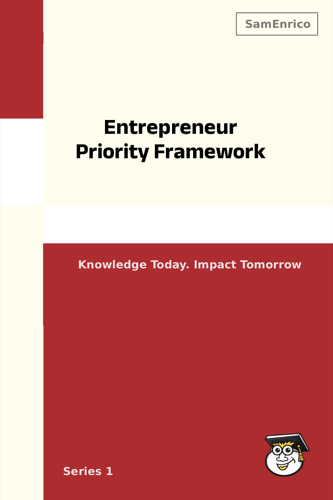
Entrepreneur Priority Framework eBook
Focus on high-leverage activities and delegate the
by Hazel Gia
Focus on high-leverage activities and delegate the rest using Eisenhower logic.
Formats
Free sample
Chapter 1: The Leverage Lie--–- The entrepreneur sat at her desk, three monitors glowing, Slack notifications pulsing like a second heartbeat. She had answered forty-seven emails, reviewed a design mockup, fixed a billing discrepancy, and “quickly” updated a spreadsheet that someone else could have updated. It was 11:00 AM. Her most important strategic initiative—the one that would double revenue—had received exactly zero minutes of her attention. When asked what she did all morning, she would say, “I was so productive.” But she wasn’t productive.
She was busy. And busy is the most expensive substitute for leverage that entrepreneurship has ever invented.This chapter dismantles the single most dangerous belief in business: that hard work and long hours are the primary drivers of success. You are about to discover why most entrepreneurs work themselves to the bone while achieving a fraction of their potential—and how a simple shift in definition can rewrite your entire future.The Definition That Changes Everything Let us begin with a deceptively simple question: What is productivity?Most entrepreneurs answer with some variation of “getting things done.” They measure their day by checkmarks on a to-do list, emails sent, meetings attended, problems solved. By that metric, the entrepreneur described above had an extraordinarily productive morning. She got things done.
Many things. But here is the Leverage Lie: Getting things done is not the same as getting the right things done.This book introduces a different definition, one that will feel uncomfortable at first because it challenges the cult of busyness that permeates entrepreneurial culture. A high-leverage activity is defined as:(Output per unit of time) × (Long-term impact)Notice what this formula does not include. It does not include effort. It does not include hours logged.
It does not include how tired you feel at the end of the day. It includes only two variables: what you produce in a given amount of time, multiplied by how much that production matters six months from now.Let us test this definition against the entrepreneur’s morning. She produced forty-seven email responses (output). Each response took approximately two minutes (time). Her output per unit of time was respectable.
But what was the long-term impact of those emails? Almost zero. Most were confirmations, clarifications, or information that could have been found in a shared document. Even if she had answered zero emails that morning, the business would have continued operating exactly as before. Her leverage score for email: near zero.Now consider an alternative morning: ninety minutes of focused work on a new customer onboarding system that reduces support tickets by 40 percent.
The output per hour is lower in the moment—she produces no emails, no checkmarks. But the long-term impact is massive. Every week after that system is implemented, she saves five hours of support time. That is leverage.The 80/20 Principle for Founders Vilfredo Pareto, an Italian economist, observed in 1906 that 80 percent of the land in Italy was owned by 20 percent of the population. This observation evolved into the Pareto Principle, or the 80/20 Rule: roughly 80 percent of effects come from 20 percent of causes.
In business, this shows up everywhere. Eighty percent of revenue comes from 20 percent of customers. Eighty percent of problems come from 20 percent of bugs. Eighty percent of results come from 20 percent of activities.Here is what most entrepreneurs miss: the 80/20 principle applies to their own work. Roughly 20 percent of your daily tasks drive 80 percent of your business results.
The other 80 percent of your tasks drive only 20 percent of results. Yet the typical entrepreneur spends their day in the 80 percent zone because those tasks feel urgent, familiar, and immediately rewarding. Answering an email produces a tiny dopamine hit. Completing a spreadsheet checkmark feels satisfying. Working on a six-month strategic initiative produces no immediate reward—only the vague discomfort of thinking hard.Tim Ferriss, in *The 4-Hour Workweek*, called this the “paradox of the inactive executive.” The executive who does nothing visible may be creating more value than the executive who responds to every interruption, because the invisible work of strategy, systems, and relationships compounds over time while busywork decays by the next morning.Consider two entrepreneurs launching the same product.
Entrepreneur A spends her days handling customer support, tweaking website colors, and answering partner emails. She feels exhausted and vital. Entrepreneur B spends his days building an automated support system, negotiating strategic partnerships, and documenting processes so that someone else can handle operations. After six months, Entrepreneur A is still handling customer support. Entrepreneur B has scaled to ten times the revenue with half the personal workload.
Who worked harder? Entrepreneur A. Who achieved more? Entrepreneur B. That is the Leverage Lie exposed.The One Thing That Makes Everything Else Easier Gary Keller, in The One Thing, asks a deceptively powerful question: “What is the one thing you can do such that by doing it, everything else becomes easier or unnecessary?”Notice the structure of this question.
It does not ask for your top three priorities. It does not ask for a balanced list. It asks for one thing. Singular. Because the moment you allow two priorities, you have already diluted your focus.
The human brain cannot multitask; it can only switch rapidly between tasks, each switch costing up to twenty minutes of lost focus. When you have two priorities, you have no priorities.Let us apply this question to a typical entrepreneur’s world. You have a product launch in six weeks. You have customer support tickets piling up. You have a website redesign half-finished.
You have a strategic partnership waiting on a proposal. Which one is the one thing?The correct answer is almost never the urgent thing. It is the thing that, once completed, reduces the urgency of everything else. A strategic partnership might bring in resources that fund additional support staff. A product launch might generate revenue that pays for the redesign.
A customer support system (not individual tickets) might eliminate the need for you to ever touch support again. The one thing is almost always a system, a relationship, or a strategic asset—not a task.Here is the entrepreneur’s trap: urgent things scream. Important things whisper. The urgent thing puts a deadline in your calendar and a person on your back. The important thing sits quietly, waiting for you to choose it.
Most entrepreneurs spend their lives responding to screams. The result is a business that is always in firefighting mode, always reactive, always exhausting.The 90% Elimination Test Theory is useless without action. This chapter concludes with a brutal exercise called the 90% Elimination Test. It is designed to rewire your brain away from busyness and toward leverage. It will feel wrong.
It will feel lazy. That is how you know it is working.Here are the steps:Step One: Write down the ten tasks you performed yesterday, or the ten tasks currently on your to-do list for today. Be specific. Do not write “work on marketing.” Write “draft three social media posts,” “respond to client email about timeline,” “review design mockup,” “update financial spreadsheet,” etc.Step Two: Draw a line through nine of them. Yes, nine.
You are keeping only one task. The single most leveraged activity on your list. The one thing that makes everything…
This is the end of the free sample. Get the eBook to keep going. Buy now
About this book
Details
- Author
- Hazel Gia
- Publisher
- SamEnrico
- Language
- English
- Genre
- Non-Fiction, Self-Help, Entrepreneurship
- Released
- 2026-06-10
- Pages (approx.)
- 110
- Available as
- eBook, Audiobook

Read better in the ZLOADR app
Your eBooks on your phone or tablet. Sign in with your SamEnrico account and start reading.
More by Hazel Gia
 Couples Stress Reduction WorkbookHazel Gia$11.99
 Parental Anger And DisobedienceHazel Gia$11.99
 Self Hypnosis for Procrastination HabitsHazel Gia$11.99
 Franchising Your Local Brand Across Borders Foreign Corrupt PracticesHazel Gia$11.99
 The Last Expedition: Love and Loss on the Nile’s Hidden SourceHazel Gia$11.99
 Blood and Mist: The Lost Battle of the CarantaniHazel Gia$11.99
 Understanding Deafness CHazel Gia$17.99
 Paid Community OnboardingHazel Gia$12.99
 Form 990 Filing Deadline GuideHazel Gia$12.99
 Ultimate Handbook Guide to St. Pierre : (Saint Pierre and Miquelon) Travel GuideHazel Gia$11.99
 Field Account ExecutiveHazel Gia$11.99
You may also like
 Hong Kong Handover 1997Dunn Johnnie$11.99
 Zumba For Postnatal Recovery CourseNeal Christian$11.99
 Zumba for BeginnersLadner Nikia$11.99
 YouTube Comment Mining GuideHumes Pandora$12.99
 Worry Box MeditationCarlin Rudy$11.99
 Workplace Stress MeditationNguyen Lynn$11.99
 Workplace Stress and Sleep RepairHawley Ivory$11.99
 Workplace Perfectionism CureDelaney Jeffry$11.99
 Workplace Injustice Anger GuideWallen Isabelle$11.99
 Work Addiction and Burnout LinkGreenwood Ester$11.99
 Women in Yoga and WellnessBeattie Galina$11.99
 Women in Stand Up ComedyChun Evangeline$11.99