
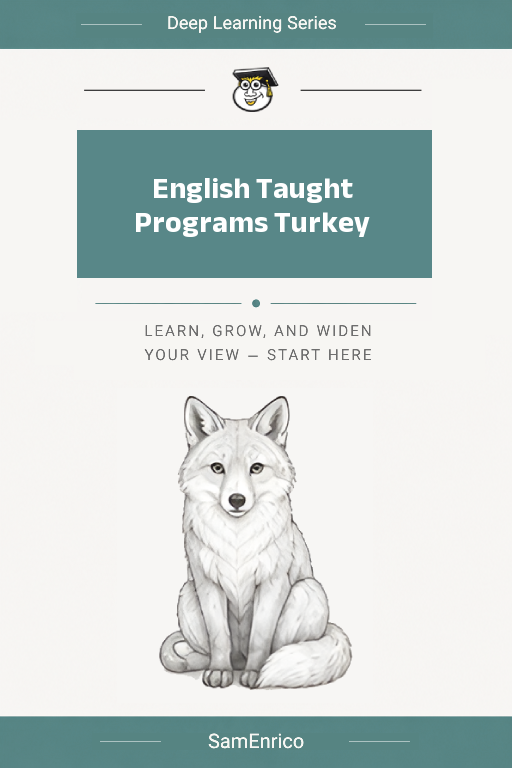
Non-FictionStudent's ShortcutEnglish
English Taught Programs Turkey eBook
Find bachelor's and master's degrees taught entire
Find bachelor's and master's degrees taught entirely in English at Turkish universities.
Formats
Free sample
Chapter 1: The Great Unspoken Divide--–- Every year, tens of thousands of students make the same mistake. They fall in love with a glossy university website that promises “100% English instruction,” they wire their application fees, they board a plane with dreams of an international education, and then—sometime around the third week of their first semester—they realize the truth. The professor is speaking Turkish. The textbook is in English, the slides have English bullet points, but the explanation, the joke, the clarification, the answer to that confused hand in the back row—all of it is in Turkish. The student feels betrayed.
The university feels misunderstood. And no one ever warned them about the great unspoken divide between policy and practice.This book exists because that divide is not a bug in the Turkish higher education system. It is a feature. And understanding it is the single most important factor in whether you will succeed or fail in an English-taught program in Turkey.The Promise Versus the Reality Let us begin with a number that sounds impressive: over one-third of all undergraduate programs across Turkey’s 209 universities are now officially designated as English-medium instruction, or EMI. That figure has tripled in the last fifteen years.
On paper, Turkey has undergone a quiet revolution, transforming from a nationally focused education system into an ambitious international player. The government’s Higher Education Council, known as YÖK, has announced a 2025 vision to increase international student enrollment to 300,000, simplify visa processes, and create English-taught program standards that would rival those of Germany or the Netherlands.But here is the number that matters more: in a 2024 classroom observation study across twelve Turkish universities, researchers found that even in programs officially labeled “100% English,” the average amount of Turkish spoken during lectures ranged from fifteen percent to over sixty percent, depending on the subject and the professor. In engineering and medical faculties, Turkish usage was highest. In business and humanities, it was lower but never zero. Not once did a researcher observe a single 90-minute lecture delivered entirely in English without a single switch to Turkish.This is the great unspoken divide.
University websites advertise “English Taught Programs.” Admissions officers confirm that all instruction is in English. But inside the classroom, a different reality unfolds—one that Turkish professors call translanguaging and that international students often call something less polite.Why does this happen? The answer is not conspiracy or laziness. It is a complex mixture of linguistics, pedagogy, culture, and sheer practicality. Turkish professors are not trying to deceive you.
They are trying to teach you. And for most of them, teaching complex material in a second language is genuinely difficult.The Four Reasons Professors Switch to Turkish Through interviews with faculty across twenty Turkish universities, four consistent reasons emerge for why professors abandon English during lectures, even in programs officially designated as EMI.Reason One: Conceptual Clarity The first and most common reason is the simplest: professors switch to Turkish because they want you to understand the material. A thermodynamics professor at a major public university put it bluntly: “I can explain the second law of thermodynamics in Turkish in thirty seconds. In English, it takes me five minutes, and half the class still looks confused. I am not here to practice my English.
I am here to teach engineering.”This is not an excuse. It is an honest assessment of cognitive load. For a native Turkish speaker who learned technical vocabulary in Turkish during their own education, translating that vocabulary into English in real time while simultaneously managing lecture pace, student questions, and classroom dynamics is mentally exhausting. When a student’s confused expression signals that the English explanation failed, the professor’s brain automatically reaches for the path of least resistance—Turkish.Reason Two: Procedural Efficiency The second reason is administrative. Lab safety rules, assignment deadlines, exam formats, grading policies, and homework instructions are frequently given in Turkish to avoid misunderstandings.
One professor at İstanbul Technical University explained: “If I tell you in English that the lab report is due on Thursday, and you misunderstand and submit it on Friday, you will fail the assignment. Then you will come to my office crying. I do not want that. So I repeat the deadline in Turkish, slowly, and I write it on the board.”This is not laziness. It is risk management.
Professors have learned from painful experience that procedural instructions delivered in English are more likely to be misunderstood, leading to grade disputes, appeals, and administrative headaches. Turkish is simply more precise for these purposes.Reason Three: Social Bonding and Classroom Management The third reason is social. Jokes, asides, and classroom management (“quiet down,” “pay attention,” “this will be on the exam”) happen in Turkish because these are the professor’s native language for emotional and social communication. A professor at Koç University, one of Turkey’s most prestigious English-medium institutions, admitted: “I can lecture in English for two hours. But when a student makes a joke, I answer in Turkish.
When someone is on their phone, I scold them in Turkish. When I want to build rapport, I use Turkish. English is for content. Turkish is for connection.”This creates a subtle but profound barrier for international students. You may understand the lecture content, but you will miss the jokes, the warnings, the camaraderie, and the cultural cues that help Turkish students navigate the classroom.Reason Four: Student Comfort and Face-Saving The fourth reason is the most surprising and the most important for international students to understand.
Turkish students rarely ask questions in class. They rarely challenge the professor. They rarely admit confusion. This is not because they understand everything. It is because Turkish academic culture views questioning a professor as potentially disrespectful—a challenge to authority that risks making the professor “lose face.”When a professor looks out at a silent classroom and sees blank faces, they cannot tell whether students understand or are simply too polite to ask.
So they switch to Turkish and ask, “Anladınız mı?” (“Did you understand?”). Only then do students nod or shake their heads. The professor is not abandoning English out of laziness. They are switching to Turkish because it is the only language in which students feel safe admitting confusion.The Three Types of Turkish EMI Universities Given this reality, it is essential to understand that not all English-taught programs are equal. Based on classroom observation studies and student surveys, Turkish universities fall into three distinct categories.
Your success depends on knowing which category your target program belongs to.Type A: High English Fidelity (70–85% English)These are Turkey’s elite private universities: Koç University, Sabancı University, and Bilkent University. Also included are a handful of top-tier public universities like Boğaziçi University and Middle East Technical University (METU). At these institutions, English is the primary language of instruction. Professors have international Ph Ds, publish in English-language journals, and are held accountable for their English proficiency. Even here, however, code-switching occurs—especially in STEM fields and during office hours.
The difference is frequency. At a Type A university, you will hear Turkish perhaps fifteen to thirty percent of the time…
This is the end of the free sample. Get the eBook to keep going. Buy now
About this book
Details
- Author
- Mcwhorter Madison
- Publisher
- SamEnrico
- Language
- English
- Genre
- Non-Fiction, Student's Shortcut, English
- Released
- 2026-06-01
- Pages (approx.)
- 135
- Available as
- eBook, Audiobook

Read better in the ZLOADR app
Your eBooks on your phone or tablet. Sign in with your SamEnrico account and start reading.
More by Mcwhorter Madison
 Documentary Films MadeMcwhorter Madison$11.99
 AliExpress Obsessive TrackingMcwhorter Madison$11.99
 Actor Stage Nonverbal PresenceMcwhorter Madison$11.99
 Evening Body Scan Wind DownMcwhorter Madison$11.99
 Homicide Detectives' BurnoutMcwhorter Madison$11.99
 Atomic Habits For Saying NoMcwhorter Madison$11.99
 Doe Network Facial RecognitionMcwhorter Madison$11.99
 Pillow App GuideMcwhorter Madison$11.99
 The Young Con Artists of Cairo: The 1920s Juvenile Fraud Ring That Shook EgyptMcwhorter Madison$11.99
 When the Sky Split Open: The Maori Birth of Earth and SeaMcwhorter Madison$11.99
 How to Start a Medicinal and Botanical Manufacturing BusinessMcwhorter Madison$11.99
 How to Produce NappiesMcwhorter Madison$11.99
You may also like
 Hong Kong Handover 1997Dunn Johnnie$11.99
 Zumba For Postnatal Recovery CourseNeal Christian$11.99
 Zumba for BeginnersLadner Nikia$11.99
 YouTube Comment Mining GuideHumes Pandora$12.99
 Worry Box MeditationCarlin Rudy$11.99
 Workplace Stress MeditationNguyen Lynn$11.99
 Workplace Stress and Sleep RepairHawley Ivory$11.99
 Workplace Perfectionism CureDelaney Jeffry$11.99
 Workplace Injustice Anger GuideWallen Isabelle$11.99
 Work Addiction and Burnout LinkGreenwood Ester$11.99
 Women in Yoga and WellnessBeattie Galina$11.99
 Women in Stand Up ComedyChun Evangeline$11.99