
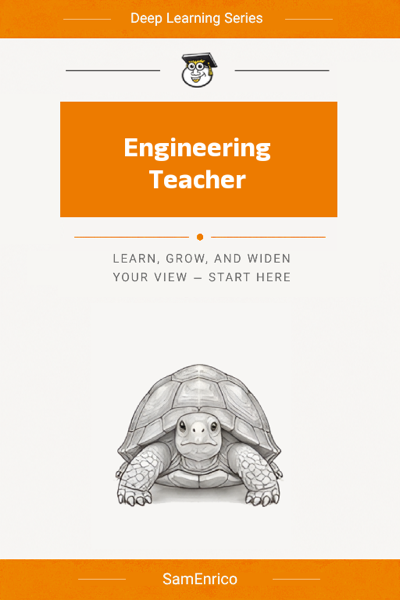
Engineering Teacher eBook
A Coursebook on Engineering Teacher
A Coursebook on Engineering Teacher
Formats
Free sample
Chapter 1: The Impostor's Equation...–- Let me tell you about the worst day of my teaching career. I had a Ph D in mechanical engineering, three first-author publications in the Journal of Turbomachinery, and the unshakeable confidence of someone who had never been truly tested in a classroom. My first lecture was on thermodynamics—the ideal gas law, something I could recite in my sleep. I walked into the room, wrote PV = n RT on the board with a flourish, and spent fifty minutes deriving every implication I could think of. I was brilliant.
I was thorough. I was, I believed, the best teacher those eighty sophomores had ever seen. Then I gave them a five-question quiz. The average score was twenty-two percent. Twenty-two percent.
One student wrote, and I am not making this up, "Is P for pressure or for power? I got confused." Another student, a young woman who had sat in the front row and taken meticulous notes, scored a four out of twenty. Four. She came to my office hours afterward, crying, and asked me if she was too stupid to be an engineer. I had no answer for her.
Because in that moment, I was asking myself the same question about myself as a teacher.This chapter is for every engineering educator who has stood in front of a classroom, poured out their hard-won expertise, and watched students stare back with blank, uncomprehending faces. It is for the professor who spends eight hours preparing a lecture only to realize that the students learned more from a five-minute You Tube video. It is for the new faculty member who was hired for research excellence and then told, by the way, you're teaching the sophomore core course, good luck. And it is for the graduate teaching assistant who has never taught anything more complicated than a lab section and is now expected to explain finite element analysis to students who do not yet understand free-body diagrams.The impostor equation is simple, elegant, and devastating. It reads like this:(Technical Expertise) ÷ (Pedagogical Training) = Impostor Syndrome When you have deep technical knowledge but no training in how to teach, the result is not competence.
The result is a painful gap between what you know and what you can communicate. And because engineering culture rewards confidence and punishes vulnerability, you will suffer in silence. You will assume that everyone else has figured it out. You will blame yourself for something that was never your fault.But here is the truth that no one told you in graduate school: teaching is a separate skill set from engineering. Being bad at teaching on your first day does not make you a bad engineer.
It makes you a normal human being who was set up to fail by a system that values research over instruction and measures success in grant dollars, not student learning.This is the chapter where we burn that system down. Not literally—your department chair would not appreciate it—but intellectually. We are going to name the crisis, trace its origins, and give you a new framework for understanding what you are actually trying to accomplish in that classroom. By the end of this chapter, you will understand why you feel like an impostor, why that feeling is not your fault, and what you can do about it starting tomorrow morning.The Silent Epidemic: Why No One Talks About Teaching Let me ask you a question. How many hours of formal training did you receive in pedagogy before you first stepped into a classroom as the instructor of record?
Not a one-hour workshop on how to use the learning management system. Not a lunchtime seminar on syllabus formatting. Real training—the kind that teaches you how people learn, how to design assessments, how to manage classroom dynamics, how to give feedback that students will actually read.If you are like the vast majority of engineering faculty, the answer is zero. A 2021 survey of engineering educators at research-intensive universities found that only eighteen percent had completed any course on teaching during their graduate studies. Of that eighteen percent, most described their training as a single "teaching practicum" that consisted of grading homework for a senior professor while receiving no feedback on their own instructional methods.This is not an accident.
It is a structural feature of how engineering Ph D programs are designed. Your advisor was evaluated on your research output. Your department was ranked on your publication record. Your funding came from grants that cared about scientific breakthroughs, not student learning outcomes. In that ecosystem, teaching was an afterthought—a distraction from the real work of creating knowledge.But here is the paradox.
The moment you accept a faculty position—or even a graduate teaching assistantship—teaching becomes the majority of your visible work. You will spend more hours preparing lectures, holding office hours, grading assignments, and meeting with students than you will doing research. Your department chair will evaluate your teaching. Your students will evaluate your teaching on anonymous surveys that can make or break your career. Your tenure dossier will require a teaching portfolio that documents your effectiveness in the classroom.You were trained for the job you thought you would have—researcher, grant-writer, Ph D-producer.
You were not trained for the job you actually have—teacher, mentor, learning architect. And then the system blames you for struggling with the skills you were never taught.That is not a failure of individual engineers. That is a failure of institutional design. And the first step to solving it is admitting that you are not the problem.A Brief History of How We Got Here To understand why engineering education looks the way it does today, we need to understand where it came from. This history matters because the assumptions embedded in your classroom—the arrangement of the furniture, the rhythm of the lecture, the weight of the final exam—are not neutral.
They are the fossilized remains of pedagogical theories that have not been updated in over a century.The Apprenticeship Era (1820–1900)The earliest engineering education in the United States took place not in universities but in the field. Aspiring civil engineers attached themselves to master practitioners—canal builders, railroad surveyors, military engineers—and learned by doing. This apprenticeship model had genuine strengths: students faced authentic problems, received immediate feedback, and developed professional judgment through years of supervised practice. It also had obvious limitations: it was slow, inconsistent, and produced engineers who knew how to build one kind of bridge but struggled when confronted with novel problems.When engineering education moved into universities—MIT was founded in 1861, followed by a wave of land-grant institutions under the Morrill Act of 1862—the apprenticeship model could not scale. You could not apprentice two hundred students to a single master engineer.
Something had to change.The Lecture Factory (1900–1980)What emerged was the lecture model, borrowed from German research universities and adapted to American industrial efficiency. The professor became the conveyor of knowledge. The student became the passive receiver. The classroom became a factory for processing raw material—eighteen-year-olds with high school math—into finished products—Bachelors of Science in Engineering.This model was efficient. One professor could…
This is the end of the free sample. Get the eBook to keep going. Buy now
About this book
Details
- Author
- Estrada Molly
- Publisher
- SamEnrico
- Language
- English
- Genre
- Non-Fiction, Informative, Educational
- Released
- 2026-05-11
- Pages (approx.)
- 152
- Available as
- eBook, Audiobook

Read better in the ZLOADR app
Your eBooks on your phone or tablet. Sign in with your SamEnrico account and start reading.
More by Estrada Molly
 I Statements for AssertivenessEstrada Molly$11.99
 Weekly Interruption Audit GuideEstrada Molly$11.99
 Napoleon Death Theories GuideEstrada Molly$11.99
 Fluency Persuasion GuideEstrada Molly$11.99
 Charlie Munger PartnerEstrada Molly$11.99
 Fishing Trip Alibi CheckEstrada Molly$11.99
 Golfer's Elbow Rehabilitation PlanEstrada Molly$11.99
 The Freelance Automated InvoicingEstrada Molly$11.99
 Scripting MistakesEstrada Molly$11.99
 The Great Unmasking: How the Internet Outed a Secret SocietyEstrada Molly$11.99
 The Battle of the Bulge: Hitler's Last Gamble in the ArdennesEstrada Molly$11.99
 The Complete Guide to the No Fad DietEstrada Molly$11.99