
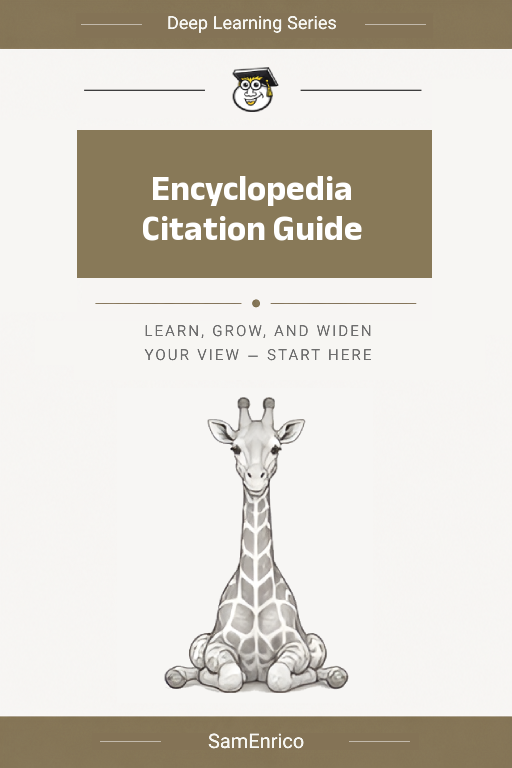
Encyclopedia Citation Guide eBook
Cite print and online encyclopedia entries with or
Cite print and online encyclopedia entries with or without authors.
Formats
Free sample
Chapter 1: The Citation Trap--Every student remembers the moment. For Maria Chen, a junior majoring in political science at a large state university, it happened at 11:47 PM on a Sunday night. Her final paper for "Comparative Revolutions" was due in thirteen minutes. She had written eighteen pages comparing the French and Russian revolutions, weaving together primary sources, peer-reviewed articles, and—because she wanted to impress her professor—a carefully selected entry from the Encyclopedia of Modern Political Thought. The entry was perfect: signed by a named author, current, and directly relevant to her argument about revolutionary legitimacy.She pasted the citation from Easy Bib, double-checked the spelling of the author's name, and hit submit.
She closed her laptop, went to sleep, and dreamed of the A she was certain she would receive.Ten days later, she got the paper back. The grade: B-minus. The professor's handwritten note in the margin: "Citation error on your encyclopedia entry. See me."Maria walked to office hours confused and embarrassed. The professor explained: "You cited this as a print encyclopedia, but you accessed it online through our library's database.
That changes everything. In APA style, the format is completely different. You also forgot the retrieval date, and you used the wrong DOI format. These aren't minor mistakes, Maria. They tell me you don't understand the source you're citing."Three points off the final grade.
Not because her argument was weak, not because her evidence was flawed, but because she mis-cited a single encyclopedia entry.Maria's story is not unusual. It is repeated hundreds of thousands of times every semester, in every discipline, at every level of education. Students lose points. Researchers have papers rejected. Professionals face accusations of sloppy work.
And at the center of almost every citation disaster is the same innocent-looking source: the encyclopedia entry.Why This Book Exists You are holding this book for one of three reasons. First, you have already made a citation mistake on an encyclopedia entry and you want to never make it again. Second, you are about to write a paper that requires citing reference works and you want to get it right the first time. Third, you are a teacher, librarian, or editor who is tired of correcting the same encyclopedia citation errors semester after semester.Whatever brought you here, you have made the right choice. But you might also be wondering: why a whole book just for encyclopedia entries?
Aren't they just like citing any other book or website?The short answer is no. The longer answer is the entire book you are about to read.The Hidden Complexity of Reference Works Encyclopedia entries occupy a strange middle ground in the world of academic sources. They are not quite books (they are shorter, written by many different authors, and organized alphabetically rather than narratively). They are not quite articles (they appear in a larger volume with editors, not in a journal with issues and volumes). And when they move online, they become even more confusing: are they websites?
Are they databases? Are they books that happen to live on a screen?This ambiguity creates the "Citation Trap" that gives this chapter its name. You think you understand the source, so you cite it the way you would cite something familiar. But encyclopedias follow different rules—rules that vary depending on whether the entry has an author, whether you accessed it in print or online, which citation style you are using, and even which specific encyclopedia you are citing.Consider just a few of the questions this book will answer:If an encyclopedia entry has no listed author, do you use "Anonymous," skip the author field, or move the title to the front?What do you do when an online encyclopedia entry has no publication date?If you find an encyclopedia entry through your university library's database, do you cite the database or the encyclopedia's own website?How do you cite a specific entry from a 30-volume print encyclopedia when each volume has a different editor?When should you include a retrieval date, and when should you leave it out?What is the difference between a DOI and a URL, and why does APA care so much about one and not the other?These are not trivial technicalities. They are the difference between a citation that demonstrates scholarly competence and one that signals carelessness.
They are the difference between an A and a B-minus.What the Top-Selling Citation Guides Don't Tell You If you have already consulted the major style guides—the Publication Manual of the American Psychological Association (APA), the MLA Handbook, the Chicago Manual of Style, or the CSE Manual for Scientific Style and Format—you may have noticed something frustrating. Each of these guides contains the rules for citing encyclopedias, but the rules are scattered across multiple chapters, buried in footnotes, or hidden in examples that don't match your specific situation.The APA manual, for example, covers encyclopedia entries in its chapter on "Reference Works," but the rules for print and online versions are separated by thirty pages. The discussion of retrieval dates appears in a completely different section about "Dynamic Sources." The treatment of DOIs is elsewhere again. By the time you have assembled all the pieces, you have read three chapters, cross-referenced two tables, and still aren't sure whether to include the database name.The MLA handbook takes a different approach. It presents a unified "container" model that works beautifully for simple sources but becomes maddeningly abstract when you try to apply it to a signed entry in an online encyclopedia that you accessed through a library database.
What counts as the first container? The encyclopedia. What counts as the second container? The database. But wait—is the website also a container?
The handbook says yes, but the examples don't show this level of nesting.The Chicago Manual of Style offers two completely different citation systems—Notes-Bibliography and Author-Date—and the rules for encyclopedias differ between them. The Notes-Bibliography system allows you to omit the publisher for well-known encyclopedias, but the Author-Date system does not. And neither system gives clear guidance on what to do when an online encyclopedia has been continuously updated so there is no stable publication date.The CSE manual, meanwhile, treats encyclopedia entries as a kind of edited book chapter, but the rules for online access are virtually nonexistent.This book synthesizes all four major style guides into a single, coherent resource focused exclusively on one source type: the encyclopedia entry. You will not need to jump between chapters or cross-reference multiple manuals. Everything you need is here, organized logically and explained clearly.What You Will Learn in This Book Before we dive into the mechanics of citation, let me give you a roadmap of where we are going.Part I: The Foundations (Chapters 1-2) establishes why encyclopedias require special treatment and introduces the seven core data points that every citation needs, regardless of style.
By the end of Part I, you will understand the anatomy of a citation well enough to build one from scratch without templates or generators.Part II: The Core Content (Chapters 3-5) tackles the three most common citation scenarios: entries with known authors…
This is the end of the free sample. Get the eBook to keep going. Buy now
About this book
Details
- Author
- Trudeau Glennis
- Publisher
- SamEnrico
- Language
- English
- Genre
- Non-Fiction, Student's Shortcut
- Released
- 2026-05-30
- Pages (approx.)
- 142
- Available as
- eBook, Audiobook

Read better in the ZLOADR app
Your eBooks on your phone or tablet. Sign in with your SamEnrico account and start reading.
More by Trudeau Glennis
 Silencing The Inner FraudTrudeau Glennis$11.99
 Dream Reliving and ProcessingTrudeau Glennis$11.99
 Addressing Foster Care PlacementTrudeau Glennis$11.99
 Twitter FOMO and ComparisonTrudeau Glennis$11.99
 Idea Validation Complete GuideTrudeau Glennis$11.99
 Thunberg Autism CommunityTrudeau Glennis$11.99
 Reading Habit GuideTrudeau Glennis$11.99
 Preseason Preparation BlueprintTrudeau Glennis$11.99
 Office Gossip Energy DrainTrudeau Glennis$11.99
 The Great Bitcoin Heist: How $460 Million Vanished in a Single NightTrudeau Glennis$11.99
 The Unlikely Maestro: How a Janitor Composed a SymphonyTrudeau Glennis$11.99
 The Siege of Chittorgarh: Rajput Fire and ValorTrudeau Glennis$11.99
You may also like
 LSE Online Program LengthAgee Letisha$11.99
 Harvard Extension School for Working AdultsRoush Yer$11.99
 LSE Online Reading ListAshford Ludivina$11.99
 LSE Online Language RequirementsWhitten Daphine$11.99
 LSE Online Class SizeHughey Garret$11.99
 LSE Online Alumni MentorshipWild Lyla$11.99
 London School of Economics Alumni NetworkDutton Chantal$11.99
 Harvard Extension School Student SupportCantrell Christene$11.99
 Harvard Extension School Library AccessSantana Adah$11.99
 Harvard Extension School Degree CompletionBray Wyatt$11.99
 Harvard Extension School Course AuditingAbbott Craig$11.99
 Harvard Extension School Extension DiplomaNew Joane$11.99