
Non-FictionStrategic AtlasEmployee Experience
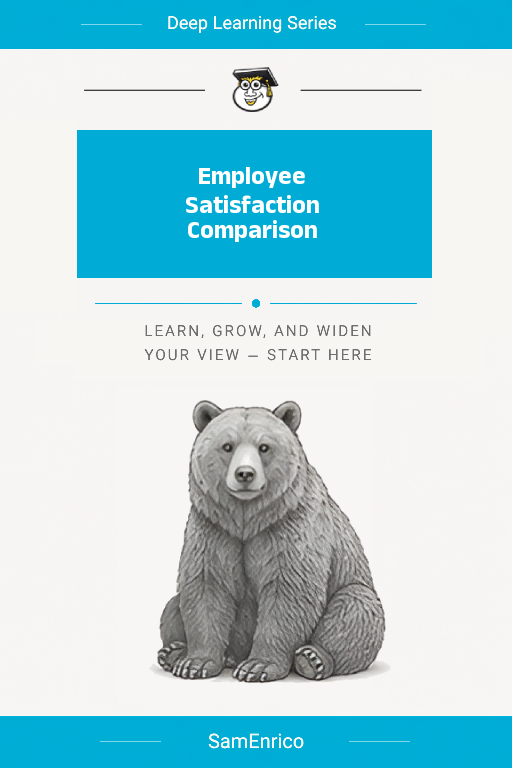
Employee Satisfaction Comparison
Compares public firms on Glassdoor ratings, employ
Compares public firms on Glassdoor ratings, employee turnover, engagement scores, and parental leave policies.
Formats
About this book
Free sample
Chapter 1: The Deceptive Star--–- In the summer of 2019, a mid‑sized software company called Verta Core celebrated its fourth consecutive year on Glassdoor’s “Best Places to Work” list with a company‑wide pizza party. The CEO beamed as he projected the company’s 4.7‑star rating onto a conference room screen. “We’re in the top 5% of all employers,” he declared. “Our culture is our competitive advantage.” Six months later, Verta Core’s stock price collapsed by 62%. The trigger was not a failed product launch or an accounting scandal.
It was a mass exodus of engineers that began quietly, accelerated silently, and only became visible to investors after the damage was irreversible. The Glassdoor rating? Still 4.6 stars. The reality? Toxic management, unpaid overtime, and a 41% annual turnover rate that the company had successfully hidden behind a sparkling veneer of positive reviews.This is not an isolated cautionary tale.
It is the central problem that this book exists to solve. In the modern information economy, every investor, analyst, and job seeker has access to a fire hose of employee satisfaction data. Glassdoor alone hosts more than 100 million company reviews. Linked In reports that 86% of job seekers consult employer ratings before applying. ESG investment funds now explicitly cite employee satisfaction as a component of their “Social” scoring.
Yet despite—or perhaps because of—this abundance, most people remain remarkably bad at comparing employee satisfaction across companies. They look at a star rating, glance at a few reviews, and form a conclusion that is often spectacularly wrong.This chapter dismantles the most common and dangerous misconception in workforce analytics: that a company’s Glassdoor star rating tells you something meaningful about its employee satisfaction. It does not. Or rather, it tells you something, but what it tells you is systematically distorted by three forces: platform‑level filtering, extreme response bias, and the fundamental inadequacy of a single‑number summary for a multidimensional phenomenon. By the end of this chapter, you will understand why two companies with identical 4.0‑star ratings can have radically different cultures, how to perform basic textual analysis to see beyond the stars, and how to…
This is the end of the free sample. Get the eBook to keep going. Buy now
Contents
- Chapter 1
- Chapter 2
- Chapter 3
- Chapter 4
- Chapter 5
- Chapter 6
- Chapter 7
- Chapter 8
- Chapter 9
- Chapter 10
- Chapter 11
- Chapter 12
Details
- Author
- Enriquez Anika
- Publisher
- SamEnrico
- Language
- English
- Genre
- Non-Fiction, Strategic Atlas, Employee Experience
- Released
- 2026-06-01
- Pages (approx.)
- 138
- Available as
- eBook, Audiobook

Read better in the ZLOADR app
Your eBooks on your phone or tablet. Sign in with your SamEnrico account and start reading.
More by Enriquez Anika
 Peg System for DIY ProjectsEnriquez Anika$11.99
 Child Nonverbal Cues Parent GuideEnriquez Anika$11.99
 Remote Review Internship GuideEnriquez Anika$11.99
 San Francisco Bay Recovery LocationEnriquez Anika$11.99
 Drone Delivery Capital OutlookEnriquez Anika$11.99
 The Lost Legion: Rome's Forgotten Stand in the East (53 BC)Enriquez Anika$11.99
 Minority Mentor LinkedIn GuideEnriquez Anika$12.99
 How to Start a Hydroponic crop farming BusinessEnriquez Anika$11.99
 Understanding Paroxysmal Nocturnal HemoglobinuriaEnriquez Anika$17.99
 Help Desk ManagerEnriquez Anika$11.99
You may also like
 Hong Kong Handover 1997Dunn Johnnie$11.99
 Zumba For Postnatal Recovery CourseNeal Christian$11.99
 Zumba for BeginnersLadner Nikia$11.99
 YouTube Comment Mining GuideHumes Pandora$12.99
 Worry Box MeditationCarlin Rudy$11.99
 Workplace Stress MeditationNguyen Lynn$11.99
 Workplace Stress and Sleep RepairHawley Ivory$11.99
 Workplace Perfectionism CureDelaney Jeffry$11.99
 Workplace Injustice Anger GuideWallen Isabelle$11.99
 Work Addiction and Burnout LinkGreenwood Ester$11.99
 Women in Yoga and WellnessBeattie Galina$11.99
 Women in Stand Up ComedyChun Evangeline$11.99