
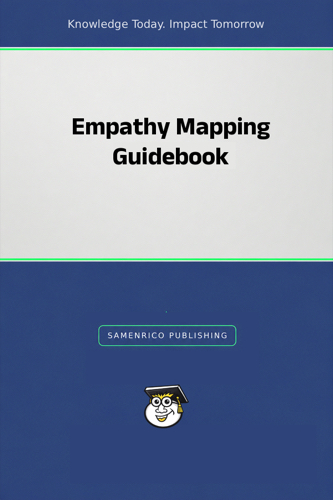
Empathy Mapping Guidebook eBook
Understand user needs and pain points through stru
Understand user needs and pain points through structured empathy interviews and observation.
Formats
Free sample
Chapter 1: The Assumption Tax--Most product failures do not die from bad execution. They die from wrong assumptions, buried so deep in the planning process that no one remembers making them.Consider this: eighty percent of feature requests from stakeholders, users, or internal teams are not solutions at all. They are symptoms of a deeper problem dressed up as a request. When a user asks for an “export to CSV” button, they are not telling you they love CSV files. They are telling you the dashboard is too slow to work with directly, or the data visualization is unreadable, or they need to manipulate numbers in ways your system does not allow.
The button is a clue. The real need is buried beneath it.The same distortion applies to what you think you know about your users. Another eighty percent of your assumptions about who they are, what they want, and why they behave the way they do are likely wrong. The remaining twenty percent is either trivial or already common knowledge. This is not pessimism.
It is a mathematical observation from decades of post-mortems on failed products. Teams do not set out to build things nobody wants. They set out to build things that seem perfectly reasonable based on what they assume to be true. Then they discover, six months and hundreds of thousands of dollars later, that the assumptions were fiction.This chapter is about recognizing the cost of those fictions. It introduces the Empathy Map not as a poster exercise for design thinking workshops but as a forensic tool for uncovering where your assumptions are leaking value.
By the end of this chapter, you will be able to audit your last three feature launches and identify which decisions were based on direct observation of users and which were based on unexamined beliefs. That distinction is the difference between building what works and building what you hope will work.The Eighty Percent Assumption Tax Let us be precise about the two eighty percent rules because they are easy to confuse and both are essential.The first rule applies to feature requests. Eighty percent of the time, when someone asks for a specific feature, that feature is a symptom. The request is a solution in search of a problem. Your job is not to build the feature.
Your job is to discover the problem that generated the request and solve that instead.A genuine example from a mid-sized Saa S company: A product manager received a request from a large customer to add a “batch export to PDF” feature. The customer said it was critical. The engineering estimate was twelve weeks. Instead of building it, the PM spent two hours watching the customer use the current system. She discovered that the customer was printing individual pages to PDF one at a time because the on-screen review process required sign-offs from three different managers.
The real problem was not the absence of batch export. The real problem was a review workflow that forced printing as a crude approval mechanism. The PM built a simple “approval queue” feature in three weeks. The customer never asked for batch export again.The second rule applies to your assumptions about users. Eighty percent of what you believe about your users without direct evidence is probably wrong.
This sounds extreme until you run the experiment. Write down ten specific beliefs you hold about your primary user segment. Then go interview five users without asking leading questions. Count how many of your ten beliefs survive contact with reality. Most teams score two or three.This is the Assumption Tax.
Every untested assumption that makes it into a product decision carries a hidden cost. The cost is not zero. It is the full cost of development multiplied by the probability that the assumption is wrong. If you build a feature based on an assumption that has a sixty percent chance of being false, you are effectively burning sixty percent of your development budget on a gamble you did not know you were making.Self-Referential Design And The Curse Of Knowledge The reason assumptions go unnoticed is not stupidity. It is the structure of expertise.
The more you know about your product, the less you can remember what it was like to know nothing about it. This is the Curse of Knowledge, and it is merciless.A team of brilliant engineers once built a developer tool that was objectively faster and more powerful than anything on the market. It failed. The reason had nothing to do with performance. The error messages were written by the lead architect, who assumed users understood the internal data structures as well as he did.
A novice user would see “Error 0x4F: Cache invalidation failed on node 12” and have no idea what to do. The engineers could not see the problem because they had forgotten what it was like to not know what “cache invalidation” meant.This is Self-Referential Design. It happens when you design for someone who thinks like you, has your resources, shares your context, and possesses your coping mechanisms. That person does not exist outside your own head. Every user brings different history, different anxiety, different tools, and different energy levels at different times of day.The False Consensus Effect makes it worse.
Most people assume that others think and feel roughly the same way they do. If a feature seems obvious to you, you assume it is obvious to everyone. If a workflow feels intuitive, you assume the user is being careless when they struggle. This is not malevolence. It is a cognitive bias that evolution built into human brains to facilitate cooperation.
But in product design, it is a liability.The cure for Self-Referential Design is not harder thinking. It is external data. You cannot think your way out of a bias you do not know you have. You can only observe users who are not you and let their behavior contradict your assumptions.User Needs Versus Business Wants Many product disagreements are actually category errors. One person is arguing about what users need.
Another is arguing about what the business wants. They sound like they are fighting about the same thing, but they are speaking different languages.User needs are functional or emotional jobs that a person is trying to accomplish. “I need to feel secure when I complete a financial transaction.” “I need to not look incompetent in front of my boss.” “I need to stop wasting time on manual data entry.” These needs are stable over time and do not care about your quarterly revenue targets.Business wants are internal metrics or strategic objectives. “We need to increase average session duration.” “We need to reduce support ticket volume by twenty percent.” “We need to upsell premium features during onboarding.” These wants are legitimate. They pay salaries.
But they are not user needs. They are business desires dressed in strategic language.The mistake is treating a business want as if it were a user need. When a product manager says “users want more engagement,” they are usually wrong. Users want to accomplish a task and leave. Engagement is a business want.
When a stakeholder says “users need a notification center,” they are often translating a business want (“we need users to…
This is the end of the free sample. Get the eBook to keep going. Buy now
About this book
Details
- Author
- Goldberg Karine
- Publisher
- SamEnrico
- Language
- English
- Genre
- Non-Fiction, Self-Help, Design Thinking
- Released
- 2026-06-10
- Pages (approx.)
- 129
- Available as
- eBook, Audiobook

Read better in the ZLOADR app
Your eBooks on your phone or tablet. Sign in with your SamEnrico account and start reading.
More by Goldberg Karine
 Long Distance RelationshipGoldberg Karine$11.99
 Alcoholism in Rural Areas Recovery GuideGoldberg Karine$11.99
 Self Esteem for Abandonment FearGoldberg Karine$11.99
 Memory Care Unit EconomicsGoldberg Karine$11.99
 HIIT for Time CrunchGoldberg Karine$11.99
 Expense Categorization For StartupsGoldberg Karine$11.99
 Type 2 Diabetes and FoodGoldberg Karine$11.99
 The Battle of Tabora: The Last Stand of the Maji Maji Rebellion (1905)Goldberg Karine$11.99
 The Ballad of the Wandering Minstrels: How Medieval Troubadours Smuggled Latin American Folklore into EuropeGoldberg Karine$11.99
 How to Produce Stamp BlocksGoldberg Karine$11.99
 How to Produce Guitar SlidesGoldberg Karine$11.99
 Rainforest Alliance CertificationGoldberg Karine$12.99
You may also like
 Design Thinking Collaboration GuideLovett Barbra$11.99
 Design Thinking Collaboration WorkbookMarcus Ardith$11.99
 Design Sprint Collaboration ManualGoldberg Dorris$11.99
 The Design Sprint CollaborationMccutcheon Jacalyn$11.99
 How Might We GuideHoyle Rosario$11.99
 Design Thinking Team Workshop GuideJordon Jenice$11.99
 Empathy Stage Design ThinkingShull Tony$11.99
 Design Thinking Team GuideCurrier Lura$11.99
 Design Thinking CollaborationKeaton Darius$11.99
 The Non Artist Design Thinking GuideFischer Tracie$11.99
 Design Thinking for TeamsHoliday Cecil$11.99
 Design Thinking TogetherGrigsby Ling$11.99