
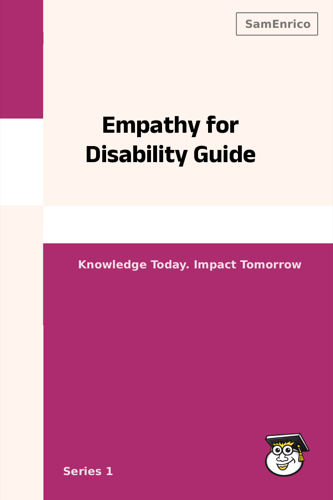
Non-FictionSelf-HelpDisability Support
Empathy for Disability Guide eBook
Validate accessibility frustrations without pity.
by Tan Latrisha
Validate accessibility frustrations without pity.
Formats
Free sample
Chapter 1: The Inspiration Trap--–- It happens quietly, almost invisibly, several times a day. A disabled person exits their home—perhaps to buy groceries, perhaps to attend a medical appointment, perhaps simply to feel sunlight on their face—and a stranger stops them. The stranger’s eyes soften. Their voice drops into a register reserved for funerals and fundraisers. They say: “You are so inspiring.”The disabled person has done nothing extraordinary.
They have not climbed a mountain. They have not survived a war. They have purchased bread. And yet, in the stranger’s gaze, this ordinary act has been transformed into a motivational poster. The disabled person is expected to smile, to say thank you, to perform gratitude for being turned into a symbol.This is the inspiration trap.
And it is not kindness. It is erasure disguised as admiration.The purpose of this chapter is to dismantle the most pervasive and socially acceptable form of disability pity: inspiration porn. Drawing on the work of Stella Young, Emily Ladau, and the essayists of Disability Visibility, we will explore how the “inspiring” narrative functions, why it is dehumanizing, and what accomplices can do instead. By the end of this chapter, you will understand the difference between genuine admiration for a disabled person’s actual achievements and the hollow performance of inspiration that reduces a human being to a motivational prop.This is not an easy chapter to read if you have ever called a disabled person inspiring. Many well-meaning people have.
The goal is not to shame you. The goal is to show you how a seemingly positive comment can cause harm—and to give you better tools for genuine connection.The Birth of Inspiration Porn The term “inspiration porn” was coined by the late Australian comedian and disability activist Stella Young. In her viral 2014 TEDx talk, she defined it as the use of disabled people as objects of inspiration for nondisabled audiences. The “porn” in the term is deliberate and jarring. It signals that these images and stories are not about disabled people at all.
They are about the feelings of nondisabled people. They are consumed, used for emotional gratification, and then discarded.Young’s classic example: a photograph of a young disabled child with limb differences, painstakingly drawing with a pencil held in their mouth, accompanied by a caption like “Your excuse today is…?” The implication is brutal. If this child can draw without hands, why are you complaining about your boring job? Your minor cold? Your slow internet?The disabled person is not a person in this frame.
They are a rhetorical weapon. Their existence is deployed to shame nondisabled people into gratitude or productivity. And they are never asked whether they consent to being used this way.Inspiration porn appears in many forms. It is the viral video of a wheelchair user dancing, framed as “miraculous” rather than joyful. It is the news segment about a blind CEO, presented as proof that disability is no barrier—while ignoring the systemic supports that made their success possible.
It is the coworker who says, “Seeing you get through the day inspires me to stop complaining about traffic,” completely unaware that the disabled person has just spent an hour navigating broken elevators, miscommunication, and physical pain.The common thread is this: the disabled person’s ordinary life is transformed into an extraordinary performance for the benefit of the nondisabled observer. The disabled person is not asked what they think about this. Their actual struggles—with access, with discrimination, with poverty, with healthcare denial—are invisible. Only their utility as a motivational tool matters.The Supercrip and Its Shadow Inspiration porn has a close cousin: the Supercrip trope. The Supercrip is the disabled person who “overcomes” their disability through sheer willpower, determination, and heroic effort.
They are the paralympian who wins gold despite being an amputee. They are the blind mountain climber. They are the Deaf entrepreneur who built a million-dollar company.These individuals are real. Their achievements are real. But the trope becomes a weapon when it is generalized to all disabled people.
The message of the Supercrip narrative is: If you are disabled and not extraordinary, you are not trying hard enough. If the blind man can climb Everest, why can’t you take the stairs? If the wheelchair user can run a marathon, why are you asking for a ramp?The Supercrip narrative also lets nondisabled people off the hook for systemic change. If disability is simply a challenge to be overcome by individual grit, then there is no need for accessible buildings, captioning, flexible work policies, or healthcare reform. The disabled person who cannot overcome—who needs accommodations, who has bad days, who is simply average—is erased.
They are not inspiring enough. They do not make a good story.Disability scholar Rosemarie Garland-Thomson calls this the “normate” gaze: the way nondisabled society looks at disabled bodies and measures them against an invisible standard of “normal.” The Supercrip is celebrated precisely because they have nearly reached that standard despite their “handicap.” The disabled person who does not approximate normal—who uses a feeding tube, who has intellectual disabilities, who does not perform productivity—is ignored or pitied.The inspiration trap, then, is a sorting mechanism. It separates disabled people into two categories: the extraordinary (who deserve a brief moment of admiration) and the invisible (who do not matter). Neither category treats disabled people as full, complex, ordinary human beings.Why “Inspiring” Is Not a Compliment Many nondisabled people genuinely believe that calling a disabled person “inspiring” is a compliment. They are surprised, even hurt, when a disabled person reacts with frustration or exhaustion.
To understand why, we have to understand what the word “inspiring” actually does.First, it creates distance. When you call someone inspiring, you place them on a pedestal. Pedestals are lonely places. They are not for conversation or connection. They are for admiration from afar.
The disabled person becomes a symbol of perseverance rather than a peer who might want to complain about the weather, share a boring story, or simply be treated as unremarkable.Second, it demands gratitude. The disabled person who does not smile and say thank you is labeled “bitter,” “negative,” or “ungrateful.” This is a trap. If they accept the compliment quietly, they are performing the role of the grateful disabled person. If they object, they are proving that they really are difficult. There is no third option that leaves their dignity intact.Third, it replaces action.
The nondisabled person who says “you’re so inspiring” has done something that feels good. They have expressed a positive emotion. They have been kind (or so they believe). They walk away feeling like a good person. But they have not fixed the broken elevator.
They have not called their city councilor about the inaccessible bus stop. They have not donated to disability justice organizations. They have performed empathy without lifting a finger.As writer and activist Imani Barbarin (known as Crutches and Spice) has observed: “Inspiration is what nondisabled people feel when they realize that disability does not mean death. The bar is that low.”The bar is indeed that low. A disabled…
This is the end of the free sample. Get the eBook to keep going. Buy now
About this book
Details
- Author
- Tan Latrisha
- Publisher
- SamEnrico
- Language
- English
- Genre
- Non-Fiction, Self-Help, Disability Support
- Released
- 2026-06-09
- Pages (approx.)
- 155
- Available as
- eBook, Audiobook

Read better in the ZLOADR app
Your eBooks on your phone or tablet. Sign in with your SamEnrico account and start reading.
More by Tan Latrisha
 The Workaholic Evening Unplug GuideTan Latrisha$11.99
 Stress and Vasovagal SyncopeTan Latrisha$11.99
 Napoleon Science LegacyTan Latrisha$11.99
 The Bloodhound and the Bandit: A K9 Hunt Across 19th-Century EuropeTan Latrisha$11.99
 How to Produce Bamboo FurnitureTan Latrisha$11.99
 How to Become a Packaging TechnicianTan Latrisha$11.99
 US Performance Review TemplatesTan Latrisha$12.99
 Blackwood HarvestingTan Latrisha$11.99
You may also like
 Hong Kong Handover 1997Dunn Johnnie$11.99
 Zumba For Postnatal Recovery CourseNeal Christian$11.99
 Zumba for BeginnersLadner Nikia$11.99
 YouTube Comment Mining GuideHumes Pandora$12.99
 Worry Box MeditationCarlin Rudy$11.99
 Workplace Stress MeditationNguyen Lynn$11.99
 Workplace Stress and Sleep RepairHawley Ivory$11.99
 Workplace Perfectionism CureDelaney Jeffry$11.99
 Workplace Injustice Anger GuideWallen Isabelle$11.99
 Work Addiction and Burnout LinkGreenwood Ester$11.99
 Women in Yoga and WellnessBeattie Galina$11.99
 Women in Stand Up ComedyChun Evangeline$11.99