
Non-FictionSelf-Help / Interactive
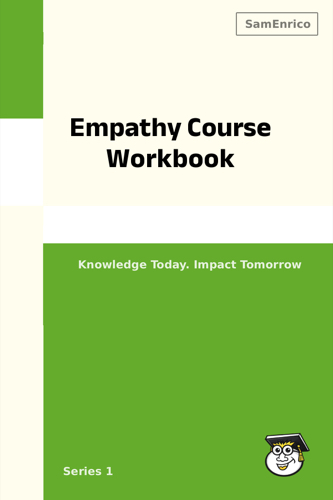
Empathy Course Workbook eBook
Includes exercises and scripts for building compas
Includes exercises and scripts for building compassionate listening skills.
Formats
Free sample
Chapter 1: The Listening Cure--We have been taught to listen the wrong way.From childhood, most of us learned that listening means staying quiet while someone else talks, then responding when they pause. That is not listening. That is waiting for your turn to speak. The difference between these two behaviors is the difference between loneliness and connection, between escalating conflict and genuine resolution, between burning out in the presence of suffering and becoming a person who can truly help.This chapter will dismantle the single most common barrier to deep listening: the belief that empathy is automatic. It will draw a sharp distinction between sympathy and empathy, introduce the three types of empathy that must work together, and expose the "Fix-It Trap" that destroys more conversations than any other habit.
By the end of this chapter, you will understand why "I understand" is often a lie, why presence matters more than problem-solving, and how to begin replacing the urge to fix with the willingness to sit alongside someone in their uncertainty.The Great Misunderstanding: Why We Think We're Good Listeners (But Aren't)Research consistently shows that most people rate themselves as above-average listeners. This is mathematically impossible, of course, but it reveals something important: we have no accurate internal meter for listening quality. Unlike running or cooking, where failure produces immediate feedback (you cannot finish the race, the food tastes bad), listening failure produces delayed or invisible consequences. The person you failed to listen to does not usually say, "You are not hearing me." They say, "Never mind," or they change the subject, or they stop sharing with you altogether. Over months and years, relationships cool, partners feel unseen, children stop confiding, and you are left wondering what went wrong.The problem begins with a fundamental confusion between hearing and listening.
Hearing is physiological; listening is relational. You can hear every word someone says and still fail to listen because listening requires something much harder than auditory processing. Listening requires the temporary suspension of your own agenda. It requires you to stop preparing your response, stop evaluating whether the speaker is right or wrong, stop searching for the moment when you can insert your wisdom. Listening is the act of making someone feel that their internal experience matters, not because you agree with it, but because they are having it.This chapter begins with a controversial claim that will guide everything that follows: empathy is not something you have or do not have.
It is a skill. Skills can be learned, practiced, forgotten if neglected, and improved with deliberate effort. If you have ever been told you are a bad listener, or if you have ever felt exhausted after a conversation without understanding why, or if you have ever watched someone's face close down while you were trying to help—none of these are character flaws. They are skill gaps. And skill gaps can be closed.Sympathy vs.
Empathy: The Distance That Disguises Itself as Kindness The most common mistake people make is confusing sympathy with empathy. They sound similar, and both are socially approved responses to suffering. But they produce opposite effects on the person who is struggling.Sympathy says, "I feel for you." It is a statement from a distance. When you sympathize with someone, you acknowledge their pain from the outside. You might say, "Oh, that's terrible," or "I feel so bad for you," or "You poor thing." These statements are not cruel.
They are often sincere. But they position you as an observer, not a companion. Sympathy keeps you safe and dry on the shore while the other person drowns. You see the waves. You register that the water is cold.
But you do not get wet.Empathy says, "I feel with you." It is a statement of shared experience. When you empathize, you do not stand at a distance and observe suffering. You get in the water. Not to take over, not to drown alongside them, but to let them know they are not alone in the cold. Empathy says, "I do not know exactly what this is like for you, but I am willing to be with you while you go through it."Here is the hard truth that most books avoid: sympathy often creates distance while empathy fosters connection.
Sympathy can feel patronizing because it implies a power differential. The sympathizer is fine. The sufferer is not. The sympathizer observes. The sufferer experiences.
Empathy, by contrast, implies solidarity. The empathizer is not claiming to have the same experience, but they are claiming to be present for it.Consider the difference in real life. A friend tells you their parent just died. A sympathetic response: "I am so sorry for your loss. That must be devastating." An empathic response: "I do not even know what to say, but I am so glad you told me.
I am here." The first response is polite and socially appropriate. The second response is vulnerable and real. The first response keeps you safe. The second response risks discomfort because you are admitting you do not have the right words. That admission, paradoxically, is exactly what the grieving person needs.
They already know you do not have the right words. No words are right. What they need is someone willing to stay anyway.Throughout this workbook, the scripts you learn will lean heavily toward the empathic side. They will often begin with admissions of not knowing, not having answers, not being able to fix. This is not weakness.
This is the foundation of compassionate listening.The Three Types of Empathy: Cognitive, Emotional, and Compassionate To build empathic skill, you must understand that empathy is not one thing. Psychologists and neuroscientists have identified three distinct types of empathy, each involving different neural pathways and each requiring different practices to develop.Cognitive empathy is the ability to understand another person's perspective. It is sometimes called perspective-taking. When you use cognitive empathy, you are not feeling what they feel; you are mapping their mental landscape. You are asking: What does the world look like from where they are standing?
What information do they have that I do not? What past experiences might be shaping their current reaction? Cognitive empathy is the most teachable form of empathy and the least emotionally draining. It is the workhorse of compassionate listening.Emotional empathy is the ability to feel what another person feels. When someone cries and you feel a lump in your throat, that is emotional empathy.
When someone describes being humiliated and your face flushes with vicarious embarrassment, that is emotional empathy. Emotional empathy is automatic and often unconscious. It is what makes us flinch when we see someone stub their toe. It is also, as we will explore in Chapter 10, the most dangerous form of empathy because it leads to empathic distress and burnout if not managed carefully.Compassionate empathy is the ability to be moved to help. It is cognitive empathy (understanding) plus emotional empathy (feeling) translated into action.
Compassionate empathy asks: Given what I understand about this person's experience, and given that I feel something in response to it, what would actually be useful right now? Sometimes the answer is a…
This is the end of the free sample. Get the eBook to keep going. Buy now
About this book
Details
- Author
- Cherry Pandora
- Publisher
- SamEnrico
- Language
- English
- Genre
- Non-Fiction, Self-Help / Interactive
- Released
- 2026-06-10
- Pages (approx.)
- 155
- Available as
- eBook, Audiobook

Read better in the ZLOADR app
Your eBooks on your phone or tablet. Sign in with your SamEnrico account and start reading.
More by Cherry Pandora
 Parent Reading Time HackCherry Pandora$11.99
 Design Thinking Process PrimerCherry Pandora$11.99
 Detox Staff Training ManualCherry Pandora$11.99
 Group Flow State TriggersCherry Pandora$11.99
 Blue Zone Green Leafy GuideCherry Pandora$11.99
 Anger Restructuring For CouplesCherry Pandora$11.99
 Remote Productivity SchedulingCherry Pandora$11.99
 The Mosaic Lovers of Pompeii: A Forgotten Tale of Art and DevotionCherry Pandora$11.99
 The Ballad of the Heike: Ghostly Lament of the Fallen SamuraiCherry Pandora$11.99
 How to Produce HygrometersCherry Pandora$11.99
 A Collector's Handbook to the Healey 2.4-litre SportsmobileCherry Pandora$11.99
 Study Abroad Scholarship GuideCherry Pandora$12.99
You may also like
 Hong Kong Handover 1997Dunn Johnnie$11.99
 Zumba For Postnatal Recovery CourseNeal Christian$11.99
 Zumba for BeginnersLadner Nikia$11.99
 YouTube Comment Mining GuideHumes Pandora$12.99
 Worry Box MeditationCarlin Rudy$11.99
 Workplace Stress MeditationNguyen Lynn$11.99
 Workplace Stress and Sleep RepairHawley Ivory$11.99
 Workplace Perfectionism CureDelaney Jeffry$11.99
 Workplace Injustice Anger GuideWallen Isabelle$11.99
 Work Addiction and Burnout LinkGreenwood Ester$11.99
 Women in Yoga and WellnessBeattie Galina$11.99
 Women in Stand Up ComedyChun Evangeline$11.99