
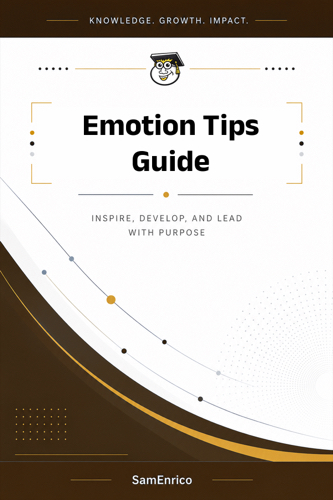
Free sample
Chapter 1: The 6-Second Window--You are not broken. Your brain is just old.Consider this: The device in your pocket is, at most, fifteen years removed from the factory. Your laptop might be three. The car you drive was designed within the last decade. But the emotional operating system running inside your skull—the one that makes you snap at your partner when you are exhausted, or freeze during a presentation, or lie awake replaying an awkward conversation from 2014—that system was last updated approximately fifty million years ago.Fifty million years.
Before hominids. Before primates. Before most mammals as you recognize them today.Your brain is an archaeological dig. The deepest layers—the brainstem and limbic system—are ancient, reptilian, and lightning-fast. The newest layers—the prefrontal cortex, responsible for planning, self-control, and rational thought—are a recent renovation.
And like any old house with a new addition, the wiring is imperfect. The ancient systems do not always communicate well with the modern ones. Sometimes, the old systems simply take over.This chapter is about understanding that takeover. More importantly, it is about discovering the small window of time—just six seconds—during which you can prevent the takeover entirely.The Lie You Have Been Told About Rationality Let us start with a cultural myth that has caused incalculable harm: the idea that rational people should feel nothing.You have encountered this myth in a hundred forms. "Don't be so emotional." "Leave your feelings at the door." "You need to be more logical about this." The implication is always the same: emotions are contaminants.
They are noise. They are the enemy of good decision-making.This is wrong. Not slightly wrong. Completely, catastrophically wrong.Emotions are not irrational interruptions to your otherwise perfect reasoning. They are rapid-fire biological data systems that have evolved over millions of years to keep you alive, connect you to others, and guide you toward better decisions faster than your conscious mind ever could.Consider a classic neurological case study.
A man known in the literature as "EVR" had a small tumor removed from his prefrontal cortex. After the surgery, his IQ remained exceptionally high. His memory was intact. He could solve complex logical problems better than most people. But he could no longer make a simple decision.What color pen to use?
He would spend thirty minutes analyzing the ink viscosity, the paper texture, the likelihood of smudging. What restaurant to visit? He would produce a spreadsheet comparing twelve establishments on seventeen criteria. His reasoning was flawless. His decisions were impossible.What EVR had lost was not intelligence.
He had lost the emotional signals that normally guide decision-making. Without those signals, every choice became an infinite regression of pros and cons. He could not feel his way to a conclusion.The neuroscientist Antonio Damasio studied EVR and others like him. His conclusion, now widely accepted: emotions are not the opposite of reason. Emotions are the substrate of reason.
You cannot make good decisions without them.So when someone tells you to be less emotional, they are not asking you to be more rational. They are asking you to ignore data. And ignoring data is never rational.The Evolutionary File on Your Feelings Why do you have emotions? Not as a philosophical question, but as a biological one. What survival problem does each emotion solve?Let us take a tour.Fear.
Fear solves the problem of imminent threat. When your ancestors heard rustling in the tall grass, the ones who felt fear and froze or fled lived to reproduce. The ones who said "I'm sure it's nothing" became dinner. Fear is not weakness. Fear is your brain's threat-detection system, and it is extraordinarily fast—faster than conscious thought, as we will explore in Chapter 2.Anger.
Anger solves the problem of blocked goals and violated boundaries. When something stands between you and what you need—food, safety, respect—anger mobilizes energy, increases heart rate, and prepares the body for action. Anger is not violence. Anger is the engine of boundary enforcement. Without it, you would be walked over constantly.Sadness.
Sadness solves the problem of loss. When you lose something important—a relationship, a job, a loved one—sadness slows you down, turns your attention inward, and signals to your community that you need support. Sadness is not depression. Sadness is the healing pause after loss. It tells others: "Come close.
I am hurting."Disgust. Disgust solves the problem of contamination. That curdled milk smell, that rotting fruit, that person who violates social norms—disgust creates a visceral rejection response that keeps you away from poisons, pathogens, and predators. Disgust is not being judgmental. Disgust is your immune system expressing itself through behavior.Joy.
Joy solves the problem of reward reinforcement. When you eat, connect, succeed, or create, joy signals "do that again." It builds social bonds, encourages exploration, and marks the behaviors that lead to survival and reproduction. Joy is not frivolous. Joy is your brain's way of saying "this is good; remember this."Every emotion has a job. Every feeling carries data.
The question is never "Should I feel this?" The question is always "What is this feeling telling me?"The Architecture of an Emotion Before you can manage an emotion, you need to understand its structure. An emotion is not a single event. It is a cascade of four interconnected processes, happening in less than a second.Process One: Trigger. Something happens. A car cuts you off.
Your child cries. Your boss sends a cryptic email. Your partner sighs in a particular way. The trigger can be external (something you see, hear, or touch) or internal (a memory, a thought, a physical sensation).Process Two: Appraisal. Your brain, in milliseconds, evaluates the trigger against your goals, values, and past experiences.
Is this good for me? Bad for me? Threatening? Promising? Relevant?
Irrelevant? This appraisal happens below conscious awareness. You do not decide to appraise. It just happens.Process Three: Physiological Response. Your body prepares for action.
Heart rate changes. Breathing shifts. Hormones release. Blood flows toward large muscle groups (for fighting or fleeing) or toward the gut (for resting and digesting). You feel these changes as sensations: chest tightness, stomach churning, heat in the face, tension in the jaw.Process Four: Behavioral Urge.
You feel an impulse to do something. Run. Fight. Cry. Hide.
Laugh. Approach. Avoid. This urge is not an action—not yet. It is a suggestion from your ancient brain about what worked for your ancestors.Here is the crucial insight: most people mistake the behavioral urge for the emotion itself.
They feel the urge to yell and think "I am so angry." But the urge is not the emotion. The emotion is the entire cascade. And the urge is where you have leverage.Because between the urge and the action, there is a gap.The 6-Second Window This is the most important concept in this book.When your amygdala—the brain's threat-detection center, located deep in the temporal lobe—perceives a potential threat, it triggers a cascade of neurochemicals. Adrenaline surges. Cortisol releases.
Your heart accelerates. Your breathing quickens. Your attention narrows to the perceived threat.This chemical surge lasts approximately six seconds.That is…
This is the end of the free sample. Get the eBook to keep going. Buy now
About this book
Details
- Author
- Espinal Lavelle
- Publisher
- SamEnrico
- Language
- English
- Genre
- Non-Fiction, Self-Help
- Released
- 2026-06-06
- Pages (approx.)
- 136
- Available as
- eBook, Audiobook

Read better in the ZLOADR app
Your eBooks on your phone or tablet. Sign in with your SamEnrico account and start reading.
More by Espinal Lavelle
 Delhi Field Force OperationsEspinal Lavelle$11.99
 Migraine and Nitrate SensitivityEspinal Lavelle$11.99
 Caregiver Partner Stress GuideEspinal Lavelle$11.99
 Pan African Movement RootsEspinal Lavelle$11.99
 Handling Unsolicited AdviceEspinal Lavelle$11.99
 Anger And Stealing ChildrenEspinal Lavelle$11.99
 Peter Thiel PayPalEspinal Lavelle$11.99
 Closet Cleanse Body ConfidenceEspinal Lavelle$11.99
 The Boy Who Planted a Million TreesEspinal Lavelle$11.99
 The Plague Walls of Venice: Engineering a City's SalvationEspinal Lavelle$11.99
 The Alchemists of Constantinople: Secrets of Byzantine ScienceEspinal Lavelle$11.99
 How to Start a Cream Separator for Industrial Use Business (Beginners Guide)Espinal Lavelle$11.99
You may also like
 Workplace Stress MeditationNguyen Lynn$11.99
 Volcano Monitoring ScientistCox Alexis$11.99
 The Tech Professional NetAguiar Nevada$11.99
 The Morning Metta RitualCanales Anya$11.99
 The Chunking Memory TechniqueClanton Hyacinth$11.99
 The Beginner Mistake FixAmmons Cassondra$11.99
 Surrendering to What IsGrimm Reatha$11.99
 Self Hypnosis for Fear of FireBillups Eli$11.99
 Road Rage for Professional DriversBrackett Janise$11.99
 Psychiatric Ward Nurse StressDunning Wyatt$11.99
 Observation vs Evaluation NVCTimmons Alda$11.99
 Networking for Nonprofit ProfessionalsPoole Jesse$11.99