
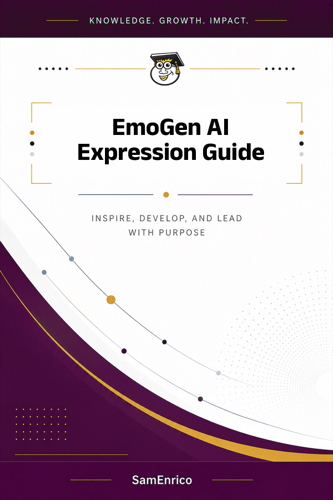
Non-FictionAI OperatorExpression Editing
EmoGen AI Expression Guide eBook
Change facial expressions in existing video, turni
by Jewett Aldo
Change facial expressions in existing video, turning neutral shots into happy, sad, or surprised.
Formats
Free sample
Chapter 1: The Impossible Smile...--–- In the summer of 2022, a major Hollywood studio spent nearly two million dollars reshooting a single scene. The reason? An actor had delivered a brilliant, heart-wrenching performance of a man receiving devastating news—but the director, during editing, decided the character should have reacted with quiet sorrow rather than explosive anger. The performance was perfect for anger. It was wrong for sorrow.
Rather than attempt to digitally alter the actor’s face—a task that VFX supervisors considered impossible at the time—the studio paid to reassemble the crew, re-light the set, and bring the actor back for a single day of pickup shots. Two million dollars. One expression change.That scene, had it been shot just eighteen months later, could have been fixed for less than two thousand dollars in cloud compute time. The actor’s original performance—the timing, the tears, the subtle tremor in the jaw—could have been preserved while the expression shifted from anger to sorrow with no visible seam. This book is about how that became possible, why it matters, and how you can do it yourself.Welcome to the era of AI-driven expression manipulation.
Welcome to Emo Gen.The Paradox of the Human Face Why is changing a frown to a smile in a video—something a toddler can do with a crayon on a photograph—considered one of the hardest unsolved problems in computer graphics? The answer lies in the evolutionary biology of the human visual system. You are not merely looking at faces. You are processing them with dedicated neural circuitry that has been honed by natural selection for three hundred million years.The fusiform face area, a small region in your temporal lobe, activates specifically when you perceive a face. It is so specialized that it can distinguish between familiar and unfamiliar faces in less than three hundred milliseconds.
It can detect asymmetry in a smile of less than one millimeter from fifty feet away. It can read micro-expressions that last one twenty-fifth of a second—so fast that you are not consciously aware of them, yet they shape your gut feeling about whether someone is lying.This hyper-sensitivity means that any error in facial manipulation—any slight misalignment of skin texture, any unnatural movement of the mouth, any flicker of pixels around the jawline—triggers an immediate “uncanny valley” response. The term, coined by robotics professor Masahiro Mori in 1970, describes the phenomenon where a robot or digital face that is almost-but-not-quite-human feels more disturbing than one that is clearly artificial. The Polar Express (2004) remains the most infamous example. The film’s CGI characters had accurate human geometry, realistic skin shaders, and motion-captured performances.
Yet audiences found them “creepy,” “soulless,” and “nightmarish.” The problem was not the technology’s ambition—it was the technology’s imperfection. The faces were close enough to human to trigger face-specific processing, but wrong enough that the processing generated an error signal: something is not right here.The VFX industry spent the next decade learning to build better puppets. Artists sculpted hundreds of blendshapes—pre-defined expression targets that could be blended together. They built facial motion capture systems that tracked tiny reflective dots on actors’ faces. They developed muscle-based simulation systems that modeled the underlying anatomy of skin, fat, and bone.
These techniques worked, but they were astronomically expensive and required armies of artists. A single shot of Thanos in Avengers: Endgame required dozens of animators working for weeks. A ten-second dialogue scene could cost half a million dollars.Then came the AI revolution. And with it, a new set of problems.The Triple Constraint: What Every Expression Change Must Satisfy Before we dive into how AI works, we need to understand what success looks like. Over the past five years, working with VFX supervisors, AI researchers, and post-production houses, I have distilled the requirements of expression manipulation into a framework I call the Triple Constraint.
Every successful expression change must satisfy all three constraints simultaneously. Violate one, and the effect fails.Constraint One: Lip Sync Preservation The words being spoken must remain visually accurate. This is the constraint that most beginners violate first. They change a neutral expression to a happy smile, but in doing so, they move the corners of the mouth upward. That movement changes the shape of the lips.
And changing the shape of the lips changes how the mouth looks when it forms phonemes.Consider the difference between the phonemes “P” and “B.” Both are bilabial plosives—sounds made by pressing the lips together and releasing. But “P” is unvoiced (vocal cords do not vibrate), while “B” is voiced (vocal cords vibrate). The visual difference is subtle but real: the lips tense differently, the release is slightly faster for “P,” and the jaw position changes. If you alter the lip geometry incorrectly, the AI might generate a face that appears to say “Blease” instead of “Please.” In a close-up shot, the audience will notice. They will not know why something feels wrong, but they will feel it.Lip sync preservation is not about perfect accuracy.
It is about relative accuracy. The mouth can stretch and compress within certain limits without breaking the illusion. But those limits are narrow. A smile that raises the lip corners by more than eight pixels (in a standard 512×512 face crop) will start to distort the lip shapes of plosives and fricatives. A surprise expression that drops the jaw too far will stretch the lower lip, turning “M” sounds (which require lip closure) into “W” sounds (which do not).
The exact thresholds depend on the actor’s anatomy and the camera angle, but the constraint is universal: change the expression without breaking the words.Constraint Two: Identity Coherence The person must remain recognizable. This constraint is more subtle than it seems. Changing an expression is not like changing a piece of clothing. The face is a dynamic, interconnected system. When you smile, your cheeks rise, your eyes squint, your nose widens slightly, and the skin around your mouth bunches into fine lines.
These changes are not arbitrary—they are the signature of your unique anatomy.An actor’s smile is as distinctive as their fingerprint. Tom Cruise’s smile is asymmetrical, with the right side of his mouth rising slightly higher than the left. Scarlett Johansson’s smile is wide, showing both upper and lower teeth. Dwayne Johnson’s smile is tight-lipped, with deep dimples forming at the corners of his mouth. A generic AI model trained on ten thousand faces knows what a “smile” looks like on average.
But when you apply that average smile to Tom Cruise, you lose the asymmetry. You lose the specific way his cheeks bunch. You lose him.Identity coherence is not just about facial geometry. It is about skin texture, lighting interaction, and the way wrinkles form and disappear with expression. A surprised expression raises the eyebrows.
But the specific pattern of horizontal forehead wrinkles that appears on a sixty-year-old actor is different from that on a thirty-year-old actor. The AI must generate wrinkles that match the actor’s age and skin type, or the face will look like a mask.Constraint Three: Temporal Stability…
This is the end of the free sample. Get the eBook to keep going. Buy now
About this book
Details
- Author
- Jewett Aldo
- Publisher
- SamEnrico
- Language
- English
- Genre
- Non-Fiction, AI Operator, Expression Editing
- Released
- 2026-06-12
- Pages (approx.)
- 136
- Available as
- eBook, Audiobook

Read better in the ZLOADR app
Your eBooks on your phone or tablet. Sign in with your SamEnrico account and start reading.
More by Jewett Aldo
 Fear of Darkness GuideJewett Aldo$11.99
 TikTok Challenge Pressure GuideJewett Aldo$11.99
 Opioid Recovery Nutrition CookbookJewett Aldo$11.99
 Understanding Dual Diagnosis DepressionJewett Aldo$11.99
 The Royal Road of Gold: Darius I’s Grand Canal and the Birth of Global TradeJewett Aldo$11.99
 How to Become a Dining Room AttendantJewett Aldo$11.99
 BarbackJewett Aldo$11.99
 Secret Shop Report WorkbookJewett Aldo$12.99
 Home Improvement Spending GuideJewett Aldo$12.99
 Understanding Infantile Onset Spinocerebellar AtaxiaJewett Aldo$17.99
You may also like
 Hong Kong Handover 1997Dunn Johnnie$11.99
 Zumba For Postnatal Recovery CourseNeal Christian$11.99
 Zumba for BeginnersLadner Nikia$11.99
 YouTube Comment Mining GuideHumes Pandora$12.99
 Worry Box MeditationCarlin Rudy$11.99
 Workplace Stress MeditationNguyen Lynn$11.99
 Workplace Stress and Sleep RepairHawley Ivory$11.99
 Workplace Perfectionism CureDelaney Jeffry$11.99
 Workplace Injustice Anger GuideWallen Isabelle$11.99
 Work Addiction and Burnout LinkGreenwood Ester$11.99
 Women in Yoga and WellnessBeattie Galina$11.99
 Women in Stand Up ComedyChun Evangeline$11.99