
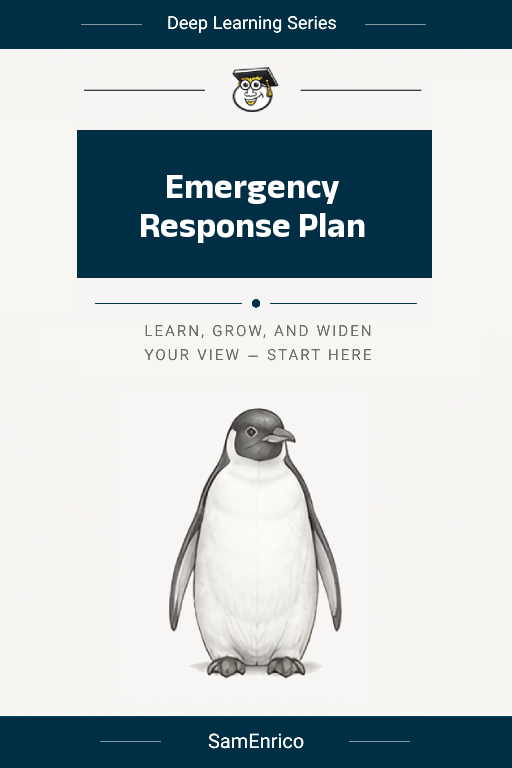
Non-FictionFirst 30 DaysCrisis Planning
Emergency Response Plan eBook
Document steps for data breach, PR crisis, or foun
Document steps for data breach, PR crisis, or founder emergency on a single contingency page.
Formats
Free sample
Chapter 1: The Denial Reflex--–- The CEO stared at the login alert on his phone. Three failed attempts from an IP address in a country where he had no employees, no customers, and no business. It was 2:14 AM on a Sunday. He swiped the notification away and went back to sleep. Forty-eight hours later, his company’s entire customer database was being auctioned on the dark web.The founder of a fast-growing Saa S startup watched a single negative tweet spiral into three hundred quote-tweets, a trending hashtag, and a front-page Business Insider article in less time than it took to brew a pot of coffee.
He had told his head of communications to “wait and see if it blows over.” It did not blow over. It blew up.The co-founder of a healthtech company collapsed mid-presentation at a board meeting. No one knew where the emergency contacts were stored, who had signing authority for medical decisions, or even the password to the company’s bank account. Three hours of chaos followed while investors panicked and employees refreshed their Linked In profiles.These three founders had one thing in common. Not a lack of intelligence.
Not a shortage of resources. Not even a failure of technical capability. They suffered from something far more primal and far more dangerous: the denial reflex.This book exists because denial is the single greatest predictor of crisis failure. Not the crisis itself. Not the severity of the breach.
Not the power of the press. Denial. And denial is not a personality flaw—it is a predictable, well-documented cognitive phenomenon that affects even the smartest, most successful leaders. The good news is that denial can be recognized, interrupted, and replaced with a different reflex: preparation.This chapter is not a theoretical exercise. It is an autopsy of the mindsets that kill companies, a field guide to the internal pitfalls that experts like Laurence Barton have catalogued as the “dirty dozen” of crisis blindness, and a practical self-audit that will reveal exactly where your leadership team is most vulnerable.
By the end of this chapter, you will understand why “it won’t happen to us” is not optimism but a liability, why your brain is wired to ignore warning signs, and how accepting inevitability—not fearing it—becomes your greatest competitive advantage.The Anatomy of the Denial Reflex Denial is not a conscious choice. No founder wakes up and decides, “Today I will ignore clear evidence of impending disaster.” Denial is a reflex, an automatic psychological defense mechanism that preserves our sense of safety and control. It is the cognitive equivalent of pulling the covers over your head when the alarm goes off—except the alarm is a data breach, a PR wildfire, or a medical emergency, and pulling the covers costs millions.The denial reflex has three distinct layers, each more dangerous than the last.Layer One: Perceptual Denial The first layer is the simplest: you do not see the threat at all. Your brain literally filters out information that conflicts with your existing beliefs about safety and competence. This is not metaphor.
Neuroscience research using functional MRI scans has shown that when people are presented with threatening information that contradicts their worldview, the visual cortex actually suppresses the processing of that information. You look at a login alert from a suspicious IP address, but your brain does not register it as a threat because your mental model says “we have good security.”The CEO who swiped away the 2:14 AM alert was not stupid. He was a former cybersecurity consultant with fifteen years of experience. His brain had classified that alert as a false positive before he even read it because his prior experience told him that most late-night alerts are nothing. Except this one was not nothing.
Perceptual denial had turned a warning signal into background noise.Layer Two: Interpretive Denial The second layer activates when you cannot avoid seeing the threat. You acknowledge the information, but you reinterpret it to neutralize its danger. “Yes, we had a weird login attempt, but it was probably a customer who forgot their password.” “Yes, that tweet is negative, but it’s just one person with a grudge.” “Yes, the founder looks pale, but she’s probably just tired from the travel.”Interpretive denial is the engine of normalcy bias—the assumption that because things have always been fine, they will continue to be fine. This bias is so powerful that it persists even in the face of mounting evidence to the contrary. Psychologists have documented normalcy bias in survivors of natural disasters, terrorist attacks, and industrial accidents.
People stand on a beach watching a tsunami approach and think, “It will stop before it reaches me.” Employees sit in an office as smoke fills the hallway and think, “It’s probably just a drill.”Founders are not immune. In fact, they may be more susceptible because their entire identity is built on the belief that they can handle whatever comes. The interpretive denial of a founder is not “this won’t happen” but “this won’t happen to me because I am different, smarter, faster.”Layer Three: Committal Denial The third layer is the most destructive. At this stage, you have seen the threat, you understand it is real, but you actively choose inaction because action would require admitting that your previous inaction was a mistake. Committal denial is the domain of sunk costs and public commitments.
You have already told your board that security is fine. You have already assured investors that the brand is resilient. You have already built a company culture that depends on the founder’s presence.To change course now would be to admit that you were wrong before. And for many leaders, admitting error feels more dangerous than the crisis itself.The founder who watched the negative tweet spiral into a trending hashtag did not lack the ability to respond. He lacked the willingness to admit that his “wait and see” instruction had been a mistake.
By the time he overcame committal denial, the window for a simple holding statement had closed. He needed a full crisis response, a fired communications director, and a year of reputation repair.The Dirty Dozen: Internal Pitfalls That Feed Denial Laurence Barton, a leading scholar of crisis management, spent decades studying why organizations fail to respond effectively to emergencies. His research identified twelve internal pitfalls that consistently appear in post-crisis autopsies. Think of these as the dirty dozen—the specific habits, structures, and beliefs that turn denial from a personal reflex into an organizational pathology.Pitfall One: The Illusion of Invulnerability This is the foundational sin. The organization believes it is too smart, too well-run, or too lucky to suffer a serious crisis.
This belief is reinforced by past success. Every day that passes without a crisis becomes “evidence” that a crisis will never come. The illusion of invulnerability is why companies with excellent safety records are sometimes the most dangerous places to work—they have stopped looking for threats because they have convinced themselves threats do not apply to them.Pitfall Two: Ignoring the “What Ifs”Leaders who suffer from this pitfall refuse to engage in scenario…
This is the end of the free sample. Get the eBook to keep going. Buy now
About this book
Details
- Author
- Dove Claretta
- Publisher
- SamEnrico
- Language
- English
- Genre
- Non-Fiction, First 30 Days, Crisis Planning
- Released
- 2026-06-01
- Pages (approx.)
- 160
- Available as
- eBook, Audiobook

Read better in the ZLOADR app
Your eBooks on your phone or tablet. Sign in with your SamEnrico account and start reading.
More by Dove Claretta
 Whole Body Breathing MeditationDove Claretta$11.99
 Jeff Buckley Grace LegacyDove Claretta$11.99
 Costco Bulk Comparison GuideDove Claretta$11.99
 Time Blocking for TeachersDove Claretta$11.99
 Deep Work Recovery RitualDove Claretta$11.99
 Email Receipt AcknowledgmentDove Claretta$11.99
 Focusmate Body DoublingDove Claretta$11.99
 The Snow Lion of the Pamirs: The Legend of Shamsuddin the First FreeriderDove Claretta$11.99
 The Silk & Gold Dynasty: How a Black Entrepreneur Built a Global Fashion EmpireDove Claretta$11.99
 How to Start a Fine Cut Tobacco Business (Beginners Guide)Dove Claretta$11.99
 How to Produce Doll and Action Figure AccessoriesDove Claretta$11.99
 Exploring Mesopotamian Art: Ziggurats, Reliefs & Cylinder SealsDove Claretta$11.99
You may also like
 Hong Kong Handover 1997Dunn Johnnie$11.99
 Zumba For Postnatal Recovery CourseNeal Christian$11.99
 Zumba for BeginnersLadner Nikia$11.99
 YouTube Comment Mining GuideHumes Pandora$12.99
 Worry Box MeditationCarlin Rudy$11.99
 Workplace Stress MeditationNguyen Lynn$11.99
 Workplace Stress and Sleep RepairHawley Ivory$11.99
 Workplace Perfectionism CureDelaney Jeffry$11.99
 Workplace Injustice Anger GuideWallen Isabelle$11.99
 Work Addiction and Burnout LinkGreenwood Ester$11.99
 Women in Yoga and WellnessBeattie Galina$11.99
 Women in Stand Up ComedyChun Evangeline$11.99