
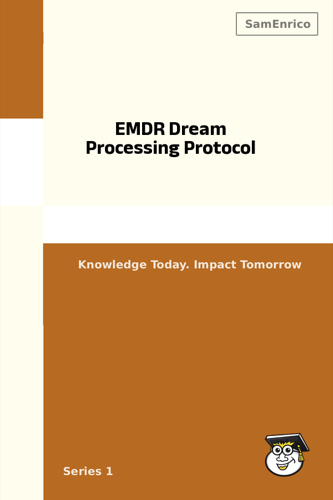
EMDR Dream Processing Protocol eBook
Use bilateral stimulation during dream recall to r
by Fulmer Nova
Use bilateral stimulation during dream recall to reprocess trauma.
Formats
Free sample
Chapter 1: The 3 AM Terror...–- The bedroom is dark. The clock reads 3:14 AM. You are drenched in sweat, your heart hammering against your ribs like a trapped animal. The dream is already dissolving—the faces fading, the details slipping away—but the feeling remains. Terror.
Shame. Helplessness. The same one you have felt every night this week, every week this month, perhaps for years. You lie still, afraid to close your eyes, afraid of what will be waiting for you when you drift back toward sleep. The ceiling stares back at you, indifferent.
Your partner sleeps soundly beside you. You are completely, utterly alone with a nightmare that has no end.If this sounds familiar, you are not broken. You are not weak. You are not "going crazy." You are, in fact, experiencing one of the most common and most misunderstood symptoms of unprocessed trauma: the repetitive nightmare. And this book is built on a radical, hope-filled premise: your nightmares are not the problem.
They are the solution.The Unspoken Epidemic Before we dive into the neuroscience, the protocols, and the step-by-step techniques that will fill the pages ahead, we must first acknowledge the sheer scale of what we are talking about. Nightmares are not a niche complaint. According to the American Academy of Sleep Medicine, approximately 50 to 70 percent of individuals diagnosed with post-traumatic stress disorder (PTSD) experience frequent, distressing nightmares. Among combat veterans, that number climbs as high as 72 percent. Among survivors of childhood abuse, it hovers around 80 percent.
But these statistics, staggering as they are, miss the deeper truth. Nightmares are not merely a symptom of trauma, like a fever is a symptom of infection. Nightmares are the location where trauma lives most vividly. They are the nightly re-enactment of a script the brain has not yet learned to close.Consider Sarah. (All names and identifying details in this book have been changed to protect client confidentiality, though the clinical facts remain intact.) Sarah was a 34-year-old graphic designer who had been in therapy for two years for "generalized anxiety." She took medication.
She practiced mindfulness. She did everything her previous therapist asked. And yet, every single night, she dreamed the same dream: she was walking through her childhood home, except the hallways stretched impossibly long, and at the end of every corridor stood her father, his face a featureless blur, his hand raised. She always woke up before the hand came down. Always at 3:17 AM.
Always with her jaw clenched so tight she had to consciously unhinge it.Sarah did not have a PTSD diagnosis. She had never been to war, never been assaulted as an adult, never been in a car accident. She had, however, grown up in a home where her father's alcoholism made his behavior unpredictable. He never hit her—not once. But he screamed.
He threw things against walls. He would be loving at dinner and terrifying by bedtime. Sarah's brain had learned, early and thoroughly, that safety could vanish without warning.Standard EMDR had been tried. Her previous therapist targeted the memory of her father's worst screaming episode. They processed it for six sessions.
Sarah could now talk about that memory without crying. But the nightmares remained. Why? Because the nightmare was not a replay of that single screaming episode. The nightmare was a composite—a condensation of hundreds of small moments of unpredictable terror, compressed into one recurring image.
The hand. The hallway. The blur.This book exists because standard approaches often fail people like Sarah. Not because EMDR itself fails—it is one of the most empirically validated treatments for trauma in existence—but because standard EMDR targets waking memories of discrete events. Nightmares do not play by those rules.
They are not linear. They are not historical. They are not even, as we will see, always literally "true" in the sense of recording an actual event. But they are always, always emotionally true. And that emotional truth is what we will learn to access.What Is a Traumatic Nightmare, Really?Let us pause here and define our terms with precision, because confusion at this level has derailed countless treatment efforts.
A nightmare is not simply a "bad dream." A bad dream might involve showing up to work naked or failing an exam you did not study for. You wake up embarrassed or annoyed, maybe amused. A nightmare is different. A nightmare wakes you up. Your heart races.
You sweat. You may scream or thrash. The feeling lingers for hours, sometimes days. And crucially, for the purposes of this book, a traumatic nightmare is one that replays—in whole or in part—the emotional and sensorimotor content of a traumatic experience, whether that experience was a single event (a car accident, an assault, a natural disaster) or a prolonged pattern (childhood neglect, domestic violence, military combat).But here is where many books and even many clinicians get it wrong. They assume that traumatic nightmares are symbolic—that the monster represents your anger, or the falling represents your loss of control, or the chase represents your avoidance.
This is the Freudian inheritance, and it has done enormous damage. When you tell a trauma survivor, "That monster in your dream is actually your repressed rage," you are doing two harmful things simultaneously. First, you are asking them to leave the felt reality of the dream (the terror, the helplessness, the physical sensation of being pursued) and enter an intellectual exercise. Second, you are implying that the nightmare is a puzzle to be solved rather than a memory to be processed.The position of this book—grounded in the Adaptive Information Processing (AIP) model of EMDR therapy, which we will explore in depth later—is radically different. Traumatic nightmares are not symbolic.
They are literal. They are direct, unfiltered replays of dysfunctional memory storage, stripped of the context and temporal markers that would normally tell the brain "this is over, this is past, this is not happening now."Let me give you an example to make this concrete. Imagine you witness a car accident. The sound of screeching tires, the smell of burnt rubber, the flash of headlights. Your brain, under ordinary circumstances, would encode that memory with a timestamp ("Tuesday, 3 PM"), a context ("intersection near the grocery store"), and a resolution ("everyone was okay").
But if that event was traumatic—if you were in the car, or if someone died—the encoding process breaks down. The memory is stored in the limbic system (the emotional brain) without being properly filed in the hippocampus (the narrative, contextual brain). As a result, the memory does not feel like a memory. It feels like it is happening right now whenever it is triggered.A nightmare is simply that same dysfunctional storage manifesting during REM sleep. Your brain, unconstrained by the waking executive functions that might suppress the material, replays the unprocessed fragments.
The screeching tires become a recurring sound. The flash of headlights becomes a recurring image. But because the nightmare is happening during sleep, the brain also adds dream-logic elements: endless hallways, impossible geometries, monsters that should not exist. The nightmare, in other words, is not the trauma plus symbolism. The nightmare is the…
This is the end of the free sample. Get the eBook to keep going. Buy now
About this book
Details
- Author
- Fulmer Nova
- Publisher
- SamEnrico
- Language
- English
- Genre
- Non-Fiction, Self-Help, EMDR
- Released
- 2026-06-06
- Pages (approx.)
- 152
- Available as
- eBook, Audiobook

Read better in the ZLOADR app
Your eBooks on your phone or tablet. Sign in with your SamEnrico account and start reading.
More by Fulmer Nova
 GAD Visualization For CalmFulmer Nova$11.99
 Iranian Revolution Oil PricesFulmer Nova$11.99
 Self Hypnosis For Testosterone BoostFulmer Nova$11.99
 Trauma Nightmare Recurrence GuideFulmer Nova$11.99
 When the World Was Carved from Ice and Fire: The Inuit Cosmic EggFulmer Nova$11.99
 The Srinivasa Ramanujan Code: The Self-Taught Genius Who Unlocked the Secrets of PrimesFulmer Nova$11.99
 German University Admissions WorkbookFulmer Nova$12.99
 Small Language Models Outlook 2026Fulmer Nova$12.99
 Understanding Hamano–tsukamoto SyndromeFulmer Nova$17.99
 Zanazziite MiningFulmer Nova$11.99
 How to Become a Claim ExaminerFulmer Nova$11.99
You may also like
 Hong Kong Handover 1997Dunn Johnnie$11.99
 Zumba For Postnatal Recovery CourseNeal Christian$11.99
 Zumba for BeginnersLadner Nikia$11.99
 YouTube Comment Mining GuideHumes Pandora$12.99
 Worry Box MeditationCarlin Rudy$11.99
 Workplace Stress MeditationNguyen Lynn$11.99
 Workplace Stress and Sleep RepairHawley Ivory$11.99
 Workplace Perfectionism CureDelaney Jeffry$11.99
 Workplace Injustice Anger GuideWallen Isabelle$11.99
 Work Addiction and Burnout LinkGreenwood Ester$11.99
 Women in Yoga and WellnessBeattie Galina$11.99
 Women in Stand Up ComedyChun Evangeline$11.99