
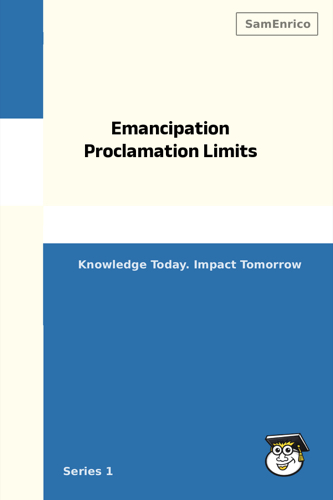
Emancipation Proclamation Limits eBook
Analyzes Lincoln's 1863 order that freed only Conf
by Forte Elmira
Analyzes Lincoln's 1863 order that freed only Confederate held slaves.
Formats
Free sample
Chapter 1: The Prisoner’s Oath...-- On March 4, 1861, Abraham Lincoln stood on the east portico of the United States Capitol, his right hand resting on a Bible, his left hand raised toward a gray sky heavy with the threat of storm. Before him stretched a nation already fractured. Seven Southern states had seceded. Federal forts were falling. The lame-duck President James Buchanan had done nothing, leaving Lincoln a inheritance of chaos.
As Chief Justice Roger Taney—the same jurist who had authored the Dred Scott decision declaring that no Black person could be a citizen—administered the oath, Lincoln placed his hand on the Bible and swore to "preserve, protect, and defend the Constitution of the United States."That Constitution, as interpreted in 1861, protected slavery in the states where it already existed. It required the return of fugitive slaves to their owners. It counted enslaved people as three-fifths of a person for purposes of congressional representation, giving slaveholding states disproportionate power. And it had been designed, in part, to preserve the Union by accommodating the institution of human bondage. The man who had long declared slavery "a moral, a social, and a political wrong" was now bound by oath to protect it.This is the first and most fundamental limit on the Emancipation Proclamation.
Before Lincoln could free anyone, he had to reckon with the document he had sworn to defend. The Constitution in peacetime was a pro-slavery constitution, and Lincoln was its faithful officer.The Founders' Original Sin To understand Lincoln’s predicament, one must travel back seventy-four years to the Constitutional Convention of 1787. The delegates gathered in Philadelphia not to end slavery but to create a stronger central government. And slavery was everywhere in the room. James Madison of Virginia, principal architect of the Constitution, owned more than one hundred enslaved people.
George Washington presided over the convention while his own enslaved workers labored at Mount Vernon. Alexander Hamilton of New York, though personally opposed to slavery, negotiated clauses that protected it.The compromises were threefold, and each would shape Lincoln’s world.First, the Three-Fifths Compromise counted enslaved people as three-fifths of a person for purposes of congressional apportionment and taxation. This gave slaveholding states vastly disproportionate representation in Congress and the Electoral College. Without it, Thomas Jefferson would not have won the presidency in 1800. Without it, the slave power would have been checked decades before the Civil War.Second, the Fugitive Slave Clause (Article IV, Section 2) required that enslaved people who escaped to free states be "delivered up" to their owners.
This clause made the entire nation complicit in slavery. A Black person in Massachusetts could be seized and returned to Georgia with the full authority of federal law.Third, the Slave Trade Clause (Article I, Section 9) prohibited Congress from banning the international slave trade until 1808. For twenty years, the new nation would continue importing enslaved Africans as a matter of constitutional protection.These were not oversights. They were deliberate bargains made to secure Southern ratification. As Madison himself explained during the convention, the "real distinction of interests" in America was not between large states and small states but between slave states and free states.
The Constitution was built on that distinction. Slavery was not a peripheral issue; it was the fault line upon which the republic was constructed.Lincoln's Early Antislavery Politics Abraham Lincoln was born in 1809 in a log cabin in Hardin County, Kentucky—a slave state. His father Thomas Lincoln owned no slaves but did not oppose the institution. The young Lincoln saw slavery firsthand on the Kentucky farms and later in Indiana, where the territory was free but Southern migrants brought their enslaved workers anyway. In 1828, at age nineteen, Lincoln made a flatboat trip to New Orleans.
There he witnessed a slave auction: families torn apart, men and women displayed like livestock, children sold away from their mothers. The scene never left him.By the 1850s, Lincoln had become a lawyer in Springfield, Illinois, and a rising figure in the new Republican Party—a party founded explicitly on opposing the expansion of slavery into the western territories. In his famous Peoria speech of 1854, Lincoln declared: "I hate it because of the monstrous injustice of slavery itself. I hate it because it deprives our republican example of its just influence in the world."But Lincoln was not an abolitionist. He never called for immediate emancipation.
He never demanded the end of slavery where it already existed. He proposed colonization—the voluntary removal of freed Black people to Africa or Central America. He argued that the Constitution protected slavery in the states, and until that Constitution was amended, he would not interfere. This moderate position made him acceptable to Northern voters who opposed slavery's expansion but feared racial equality.In 1858, Lincoln debated Stephen Douglas, the architect of the Kansas-Nebraska Act, for a Senate seat. The debates turned on one question: should slavery be allowed to spread?
Douglas argued for "popular sovereignty"—let each territory decide for itself. Lincoln argued for containment: slavery was a moral evil, and like a fire, it would die out if not fed with new territory. But Lincoln repeatedly stated that he did not seek to interfere with slavery where it already existed. "I have no purpose, directly or indirectly, to interfere with the institution of slavery in the States where it exists," he said in his 1858 campaign. "I believe I have no lawful right to do so, and I have no inclination to do so."These were not merely campaign promises.
They were statements of constitutional belief. Lincoln understood that the President of the United States had no power to touch slavery in the states. Only state legislatures could abolish it within their borders. The federal government could act only on federal property (like Washington, D.C.) or on the territories. Lincoln’s entire political career before the presidency was built on this constitutional floor.The Corwin Amendment: Lincoln's Desperate Gamble The most astonishing evidence of Lincoln’s commitment to constitutional limits came after his election but before his inauguration.
Between November 1860 and March 1861, as Southern states seceded one by one, Congress scrambled for a compromise that would save the Union. The most radical proposal came from Representative Thomas Corwin of Ohio: a constitutional amendment that would permanently bar Congress from ever interfering with slavery in the states where it existed.The Corwin Amendment read, in part: "No amendment shall be made to the Constitution which will authorize or give to Congress the power to abolish or interfere, within any State, with the domestic institutions thereof, including that of persons held to labor or service by the laws of said State."In other words, the amendment would lock slavery into the Constitution forever. No future Congress could touch it. No future amendment could override it (since the amendment itself prohibited amendments on this subject). It was, as historian Eric Foner has noted, a suicide pact with slavery.And Abraham Lincoln supported it.In his first inaugural address, Lincoln announced: "I understand a proposed amendment to the Constitution—which amendment, however, I have not seen—has passed Congress, to the effect that the federal government shall never interfere with the domestic institutions of the…
This is the end of the free sample. Get the eBook to keep going. Buy now
About this book
Details
- Author
- Forte Elmira
- Publisher
- SamEnrico
- Language
- English
- Genre
- Non-Fiction, History, Civil War
- Released
- 2026-06-06
- Pages (approx.)
- 133
- Available as
- eBook, Audiobook

Read better in the ZLOADR app
Your eBooks on your phone or tablet. Sign in with your SamEnrico account and start reading.
More by Forte Elmira
 Walton's Radio ShacksForte Elmira$11.99
 Step Eight Amends TimingForte Elmira$11.99
 Chunking Geography CapitalsForte Elmira$11.99
 The Stone of Fal's Last GuardianForte Elmira$11.99
 Construction LabourerForte Elmira$11.99
 Ghana Port Operations and Last-Mile Delivery WorkbookForte Elmira$12.99
 How to Produce Boxing Ring PartsForte Elmira$11.99
 How to Start a Professional Organization BusinessForte Elmira$11.99
You may also like
 Hong Kong Handover 1997Dunn Johnnie$11.99
 Zumba For Postnatal Recovery CourseNeal Christian$11.99
 Zumba for BeginnersLadner Nikia$11.99
 YouTube Comment Mining GuideHumes Pandora$12.99
 Worry Box MeditationCarlin Rudy$11.99
 Workplace Stress MeditationNguyen Lynn$11.99
 Workplace Stress and Sleep RepairHawley Ivory$11.99
 Workplace Perfectionism CureDelaney Jeffry$11.99
 Workplace Injustice Anger GuideWallen Isabelle$11.99
 Work Addiction and Burnout LinkGreenwood Ester$11.99
 Women in Yoga and WellnessBeattie Galina$11.99
 Women in Stand Up ComedyChun Evangeline$11.99