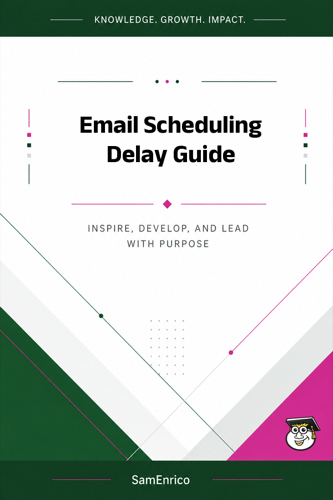
Email Scheduling Delay Guide eBook
Writes emails now but sends later at optimal times
Writes emails now but sends later at optimal times.
Formats
Free sample
Chapter 1: The Send Button Lie...--Chapter 1: The Send Button Lie–- The most dangerous button in your professional life is not labeled "Delete," "Reply All," or even "Archive." It is a button you press dozens of times each day without a second thought. It is a button that has caused more lost promotions, broken relationships, and sleepless nights than any other single feature in the history of office software. That button is labeled "Send." And everything you have been taught about how to use it is a lie.You have been told that speed is professionalism. That a quick reply demonstrates competence. That letting an email sit unanswered is rude, lazy, or passive-aggressive.
That the best time to send an email is the moment you finish writing it. These beliefs are not just wrong. They are actively destructive. They are the product of a work culture that confuses activity with productivity, urgency with importance, and reaction with responsibility.This chapter will dismantle the Send Button Lie piece by piece. We will explore why your instinct to hit send immediately is biologically and psychologically wired against your best interests.
We will examine the hidden costs of instant sending that no one talks about—the cognitive fragmentation, the emotional regret, the relational damage, and the slow erosion of your ability to focus. And we will introduce the single most transformative habit in this entire book: the deliberate pause between writing and sending. By the time you finish this chapter, you will understand why the send button should be the last thing you press, not the first. And you will never look at your outbox the same way again.The Dopamine Trap: Why Sending Feels So Good (And Why That Feeling Is Lying to You)Let us begin with a uncomfortable truth: the pleasure you feel when you click send is not a sign that you have done something right. It is a sign that you have fallen into a neurological trap.Every time you complete a small, discrete task—checking a box, closing a tab, clicking send—your brain releases a tiny amount of dopamine.
This neurotransmitter is often called the "pleasure chemical," but its real job is more subtle. Dopamine reinforces behaviors that your brain perceives as rewarding, regardless of whether those behaviors are actually good for you. Gambling addicts experience dopamine spikes when they pull the lever, not when they win. Social media users experience dopamine when they see a notification, not when they read the message. And email users experience dopamine when they click send, not when the recipient reads the email or responds favorably.This is the Dopamine Trap.
Your brain rewards the act of sending, not the quality of what you sent or the outcome that follows. This means that every time you fire off a hasty, poorly considered, or even harmful email, your brain gives you a little pat on the head and says, "Good job, you did a thing." The reward arrives before the consequences. By the time you realize the email was a mistake—hours later, when regret sets in—the dopamine has already done its work. Your brain has been trained to repeat the behavior.The research on this phenomenon is striking. In a study conducted by researchers at the University of Texas at Austin, participants who were allowed to check their email frequently reported higher levels of stress and lower levels of productivity than participants who were forced to batch their email processing into specific time blocks.
But here is the twist: the frequent-checking group also reported feeling more productive. They felt busier, more responsive, more on top of things. Their brains had confused the dopamine of task completion with the actual achievement of meaningful work.The Send Button Lie exploits this confusion. It tells you that clicking send is progress. But progress is not measured in clicks.
It is measured in outcomes. An email that is sent instantly but ignored, misunderstood, or resented is not progress. It is noise. And noise, no matter how satisfying it feels to produce, does not move your career or your relationships forward.The 23-Minute Ghost: How Instant Sending Destroys Your Attention The cost of instant sending is not limited to the quality of your emails. It also exacts a devastating toll on your ability to do anything else.In a landmark study from the University of California, Irvine, researchers followed knowledge workers in a real-world office environment.
They tracked how long it took workers to return to a focused task after being interrupted by an email notification. The average was twenty-three minutes and fifteen seconds. Let that sink in. A single email—not even one you chose to write, but one that appeared in your inbox—stole nearly half an hour of your cognitive capacity.Why does it take so long to recover? Because the brain does not switch tasks like a light switch.
It does not simply turn off email and turn on spreadsheets. Instead, it must disengage from the email context, reorient to the previous task, rebuild the mental model of what you were doing, and overcome the residual attention drain of the interruption. This process is called context switching, and it is one of the most expensive hidden costs of modern knowledge work.Now consider the math. If you send ten emails per day, and each email is associated with at least one interruption (either the notification that prompted you to write it or the notification you sent to someone else), you are losing nearly four hours of deep work capacity every single day. Four hours.
That is half a standard workday. You are not working eight hours and sending emails. You are working four hours and spending the other four recovering from email.The Send Button Lie tells you that sending emails quickly makes you efficient. But efficiency is not measured by speed. It is measured by the ratio of valuable output to total input.
If your emails are low-quality and your deep work is fragmented, your efficiency is terrible regardless of how fast you click send. The truly efficient worker is not the one who replies fastest. It is the one who replies best, at the right time, with the right message, while preserving their cognitive resources for the work that actually matters.The Regret Inventory: A Simple Exercise in Humility Before we go any further, let us take a moment to conduct a simple but uncomfortable exercise. I call it the Regret Inventory.Think back over the past twelve months. Recall every email you sent that you later regretted.
Perhaps the regret was small—a typo, a missing attachment, a slightly sharper tone than intended. Perhaps it was large—a message that damaged a relationship, cost you an opportunity, or started an unnecessary conflict. Write down as many as you can remember. Do not censor yourself. No one else will see this list.Now, for each email on your list, answer three questions.
First, how much time passed between when you finished writing the email and when you clicked send? Second, what was your emotional state when you wrote it? Third, would sending that email an hour later—or a…
This is the end of the free sample. Get the eBook to keep going. Buy now
About this book
Details
- Author
- Staten Shirlee
- Publisher
- SamEnrico
- Language
- English
- Genre
- Non-Fiction, Business Brief, Timing
- Released
- 2026-06-10
- Pages (approx.)
- 152
- Available as
- eBook, Audiobook

Read better in the ZLOADR app
Your eBooks on your phone or tablet. Sign in with your SamEnrico account and start reading.
More by Staten Shirlee
 Meditation for Pelvic Floor PainStaten Shirlee$11.99
 Breast Cancer Pregnancy GuideStaten Shirlee$11.99
 Data Leak Substance Abuse Records ScriptsStaten Shirlee$11.99
 The Inca Codebreakers: Ancient Algorithms in the AndesStaten Shirlee$11.99
 Love Letters from the Front: The Hidden Romance of WWII's 'Ghost Army'Staten Shirlee$11.99
 Clerk Deli PTStaten Shirlee$11.99
 Zummit YC Application TipsStaten Shirlee$12.99
 Annual Blocking CalendarStaten Shirlee$12.99
 Understanding Cold Agglutinin DiseaseStaten Shirlee$17.99
 How to Start a Cart Cover Made of Canvas Business (Beginners Guide)Staten Shirlee$11.99