
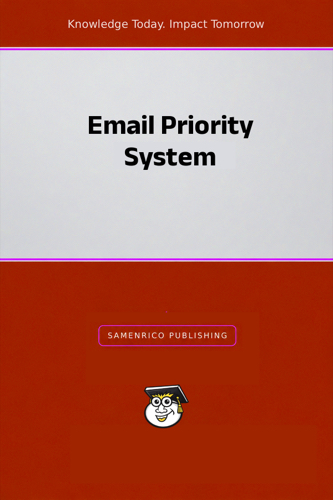
Email Priority System eBook
Use flags stars and colors to distinguish urgent f
by Beyer Jeffie
Use flags stars and colors to distinguish urgent from important.
Formats
Free sample
Chapter 1: The Gray Inbox–- The email arrived at 7:14 AM. By 7:16, you had already read it twice. By 7:18, you had flagged it with a yellow star—the same yellow star you use for everything, because you have no other system. By 7:22, you had closed your inbox. By 7:23, you reopened it to re-read the same email.
By 7:25, you had forgotten what the yellow star meant. By 7:26, you felt anxious. By 7:30, your day was already off the rails, and you hadn’t even had coffee yet.This is not a failure of discipline. This is not a character flaw. This is not a sign that you are bad at your job, or lazy, or easily distracted.
This is the predictable outcome of using a tool—your email client—that was designed to maximize engagement, not to respect your priorities. And the single yellow star? That was never meant to save you. It was meant to keep you clicking.Let’s call this what it is: the Gray Inbox Problem.Every morning, millions of professionals open an inbox that looks identical to the one they closed the night before. A long, undifferentiated list of text.
A few bolded subject lines (unread). A few stars or flags that have lost all meaning because you use them for everything. A scroll bar that mocks you. And somewhere in that gray abyss—a flat, colorless, context-free zone—are messages that could change your career, ruin your week, or wait until Friday without consequence. But you cannot tell which is which.
Not by looking. Not without reading. And reading takes time you do not have.So you do what everyone does. You start at the top. You read the newest message first, because your inbox defaults to reverse chronological order, even though your boss taught you fifteen years ago that “first in, first out” is a lie.
You reply to something that feels urgent because the subject line has the word “ASAP” in it, even though the sender puts “ASAP” on every email they’ve ever sent. You flag three other messages with the same yellow star, because that’s the only flag you know how to use. You close your inbox at 9:00 AM feeling like you’ve accomplished something. And then you reopen it at 9:07 because you just remembered you forgot to reply to your most important client.By 5:00 PM, you have opened your inbox forty-seven times. You have replied to thirty-two messages.
You have flagged nineteen emails. You have forgotten to follow up on six of them. And you have not done one single hour of deep, meaningful, strategic work—the kind of work that actually moves the needle in your career.If this sounds familiar, you are not alone.The Best Seller Gap: Why Your Favorite Productivity Books Failed You Let me be clear about something upfront: I have read every major productivity book of the last thirty years. Stephen Covey’s The 7 Habits of Highly Effective People. David Allen’s Getting Things Done.
Cal Newport’s Deep Work. Tim Ferriss’s *The 4-Hour Work Week*. Julie Morgenstern’s Never Check Email In The Morning. I have dog-eared the pages. I have highlighted passages.
I have recommended them to friends, colleagues, and strangers on airplanes.And every single one of them has a blind spot the size of your inbox.These books introduce brilliant frameworks. Covey gave us the Urgent vs. Important matrix—a quadrant so elegant and powerful that it has survived for decades as the gold standard for prioritization. Allen gave us the “two-minute rule” and the concept of a trusted system. Newport gave us the philosophical justification for protecting deep work from shallow distractions.
Ferriss gave us permission to automate, delegate, and eliminate.But here is what none of them gave you: a visual, executable, color-coded workflow for email.Covey tells you to put tasks in four quadrants. He does not tell you how to look at your inbox and instantly know which emails belong in which quadrant. Allen tells you to process your inbox to empty. He does not tell you how to distinguish, at a glance, between an email that requires action today and an email that can wait until next week. Newport tells you to stop checking email constantly.
He does not tell you how to flag messages so that when you do check email, you can process them in thirty seconds instead of three minutes.This is what I call the Best Seller Gap. Bestselling productivity authors are philosophers. They are theorists. They are brilliant at explaining what you should do and why you should do it. But they are terrible at telling you how—specifically, mechanically, step-by-step—to implement their ideas inside the actual tools you use every single day.And the tool you use every single day—your email client—is not neutral.
It is not designed to help you prioritize. It is designed to keep you inside it.The Cognitive Load Crisis: Why Your Brain Is Fighting a Losing Battle To understand why the Gray Inbox Problem is so destructive, you need to understand something about how your brain processes information.The human brain is extraordinary, but it has limits. One of those limits is something called cognitive load. Cognitive load is the total amount of mental effort being used in your working memory at any given moment. When cognitive load is low, you can think clearly, make good decisions, and execute complex tasks.
When cognitive load is high, you become slower, more error-prone, and more likely to make impulsive choices.Every email in your inbox imposes cognitive load. Even unread emails. Even emails you have already flagged. Every time you see a subject line, your brain automatically begins a low-level processing loop: Do I need to respond to this? Is this urgent?
Did I already reply? Who sent this? When did it arrive? What was I supposed to do with it?Now multiply that by the average number of emails in a professional’s inbox: 200, 500, 1,000, or more. Each one is a tiny weight on your cognitive load.
None of them, individually, is heavy. But together, they form a burden that never lifts.Here is where color enters the picture—and why the Gray Inbox is so damaging.Research in cognitive psychology and visual perception has consistently shown that the human brain processes color approximately 60,000 times faster than it processes text. That is not a typo. Sixty thousand times faster. When you see a red object, you do not need to read a label that says “this is red.” You know it instantly.
The recognition is pre-conscious, automatic, and effortless.Now compare that to your Gray Inbox. Your inbox presents you with a wall of black text on a white or gray background. Every single line requires reading. Every single line requires interpretation. Every single line requires a decision.
And because there are no visual cues—no colors, no patterns, no instant-recognition signals—your brain has to process each email sequentially, one at a time, using slow, deliberate, exhausting conscious thought.This is not an accident. Email clients are designed to maximize the time you spend inside them. If they made it easy to triage and ignore…
This is the end of the free sample. Get the eBook to keep going. Buy now
About this book
Details
- Author
- Beyer Jeffie
- Publisher
- SamEnrico
- Language
- English
- Genre
- Non-Fiction, Business Brief, Prioritization
- Released
- 2026-06-08
- Pages (approx.)
- 143
- Available as
- eBook, Audiobook

Read better in the ZLOADR app
Your eBooks on your phone or tablet. Sign in with your SamEnrico account and start reading.
More by Beyer Jeffie
 Remote Work Priority MatrixBeyer Jeffie$11.99
 Vegan Supplement Stacking CourseBeyer Jeffie$11.99
 The Stretch Habit TrackerBeyer Jeffie$11.99
 Franchising Your Local Brand Across Borders Digital MarketingBeyer Jeffie$11.99
 The Last Broadcast of the Titanic’s AIBeyer Jeffie$11.99
 Ice & Iron: The Rise and Fall of the 'Crystal Cartel'Beyer Jeffie$11.99
 Understanding Cutis Laxa OsteoporosisBeyer Jeffie$17.99
 A Beginners Guide to Balance Beam (Volume 1)Beyer Jeffie$11.99
 India Green Incentive GuideBeyer Jeffie$12.99
 Marketing Plan Template GuideBeyer Jeffie$12.99
 Area Marketing RepresentativeBeyer Jeffie$11.99
You may also like
 Pain Point Prioritization GuideStrauss Asha$11.99
 Eisenhower Matrix for PMsBerg Lucretia$11.99
 Email High Priority Flag OnlyTiller Carletta$11.99
 Energy Efficient To Do ListBeavers Yael$11.99
 The To Do List Prioritization GuideCardenas Verdell$11.99
 Email Sender Prioritization RuleHefner Sheilah$11.99
 Email Priority Inbox SetupHall Frank$11.99