
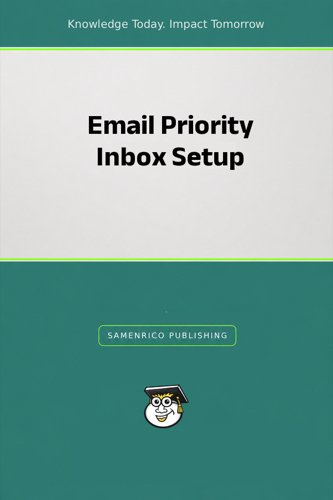
Email Priority Inbox Setup eBook
Use priority inbox features to surface important e
by Hall Frank
Use priority inbox features to surface important emails and hide the rest.
Formats
Free sample
Chapter 1: The $10,000 Inbox--–- On a Tuesday morning in March, a senior marketing director named Sarah did something she had done ten thousand times before: she opened her email. The ding had pulled her out of a spreadsheet she was building—a quarterly forecast that would determine her team’s bonuses for the year. “Just one quick check,” she told herself. Three hours later, she had answered forty-seven emails, attended two unnecessary conference calls that came from those emails, and completely lost the thread of the forecast. At 6:00 PM, she saved the spreadsheet with a new filename: “forecast_Q2_v14_ FINAL_ real final_ this one.” She had accomplished nothing of strategic value.
Her team’s bonuses would be smaller because she had spent her day reacting instead of leading. That evening, lying awake at 2:00 AM, Sarah calculated something: if she spent three hours per day on low-priority email, and her fully-loaded compensation was $150 per hour, she was costing her company $112,500 per year. Over a decade, that was more than a million dollars. Her inbox had become the most expensive piece of real estate she owned.This book is written for Sarah. And for you, if you have ever felt that your email owns you rather than the other way around.The Email Tax: What You’re Really Paying Before we build a single filter, create a single rule, or configure a single folder, we must understand the true cost of the chaotic inbox.
Most people believe email is free. It is not. Every message that lands in your inbox imposes a cognitive tax—a small but real cost in attention, time, and emotional energy. When you have fifty such messages, the tax is manageable. When you have one hundred, it is uncomfortable.
When you have two hundred or more per day, the tax becomes a crushing burden that affects not only your productivity but your mental health, your relationships, and your career trajectory.The 23-Minute Recovery Problem. Research conducted at the University of California, Irvine, found that after a single interruption—such as glancing at an incoming email—it takes an average of twenty-three minutes to return to the original task at full focus. This is not a return to “doing something.” It is a return to the same depth of concentration, the same flow state, the same level of cognitive performance. During those twenty-three minutes, you are working, but you are working shallowly. You are checking other things.
You are re-orienting. You are, in the words of productivity researcher Cal Newport, “fracturing your attention into useless shards.”Now multiply that twenty-three minutes by the number of times you check email each day. The average professional checks email every thirty-seven minutes. That is roughly sixteen times per eight-hour workday. Even if only half of those checks result in a full interruption—eight interruptions per day—you lose over three hours of deep work potential.
Three hours. Every single day. That is fifteen hours per week. That is seven hundred and eighty hours per year. That is ninety-seven full eight-hour workdays.
You are losing nearly one hundred days of productive time annually to the simple act of glancing at email.The Hidden Math of Low-Priority Mail. But the math gets worse. Not all emails are equal. The real damage comes not from the critical messages that require your attention, but from the ninety percent of emails that do not. These are the newsletters you never subscribed to, the automated notifications from project management tools, the “FYI” messages where you are CC’d for visibility only, the calendar invites for meetings you will decline, and the endless threads where colleagues debate decisions that do not involve you.
Each of these low-priority messages triggers the same interruption cost as a high-priority message. Your brain cannot distinguish importance at the moment of notification. It only knows that something has arrived. So you look. And you lose twenty-three minutes.
Over and over and over again.This is what I call the Email Tax—the measurable, predictable loss of productive time caused by the mismatch between the volume of incoming messages and your brain’s limited capacity to process them. For Sarah, the marketing director, that tax was $112,500 per year. For you, it might be higher or lower, but it is almost certainly higher than you think. At the end of this chapter, you will calculate your own Email Tax. I warn you: the number will be uncomfortable.
That discomfort is the beginning of change.Why Inbox Zero Failed You You have almost certainly heard of Inbox Zero. Popularized by productivity expert Merlin Mann in the mid-2000s, Inbox Zero is the practice of keeping your email inbox empty—or nearly empty—at all times by constantly processing, archiving, deleting, and responding to messages. The promise was seductive: a clean inbox equals a clean mind. An empty inbox equals an empty to-do list. Zero emails equals zero stress.Inbox Zero failed.
It failed not because it was a bad idea, but because it solved the wrong problem.The Vanity Metric Problem. An empty inbox is a vanity metric. It looks good. It feels good. It gives you a small dopamine hit every time you archive the last message.
But it does not measure what actually matters: whether you are spending your time on the right things. You can have an empty inbox and still have a completely wasted day. In fact, Inbox Zero often makes the problem worse because it encourages you to process low-priority emails as quickly as possible just to get them out of sight. You answer the newsletter. You respond to the FYI.
You accept the irrelevant calendar invite. You have achieved emptiness, but you have achieved nothing else.The Equal-Weight Fallacy. More fundamentally, Inbox Zero treats all emails as equal. Whether a message is from your largest client or a mailing list you joined in 2014, Inbox Zero demands the same response: process it now. This is a catastrophic failure of prioritization.
Your brain is not designed to treat everything as urgent. When you force it to do so, you enter a state of constant low-grade anxiety. You become reactive rather than proactive. You become a firefighter rather than an architect. You spend your days putting out small fires while the building burns down around you.The Archiving Illusion.
Inbox Zero advocates will tell you to archive everything. “If it’s done, file it away,” they say. But archiving does not reduce cognitive load. It simply hides it. Those archived emails still exist.
They still represent commitments, tasks, and open loops. Your brain knows they are there, even if you cannot see them. This is the Zeigarnik effect in action: uncompleted tasks occupy mental bandwidth far out of proportion to their importance. Archiving an email does not complete the task. It just makes the task invisible, which is worse.The Inbox as To-Do List.
The most damaging assumption of Inbox Zero is that your inbox should serve as your to-do list. This is a trap. Your inbox is a communication channel, not a task manager. When you treat it as a to-do list, you give every person who sends you email the power…
This is the end of the free sample. Get the eBook to keep going. Buy now
About this book
Details
- Author
- Hall Frank
- Publisher
- SamEnrico
- Language
- English
- Genre
- Non-Fiction, Business Brief, Prioritization
- Released
- 2026-06-06
- Pages (approx.)
- 139
- Available as
- eBook, Audiobook

Read better in the ZLOADR app
Your eBooks on your phone or tablet. Sign in with your SamEnrico account and start reading.
More by Hall Frank
 Deep Work for ADHD BrainsHall Frank$11.99
 Annual Strategic BlockingHall Frank$11.99
 Procrastination BusterHall Frank$11.99
 Amazon Shopping Comparison GuideHall Frank$11.99
 Frank Sinatra Chairman VoiceHall Frank$11.99
 Congressional Baseball Game HistoryHall Frank$11.99
 Scripting for ForgivenessHall Frank$11.99
 The Great Paris Jewel Heist: The Wrong Man’s TrialHall Frank$11.99
 The Merchant Princes of the Swahili Coast: Wealth, Trade, and Cultural FlourishingHall Frank$11.99
 How to Produce Pole Dancing KitsHall Frank$11.99
 Indian Stock Option Plan ComplianceHall Frank$12.99
 Compliance ChecklistHall Frank$12.99
You may also like
 Pain Point Prioritization GuideStrauss Asha$11.99
 Eisenhower Matrix for PMsBerg Lucretia$11.99
 Email High Priority Flag OnlyTiller Carletta$11.99
 Email Priority SystemBeyer Jeffie$11.99
 Energy Efficient To Do ListBeavers Yael$11.99
 The To Do List Prioritization GuideCardenas Verdell$11.99
 Email Sender Prioritization RuleHefner Sheilah$11.99