
Non-FictionBusiness BriefSecurity
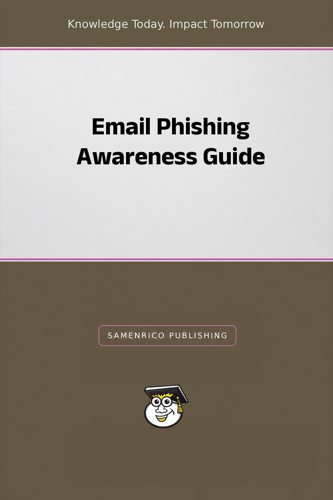
Email Phishing Awareness Guide eBook
Reduces time lost to security threats and scam inv
Reduces time lost to security threats and scam investigations.
Formats
Free sample
Chapter 1: The Hourglass Drain--–- It begins, as these things always do, with a click. Not a dramatic, building-crash sort of click, but something far more ordinary. A mid-afternoon click, perhaps fueled by fatigue or distraction. A cup of coffee going cold on the desk. The faint hum of office HVAC.
An email arrives. The subject line reads: "Urgent: Your Outlook password expires in 24 hours." The sender appears to be "IT Support." The logo looks right. The threat feels real—after all, nobody wants to be locked out of their email. So the user clicks. One second.
That is all it takes.Ninety days later, that same user is sitting in a conference room across from a forensic accountant, an attorney, and a very disappointed CFO. Between them lies a spreadsheet showing $187,000 wired to a fraudulent account. The attacker had not just stolen credentials; they had lived inside the email system for three months, reading every thread, learning vendor names, payment schedules, and the CEO's travel calendar. The original click took one second. The investigation took three months.
The cost in lost productivity, legal fees, and burned client trust? Incalculable.This is the hourglass drain. And it is the single greatest hidden cost of phishing that no security vendor wants to talk about.The Four-Hour Lie Let us begin with a number that will make any CFO wince: four hours. That is the average total time an organization loses to a single phishing incident—not including the actual financial loss from fraud. Four hours of collective productivity.
Four hours of IT overtime. Four hours of management meetings. Four hours of user anxiety. And the cruelest part? Most of that time has nothing to do with the attack itself.
It is wasted on the investigation that follows.Here is what those four hours actually look like in practice. Minute zero: a user reports a suspicious email to IT. That report lands in a ticket queue alongside password resets and printer issues. Fifteen minutes pass before anyone looks at it. The IT analyst opens the email, squints at the sender address, and says to themselves, "This looks weird, but I'm not sure." They forward it to a senior colleague.
Another ten minutes vanish. The senior analyst examines the headers, runs a domain reputation check, and confirms: it is malicious. Thirty minutes have now elapsed since the report. The attacker, if they have already captured credentials, has had half an hour of unfettered access.Now the real time sink begins. The analyst must determine who else received the same email.
They run a message trace across the organization—five minutes. They find thirty-seven other recipients. They must now manually email each of those users, asking them to delete the email and run a virus scan. Twenty minutes of drafting and sending. Users start replying with questions: "I already clicked the link, what do I do?" Another twenty minutes of back-and-forth.
The analyst pulls the email from all inboxes using admin tools—ten minutes. They check the email gateway logs to see if any user submitted credentials—fifteen minutes. They find three users who did. Now the analyst must force password resets for those three users, which requires calling each of them to verify identity—thirty minutes. Each user panics, asks why this happened, and demands to know if they are in trouble.Two hours have now passed.
The attacker has long since extracted whatever data they wanted. The original email is gone, but the damage is done. The analyst writes an incident report for management—forty-five minutes. Management asks for a root cause analysis—another hour. The user who originally reported the email receives a survey asking if their issue was resolved satisfactorily.
They give a low score because the whole process felt chaotic. The IT team's metrics look terrible. Morale drops.Four hours. One email. Zero actual money stolen in this case—only time.
But time is money. At a blended labor rate of $50 per hour, that single incident cost $200 in direct payroll. Scale that across fifty incidents per month, and you are losing $10,000 every month to investigation time waste. And that is before a single dollar of fraud has occurred.The four-hour lie is that phishing investigations are technical problems. They are not.
They are process problems, communication problems, and—most critically—time management problems.The Anatomy of the Unproductive Hour If four hours is the total drain, then one of those hours deserves special attention. Call it the Unproductive Hour—the gap between when a user recognizes something is wrong and when the IT team actually closes the ticket with confidence.The Unproductive Hour has three distinct phases. The first phase is user paralysis. After a user reports a suspicious email, they typically do nothing else. They sit frozen, afraid to delete the email (in case IT needs it), afraid to forward it (in case that spreads the threat), and afraid to keep working (in case they are somehow responsible).
This paralysis is not laziness; it is fear dressed up as caution. Security training has taught users that phishing is terrifying and that one wrong move will bring down the company. The unintended consequence is that users stop moving entirely. They wait for permission. The clock ticks.The second phase is investigation limbo.
The IT ticket sits in a queue, unassigned or assigned to an overwhelmed analyst. No one has communicated to the user that their report is being handled. The user sends a follow-up email: "Did you get my report?" Another follow-up: "Should I do something?" The analyst, now interrupted twice, loses focus on their current task. The ticket sits longer. The user grows more anxious.
The analyst grows more frustrated. Neither is productive.The third phase is closure theatre. Once the analyst has verified that the email is malicious, they must perform a series of administrative tasks that have nothing to do with security and everything to do with bureaucracy. Writing an incident summary. Updating a spreadsheet.
Closing the ticket. Sending a notification to the user that says, essentially, "We handled it." The user reads the notification and feels a brief moment of relief, followed by resentment that it took so long. The analyst closes their laptop and feels exhausted, not from solving a hard problem, but from wrestling with a broken system.The Unproductive Hour is not inevitable. It is the product of design choices—choices about tooling, about communication, about role clarity. And those choices can be unmade.The Blame Cycle: A Self-Perpetuating Machine If the Unproductive Hour is the symptom, the Blame Cycle is the disease.
The Blame Cycle has three actors, each pointing fingers at the others, and each finger-pointing session extends downtime by another thirty to sixty minutes.Users blame IT. "Why didn't your filters block this email in the first place?" This is a reasonable question. Email security filters are supposed to catch phishing messages. When one slips through, users feel betrayed by technology. They assume IT configured the filters poorly or, worse, that IT doesn't care.
This assumption is almost always wrong, but perception matters more than reality when time is being lost. Users withdraw their trust in IT. They stop…
This is the end of the free sample. Get the eBook to keep going. Buy now
About this book
Details
- Author
- Wicker Rosina
- Publisher
- SamEnrico
- Language
- English
- Genre
- Non-Fiction, Business Brief, Security
- Released
- 2026-06-11
- Pages (approx.)
- 156
- Available as
- eBook, Audiobook

Read better in the ZLOADR app
Your eBooks on your phone or tablet. Sign in with your SamEnrico account and start reading.
More by Wicker Rosina
 Pinterest VA For Bloggers PlaybookWicker Rosina$11.99
 Strategic Planning BlocksWicker Rosina$12.99
 Mindfulness for Migraine SufferersWicker Rosina$11.99
 Triple Negative Breast Cancer GuideWicker Rosina$11.99
 Conversation Starters for LaundromatsWicker Rosina$11.99
 The Lost Kingdom of Lapita: Uncovering Oceania’s Forgotten TreasureWicker Rosina$11.99
 Blood Moon Conspiracy: The Untold Story of the 1924 Vampire PanicWicker Rosina$11.99
 How to Start a Cars Business (Beginners Guide)Wicker Rosina$11.99
 Understanding Cofs SyndromeWicker Rosina$17.99Strategic Planning BlocksWicker Rosina$12.99
 Seamless HR YC TipsWicker Rosina$12.99
 Business Intelligence SpecialistWicker Rosina$11.99
You may also like
 Hong Kong Handover 1997Dunn Johnnie$11.99
 Zumba For Postnatal Recovery CourseNeal Christian$11.99
 Zumba for BeginnersLadner Nikia$11.99
 YouTube Comment Mining GuideHumes Pandora$12.99
 Worry Box MeditationCarlin Rudy$11.99
 Workplace Stress MeditationNguyen Lynn$11.99
 Workplace Stress and Sleep RepairHawley Ivory$11.99
 Workplace Perfectionism CureDelaney Jeffry$11.99
 Workplace Injustice Anger GuideWallen Isabelle$11.99
 Work Addiction and Burnout LinkGreenwood Ester$11.99
 Women in Yoga and WellnessBeattie Galina$11.99
 Women in Stand Up ComedyChun Evangeline$11.99