
Non-FictionSelf-HelpDigital Organization
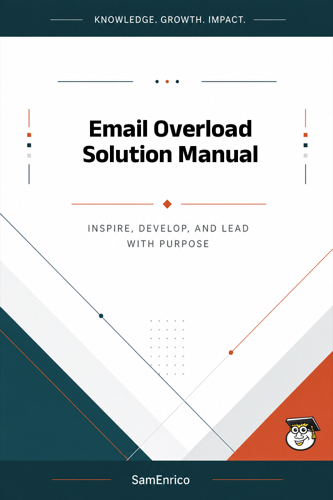
Email Overload Solution Manual eBook
Transform your inbox from stress source to product
Transform your inbox from stress source to productivity tool with batch processing and template systems.
Formats
Free sample
Chapter 1: The Dopamine Trap–- You are not lazy, undisciplined, or broken. You are being chemically hijacked by a system designed by some of the smartest engineers in the world to keep you checking, scrolling, and responding long after the productive value of doing so has dropped to zero.Let that land for a moment. The same psychological principles that make slot machines irresistible were deliberately built into your email application. The notification badge on your phone is not a neutral indicator of new messages. It is a variable reward trigger, carefully calibrated to exploit a feature of your brain that evolved millions of years before email existed.This chapter is not about technique.
It is not about folders, filters, or fancy automations. Those come later. This chapter is about diagnosis. Before you can solve a problem, you must understand why it has such a powerful grip on you. And the honest answer is uncomfortable: email feels good to check, even when it contains nothing good.The Science of the Open Loop Every time you see that little red badge, your brain releases a small amount of dopamine.
Not because you have received something valuable, but because you might have. This is the distinction that changes everything. Dopamine is not released in response to reward. It is released in response to anticipation of reward. The uncertainty is what makes it potent.Psychologists call this a variable ratio reinforcement schedule.
B.F. Skinner discovered it in the 1950s when he observed that pigeons pecked a button most frantically when the food reward came unpredictably. If the food came every single time, the pigeons pecked steadily but without mania. If the food never came, they stopped. But when the food came sometimes but not always, at random intervals, the pigeons pecked themselves into exhaustion.Your email works exactly the same way.
Sometimes you open your inbox and find a kind note from a colleague or good news from a client. Sometimes you find nothing but spam. Sometimes you find a stressful demand from your boss. The unpredictability is what keeps you coming back. The possibility of a pleasant surprise overrides the statistical reality that most messages are neutral at best and actively stressful at worst.This is not a character flaw.
This is your brain functioning exactly as evolution designed it. The problem is that email designers know this and have built their products to exploit it. Every notification, every badge, every preview line is optimized to keep you inside the application for as long as possible. You are not the customer. You are the product being harvested for attention.Your Three-Day Email Autopsy Before you change anything, you need data.
Not intuition, not guilt, not vague memories of wasted time. Hard, uncomfortable data about how you actually interact with your email.For the next three days, you will conduct what this book calls an Email Autopsy. You will not change your behavior during these three days. You will simply observe and record. Trying to change before you understand is like trying to fix an engine without opening the hood.Here is exactly what you will track.
Get a notebook, a note-taking app, or print the worksheet from Appendix B.Tracked Item 1: Frequency. Every time you open your email application, make a tally mark. This includes manual opens (you click the icon) and automatic opens (notifications pull you in). Also track every time you glance at your phone screen to see the badge count without opening the app. These micro-checks matter.Tracked Item 2: Trigger.
For each open, note what caused it. Was it a notification banner? A badge count? A habit impulse like opening email first thing in the morning? A moment of boredom while waiting for something else?Tracked Item 3: Emotional valence.
After you finish your email session, rate it on a simple scale from -3 to +3. Negative scores represent sessions that left you feeling stressed, overwhelmed, anxious, or inadequate. Positive scores represent sessions that left you feeling productive, connected, or relieved. Zero represents neutral.Tracked Item 4: Time per session. Use a timer or a rough estimate.
Be honest. Most people underestimate by a factor of two.At the end of three days, you will have a map of your email addiction. Most readers discover that they check email between forty and eighty times per day. Most discover that the majority of sessions are triggered by notifications, not by conscious choice. And most discover that their average emotional valence is negative.Do the autopsy.
It is non-negotiable. The rest of the book will not work if you skip this step.The Four Hidden Costs You Are Paying During your three-day autopsy, you will likely notice patterns. But there are deeper costs that tally marks cannot capture. These are the hidden taxes that email extracts from your life, often without your awareness.Cost One: Context Switching Tax. Every time you switch from one task to email and back, your brain pays a penalty.
Neuroscientists have measured this penalty at approximately twenty minutes to fully return to your previous depth of focus after a single interruption. If you check email thirty times per day, you never fully return. You live in a state of perpetual shallow attention, capable of responding but incapable of creating.Cost Two: Cortisol Elevation. Stress is not just a feeling. It is a hormone called cortisol that, when chronically elevated, damages your immune system, impairs your memory, and shortens your lifespan.
Every stressful email floods your system with cortisol. And because email never ends, your cortisol never fully clears. You are walking around in a low-grade biological emergency, all day, every day.Cost Three: IQ Suppression. Researchers at the University of London found that constantly checking email produces a temporary drop in IQ of ten points. To put that in perspective, missing a full night of sleep produces a drop of about five points.
Smoking marijuana produces a drop of about four points. Email-induced distraction is twice as damaging to your cognitive function as being legally drunk in most jurisdictions.Cost Four: Relationship Erosion. This is the cost that never appears in productivity studies but matters most. When you check your phone during dinner, you tell your family that strangers have higher priority than they do. When you reply to email while your child is telling you about their day, you teach them that their voice matters less than a notification badge.
When you keep one eye on your inbox during a conversation with your partner, you are not present. You are somewhere else. And the people who love you can feel it.The Difference Between Urgent and Important By day three of your autopsy, you will have noticed something disturbing. The vast majority of emails you receive are neither urgent nor important. But they feel urgent because they arrived in your inbox.
This is the great lie that email perpetuates.The Eisenhower Matrix, named for President Dwight Eisenhower, divides tasks along two dimensions: urgency (must be done now) and importance (matters in the long run). Most email falls into one of three categories: urgent but unimportant (someone else's emergency), important but not urgent (strategic work you should be doing…
This is the end of the free sample. Get the eBook to keep going. Buy now
About this book
Details
- Author
- Delarosa Kandice
- Publisher
- SamEnrico
- Language
- English
- Genre
- Non-Fiction, Self-Help, Digital Organization
- Released
- 2026-06-07
- Pages (approx.)
- 135
- Available as
- eBook, Audiobook

Read better in the ZLOADR app
Your eBooks on your phone or tablet. Sign in with your SamEnrico account and start reading.
More by Delarosa Kandice
 Single Person Meal PrepDelarosa Kandice$11.99
 App Blocker Tool GuideDelarosa Kandice$11.99
 Venice Gondola RelaxationDelarosa Kandice$11.99
 Self Care for CaregiversDelarosa Kandice$11.99
 Scrupulosity Religious OCDDelarosa Kandice$11.99
 Fear of Failure for NonprofitsDelarosa Kandice$11.99
 Behavioral Activation for ApathyDelarosa Kandice$11.99
 Whispers of the Marid: The Djinn King’s Forgotten WisdomDelarosa Kandice$11.99
 Beyond Limits: The Paralympic Art of Defying GravityDelarosa Kandice$11.99
 Present Value Excel GuideDelarosa Kandice$12.99
 Airbnb Design Sprint KanbanDelarosa Kandice$12.99
 A Collector's Handbook to the Marcos 2-litreDelarosa Kandice$11.99
You may also like
 Hong Kong Handover 1997Dunn Johnnie$11.99
 Zumba For Postnatal Recovery CourseNeal Christian$11.99
 Zumba for BeginnersLadner Nikia$11.99
 YouTube Comment Mining GuideHumes Pandora$12.99
 Worry Box MeditationCarlin Rudy$11.99
 Workplace Stress MeditationNguyen Lynn$11.99
 Workplace Stress and Sleep RepairHawley Ivory$11.99
 Workplace Perfectionism CureDelaney Jeffry$11.99
 Workplace Injustice Anger GuideWallen Isabelle$11.99
 Work Addiction and Burnout LinkGreenwood Ester$11.99
 Women in Yoga and WellnessBeattie Galina$11.99
 Women in Stand Up ComedyChun Evangeline$11.99