
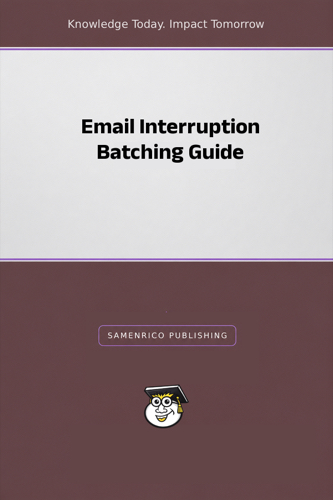
Email Interruption Batching Guide eBook
Process emails in focused batches instead of const
Process emails in focused batches instead of constant checking using this practical system.
Formats
Free sample
Chapter 1: The Twenty-Three Minute Theft...--–- The email arrives with a soft ding. You glance at the subject line. Three seconds later, you are no longer doing what you were doing. The report you were writing? Forgotten.
The spreadsheet you were analyzing? Minimized. The line of code you were debugging? Replaced by a blinking cursor and a growing sense of obligation.This is not a failure of willpower. This is not laziness, procrastination, or a lack of discipline.
This is a neurological hijacking, and it has been engineered with precision. Every ding, every pop-up, every notification badge is designed to do one thing: interrupt you. And every interruption comes with a hidden price tag that most professionals never see—until now.Welcome to the Twenty-Three Minute Tax.The Most Expensive Free Service You’ll Ever Use Email is free. The software costs nothing. The servers hum along at someone else’s expense.
But the attention you spend on email—that is not free. That is the most expensive currency you own, and you are spending it like a drunken sailor in a portside casino.Let us run a quick calculation. Imagine you earn $50 per hour. That is roughly $100,000 per year for a full-time professional. Now imagine you check email twenty times per day.
Most professionals check far more—one study found the average knowledge worker checks email seventy-seven times per day—but let us be conservative. Twenty checks. Each check takes one minute to open, scan, and close. That is twenty minutes per day, or one hundred minutes per five-day workweek, or eighty-seven hours per year. At $50 per hour, that is $4,350 per year just for the act of opening email.But that is not the real cost.The real cost comes after you close the email client.
The real cost is the time it takes to return to what you were doing before the interruption. And that cost is staggering.In 2005, researchers at the University of California, Irvine did something remarkable. They followed real workers in a real office and measured exactly what happened when an email interruption occurred. Their finding, replicated multiple times since, is this: after an email interruption, it takes an average of twenty-three minutes and fifteen seconds to fully return to the original task.Not twenty-three seconds. Twenty-three minutes.Let that sink in.
You hear a ding. You glance at your inbox. You spend sixty seconds reading and perhaps replying. Then you spend the next twenty-three minutes trying to remember where you were, what you were doing, what you were thinking before the interruption. Your brain is not a light switch.
It does not turn on and off instantly. It is more like a freight train: stopping takes distance, and restarting takes even more.Now multiply that by four email checks before noon. Four checks. Ninety-two minutes of recovery time. An hour and a half of your morning, gone.
Not spent on email. Spent on recovering from email.This is the Twenty-Three Minute Tax. And you have been paying it every single day.The Research That Changed Everything The UC Irvine study, led by researchers Gloria Mark and Victor Gonzalez, was methodologically brilliant. They equipped workers with pagers (this was 2005, before smartphones dominated every pocket) and pinged them at random intervals. When the pager went off, the worker documented what they were doing and whether they had been interrupted.
The researchers then analyzed the flow of work and discovered something counterintuitive: interruptions did not just cost the time of the interruption itself. They cost the time required to resume the interrupted task, and that resumption time was an order of magnitude larger than the interruption itself.Later studies refined the finding. In 2014, Mark and her colleagues published follow-up research showing that workers switched activities an average of every three minutes and five seconds. Email was the primary driver of these switches. And each switch, each context shift, came with a cognitive overhead that the researchers called "resumption lag."Other researchers have replicated the finding across different industries.
A study of software developers found that after an interruption—including email—it took an average of twenty-three minutes to return to the previous coding task. A study of accountants found similar results. A study of medical residents found that interruptions led to a 12.7% increase in errors and a 15.3% increase in time spent on tasks.The numbers are consistent, robust, and terrifying.Here is what the research does not say: it does not say that email is bad. It does not say that you should stop communicating with colleagues. It does not say that the modern workplace should abandon asynchronous messaging.
The research simply says that how you interact with email matters enormously. Random checking—the default mode for most professionals—is the most expensive possible strategy. Structured batching—processing email in focused, scheduled blocks—is the least expensive.The difference between the two is not subtle. It is the difference between paying the Twenty-Three Minute Tax a dozen times per day and paying it zero times per day.The Dopamine Trap: Why Your Brain Loves the Ding If the cost of email interruption is so high, why do we keep checking? Why do we reach for our phones the moment a notification appears?
Why do we feel a small pang of anxiety when the inbox badge shows a number greater than zero?The answer lies in the brain’s reward system, specifically a neurotransmitter called dopamine. Dopamine is often misunderstood as the "pleasure chemical," but its actual role is more nuanced. Dopamine is the motivation chemical. It is released not when you receive a reward, but when you anticipate a reward. The slot machine player feels dopamine not when the coins pour out, but when the wheels are spinning.
The gambler is not addicted to winning. The gambler is addicted to the possibility of winning.Email exploits this same mechanism perfectly.When you check your inbox, you never know what you will find. It might be a boring newsletter. It might be a meeting invitation. It might be an angry message from a client.
Or it might be good news—a compliment from a boss, an exciting opportunity, a personal note from a friend. This variability is called a variable reward schedule, and it is the most addictive pattern known to behavioral psychology.B.F. Skinner, the father of operant conditioning, demonstrated this with pigeons in the 1950s. Pigeons rewarded every time they pecked a button learned to peck, but they stopped quickly when the reward stopped. Pigeons rewarded sometimes—randomly, unpredictably—pecked obsessively, compulsively, even when the reward stopped entirely.
They could not stop because they could not predict when the next reward might come.You are the pigeon. The inbox is the button. And the ding is the sound of the wheels spinning.This is not a metaphor. Neuroscientists have scanned the brains of people receiving variable rewards and observed dopamine spikes in the nucleus accumbens, the same region activated by cocaine and gambling. Email notifications trigger a low-grade addiction, not because email is inherently addictive, but because the pattern of variable rewards is neurologically irresistible.The solution is not willpower.
Willpower is a finite resource, and dopamine is a fire hose. The solution is to change the pattern. When you…
This is the end of the free sample. Get the eBook to keep going. Buy now
About this book
Details
- Author
- Benedict Amira
- Publisher
- SamEnrico
- Language
- English
- Genre
- Non-Fiction, Self-Help, Email Batching
- Released
- 2026-06-07
- Pages (approx.)
- 153
- Available as
- eBook, Audiobook

Read better in the ZLOADR app
Your eBooks on your phone or tablet. Sign in with your SamEnrico account and start reading.
More by Benedict Amira
 Face Pattern Recognition GuideBenedict Amira$11.99
 The Anger Breathwork GuideBenedict Amira$11.99
 Self Hypnosis Arm Levitation Technique WorkbookBenedict Amira$11.99
 Fitness Accountability PartnerBenedict Amira$11.99
 The Great British Spy Swap: Cold War Secrets ExposedBenedict Amira$11.99
 The Silk Road's Last Emperor: A Silk Road Trade SecretBenedict Amira$11.99
 How to Start a Precious Metal Ores Mining and Preparation Business (Beginners Guide)Benedict Amira$11.99
 DALL E Redbubble GuideBenedict Amira$12.99
 Scrum for Spotify StartupsBenedict Amira$12.99
 Fraud SpecialistBenedict Amira$11.99
 Understanding Enchondromatosis Dwarfism CalfnessBenedict Amira$17.99