
Non-FictionBusiness BriefEmailBatching
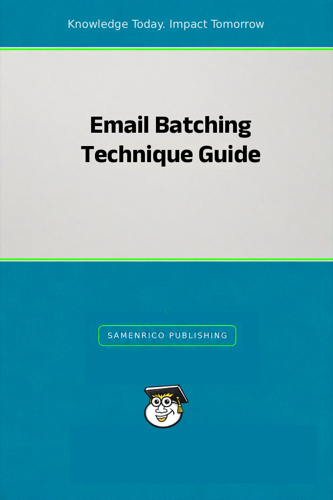
Email Batching Technique Guide eBook
Process emails in scheduled batches rather than as
Process emails in scheduled batches rather than as they arrive.
Formats
Free sample
Chapter 1: The Reaction Trap--–- You are about to discover something that will change how you see your inbox forever. But first, I need you to answer a single question honestly. When you sat down at your desk this morning, what was the first thing you did? Did you open your email client before you even took off your coat? Did you scroll through subject lines while your coffee went cold?
Did you tell yourself you were just “checking real quick” before starting your real work?If you answered yes to any of those questions, you are not alone. You are also not being productive. You are being played.The Hidden Cost of the Morning Check Let me paint a picture that might feel uncomfortably familiar. It is 8:47 AM. You have just arrived at work.
Your computer is still booting up, but your phone is already in your hand, thumb hovering over the mail icon. You tell yourself this is responsible behavior. You are staying on top of things. You are being responsive.What you are actually doing is handing the first and best minutes of your day to every person who decided to send you an email overnight. You are starting your day in a state of reaction rather than creation.
And you are unknowingly triggering a cascade of neurological and psychological effects that will degrade your performance for the next several hours.Julie Morgenstern, in her groundbreaking book Never Check Email in the Morning, introduced a concept that should be tattooed on the forearm of every knowledge worker: the difference between offense and defense. Checking email first thing puts you in defensive mode. You are spending your highest energy of the day responding to other people's priorities. You are a firefighter rushing from blaze to blaze, never stopping to ask whether the fires should have been lit in the first place.Offense, by contrast, is proactive. Offense is writing the proposal before answering the question about the proposal.
Offense is coding the feature before replying to the status update request. Offense is doing the work that actually moves your goals forward, not the work that merely makes your inbox smaller.Let me be clear: I am not saying email is evil. I am not saying you should never reply to messages. I am saying that the timing of your email processing determines whether you spend your day on offense or defense. And the data is unequivocal: when you check email first thing, you choose defense.The Twenty-Eight Percent Rule Here is a number that should terrify you: twenty-eight percent.
According to research cited across multiple productivity studies, the average professional loses twenty-eight percent of their workweek to irrelevant, poorly written, or completely unnecessary emails. That is nearly eleven hours every week. Eleven hours. That is an entire workday plus an afternoon. Every single week.
Gone.Let me make this concrete. Imagine someone walked into your office right now and said, “I am going to give you back eleven hours every week. You can use them for deep work, for family, for exercise, for sleep. All you have to do is stop processing email that does not matter.”You would take that deal in a heartbeat. And yet, you are currently rejecting that deal every single day, because you have not yet learned to distinguish between email that deserves your attention and email that does not.The problem is not that you are lazy or undisciplined.
The problem is that email has been designed to feel productive. When you open your inbox and see fifty messages, and you reply to ten of them and archive twenty and delete twenty more, you feel a sense of accomplishment. Your brain releases a small burst of dopamine. You have done something. You have made progress.But have you?
Have you actually moved your projects forward? Have you created something new? Have you solved a difficult problem? Or have you simply shifted digital paper from one pile to another?The great productivity deception of our age is that answering email has become a substitute for doing real work. We have confused busyness with effectiveness.
We have mistaken motion for progress. And the inbox is the primary weapon in this deception.Email Is Not Your Real Job Jocelyn K. Glei, author of Unsubscribe, puts it bluntly: “Your job is not your inbox.” That seems obvious when stated aloud, but watch how you behave tomorrow. What percentage of your day will be spent reading, writing, sorting, and responding to email? For most knowledge workers, the answer is between forty and sixty percent.
For some, it is as high as eighty percent.If someone is paying you to answer email, then by all means, continue. But for the vast majority of professionals—managers, developers, writers, designers, strategists, marketers, salespeople, consultants—email is a support function, not the core function. It is the administrative overhead of your actual job, not the job itself.Think about your most recent performance review. Did your manager commend you for your excellent email response time? Perhaps.
But did they promote you because of it? Did they give you a raise because you were particularly good at hitting “reply all”? No. They promoted you because you delivered projects, solved problems, generated revenue, or created value. Email was not the work.
Email was the scaffolding around the work.The challenge is that email provides immediate gratification while real work provides delayed gratification. When you answer an email, you get a quick win. The message disappears from your inbox. The person on the other end gets a reply. You feel a small surge of accomplishment.
When you sit down to write a proposal or design a system or analyze a data set, you get nothing for hours. The satisfaction is delayed, sometimes until the next day or the following week.Our brains are wired for immediate rewards. The inbox offers them constantly. Deep work offers them rarely. This is not a character flaw.
This is biology. And the only way to overcome biology is with a system.The Empty Inbox Misunderstanding Before we go further, we need to address a concept that has caused tremendous confusion in the productivity world: Inbox Zero.Merlin Mann, the creator of the term, has spent years trying to correct the misunderstanding. He never meant that you should have zero emails in your inbox at all times. He never meant that emptiness was the goal. What he meant was that your inbox should have zero mental toll—that you should not be carrying psychological weight from the messages sitting there.The distinction matters enormously.
An inbox with five thousand emails that have been properly filtered, archived, labeled, and processed causes no stress. Those emails are not asking you for anything. They are simply stored in a place you rarely visit. An inbox with twelve unread emails that require complex decisions, difficult replies, or emotional labor causes massive stress. Those twelve emails are open loops, each one tugging at your attention.The goal of batching is not to achieve a literal empty inbox.
The goal is to achieve clarity—to know, at every moment, exactly which emails require your attention and which do not.…
This is the end of the free sample. Get the eBook to keep going. Buy now
About this book
Details
- Author
- Garber Arlyne
- Publisher
- SamEnrico
- Language
- English
- Genre
- Non-Fiction, Business Brief, Email, Batching
- Released
- 2026-06-09
- Pages (approx.)
- 119
- Available as
- eBook, Audiobook

Read better in the ZLOADR app
Your eBooks on your phone or tablet. Sign in with your SamEnrico account and start reading.
More by Garber Arlyne
 Blue Zone Garden GuidanceGarber Arlyne$11.99
 Co Parenting Stress GuideGarber Arlyne$11.99
 Weight Neutral Binge RecoveryGarber Arlyne$11.99
 The Reinforcement Weight Loss GuideGarber Arlyne$11.99
 The Massacre of Saint Bartholomew: Blood in the Streets of Paris (1572)Garber Arlyne$11.99
 Understanding Westerhof–beemer–cormane SyndromeGarber Arlyne$17.99
 Madrid Change RecordingGarber Arlyne$12.99
 Ghana Social Media GuideGarber Arlyne$12.99
 Textile Care SpecialistGarber Arlyne$11.99
 How to Start a Barge Transport (except for Inland Waterway) Freight Service Business (Beginners GuidGarber Arlyne$11.99
You may also like
 Hong Kong Handover 1997Dunn Johnnie$11.99
 Zumba For Postnatal Recovery CourseNeal Christian$11.99
 Zumba for BeginnersLadner Nikia$11.99
 YouTube Comment Mining GuideHumes Pandora$12.99
 Worry Box MeditationCarlin Rudy$11.99
 Workplace Stress MeditationNguyen Lynn$11.99
 Workplace Stress and Sleep RepairHawley Ivory$11.99
 Workplace Perfectionism CureDelaney Jeffry$11.99
 Workplace Injustice Anger GuideWallen Isabelle$11.99
 Work Addiction and Burnout LinkGreenwood Ester$11.99
 Women in Yoga and WellnessBeattie Galina$11.99
 Women in Stand Up ComedyChun Evangeline$11.99