
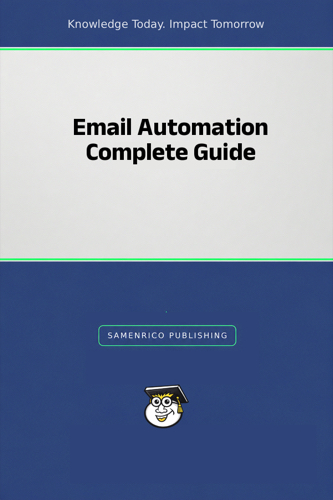
Non-FictionBusiness BriefComplete
Email Automation Complete Guide eBook
Comprehensive resource for all email marketing met
by Stokes Irvin
Comprehensive resource for all email marketing methods.
Formats
Free sample
Chapter 1: The Invisible Selling Machine--–- Most marketers wake up thinking about what they want to say. The best marketers wake up thinking about what their customers want to hear, and when they want to hear it. This single distinction separates the practitioners of "batch and blast" from the architects of automated revenue engines.If you are reading this book, you have likely experienced the sinking feeling that accompanies a 2 percent open rate on a newsletter you spent eight hours crafting. You have probably watched a beautifully designed promotional email land in the spam folder of 15,000 people who explicitly asked to hear from you. You may have even wondered whether email marketing itself is dying, as industry pundits have been predicting since 2010.Here is the truth they are not telling you: email is not dying.
Batch and blast is dying. The difference is everything.Every single day, over 350 billion emails are sent across the internet. The vast majority of them are ignored, deleted, or reported as spam. But a small fraction—less than one percent—achieve something remarkable. They generate opens above 50 percent.
They drive click-through rates that exceed industry averages by 300 percent. They produce revenue that scales predictably, month after month, without requiring the marketing team to work more hours.What do those emails have in common? They are not broadcasts. They are responses.This book exists to transform your email program from a broadcasting tool into what Ryan Deiss calls the "Invisible Selling Machine"—a system that delivers the right message, to the right person, at exactly the right moment in their journey, without the recipient ever feeling marketed to. It is automation not as a cost-cutting measure, but as a relationship-building engine.The journey begins with a single, uncomfortable question: is your current email marketing strategy built on permission or interruption?The Cost of Interruption Marketing Before we can build the machine, we must understand what we are replacing.
Traditional email marketing operates on a broadcast model. The marketing team decides what to say, writes a single message, and sends it to the entire database. This approach has three hidden costs that rarely appear on any profit and loss statement, yet silently destroy long-term results.The first cost is attention degradation. Every time you send an irrelevant email to a subscriber, you train them to ignore you. The human brain is remarkably efficient at filtering noise.
After receiving three irrelevant emails in a row, a subscriber unconsciously flags your sender address as "not worth watching." Your future emails—even the relevant ones—will be opened less frequently, not because your content worsened, but because your subscriber learned to ignore you.This is why open rates tend to decline steadily over time for broadcast senders. It is not list fatigue in the abstract. It is Pavlovian conditioning in reverse. You have trained your audience that your messages contain nothing for them.The second cost is brand erosion. Every irrelevant email communicates a subtle but powerful message: we do not know you, we do not remember what you care about, and we are not paying attention.
For a brand trying to build trust and loyalty, this is catastrophic. A customer who feels unseen by a brand is a customer who is one click away from a competitor who sees them.The third cost is the most insidious: false learning. Broadcast metrics lie to you in predictable ways. When a broadcast email generates a 10 percent open rate, it is tempting to conclude that your subject line needs work or your send time needs adjustment. But what if those 10 percent were going to open regardless of what you sent?
What if the 90 percent who ignored you were never going to engage because the message was fundamentally irrelevant to them?Broadcast optimization optimizes for the already-engaged. It leaves the silent majority untouched and, worse, unstudied.The 86 Percent Difference Consider a statistic that should haunt every broadcast marketer: automated emails generate open rates that are, on average, 86 percent higher than bulk broadcasts. This is not a marginal improvement. This is the difference between a program that barely justifies its existence and a program that drives the majority of your marketing ROI.What explains this staggering difference? The answer is not better design or fancier technology.
The answer is context.An automated email is never a guess. It is a response to something the customer just did. They abandoned a cart. They downloaded a white paper. They viewed a product three times without purchasing.
They celebrated a birthday. They reached 90 days without a purchase after previously buying monthly.Each of these triggers creates a moment of peak relevance. The customer is, in that exact instant, more likely to be thinking about your category, more likely to be receptive to your message, and more likely to take action than at any other time. The automated email arrives not as an interruption, but as an accompaniment to an existing thought.This is the fundamental insight that separates automation from broadcasting. Broadcasting asks, "What do we want to say today?" Automation asks, "What does this customer need to hear right now, based on what they just did?"The answer to that second question is almost always more valuable than the answer to the first.The Five Stages of the Customer Journey To build an effective automation system, you must first understand where your customers are in their relationship with you.
Ryan Deiss's customer journey framework provides the map. It identifies five distinct stages that every customer passes through, from first awareness to enthusiastic advocacy.The first stage is Aware. At this moment, the customer knows your brand exists. That is all. They saw an ad, heard a podcast mention, or received a referral from a friend.
They have not engaged with your content, subscribed to your email list, or given you any permission to contact them. The Aware stage is the domain of advertising and public relations, not email.The second stage is Engaged. Here, the customer has consumed some of your content. They read a blog post, watched a video, or listened to an episode. They are building familiarity with your ideas and your brand voice.
Crucially, they have not yet given you their email address. Engagement happens in environments you control but where you cannot directly reach out. This is the stage where you earn the right to move to the next level.The third stage is Subscriber. This is where email begins. The customer has raised their hand and said, "Yes, I want to hear from you." They have provided their email address, usually in exchange for a lead magnet—an ebook, a discount code, a template, a webinar registration.
The Subscriber stage is the foundation of all email marketing, but for most brands, it is also where the journey stalls. They treat "subscriber" as the destination rather than a waypoint.The fourth stage is Customer. This is the first monetary transaction. The customer has paid you money for a product or service. This stage is transformational because it changes the nature of your relationship.
A subscriber owes you nothing. A customer has invested in you. The psychological commitment is entirely different, and your automated…
This is the end of the free sample. Get the eBook to keep going. Buy now
About this book
Details
- Author
- Stokes Irvin
- Publisher
- SamEnrico
- Language
- English
- Genre
- Non-Fiction, Business Brief, Complete
- Released
- 2026-06-10
- Pages (approx.)
- 132
- Available as
- eBook, Audiobook

Read better in the ZLOADR app
Your eBooks on your phone or tablet. Sign in with your SamEnrico account and start reading.
More by Stokes Irvin
 The Phosphorus FactsheetStokes Irvin$11.99
 Self Hypnosis For Grief Processing CourseStokes Irvin$11.99
 Criticism Sensitive Relationship GuideStokes Irvin$11.99
 Recurring Dream Premonition GuideStokes Irvin$11.99
 Shifting Continents: The Scientists Who Mapped Earth's Hidden PuzzleStokes Irvin$11.99
 Whispers in the Abyss: The Lost City of Dwarka's Siren SongStokes Irvin$11.99
 Understanding Epstein SyndromeStokes Irvin$17.99
 Learn to Play PokerStokes Irvin$11.99
 House Sitting Luxury HomesStokes Irvin$12.99
 Mentoring Junior Colleagues in SaudiStokes Irvin$12.99
You may also like
 Hong Kong Handover 1997Dunn Johnnie$11.99
 Zumba For Postnatal Recovery CourseNeal Christian$11.99
 Zumba for BeginnersLadner Nikia$11.99
 YouTube Comment Mining GuideHumes Pandora$12.99
 Worry Box MeditationCarlin Rudy$11.99
 Workplace Stress MeditationNguyen Lynn$11.99
 Workplace Stress and Sleep RepairHawley Ivory$11.99
 Workplace Perfectionism CureDelaney Jeffry$11.99
 Workplace Injustice Anger GuideWallen Isabelle$11.99
 Work Addiction and Burnout LinkGreenwood Ester$11.99
 Women in Yoga and WellnessBeattie Galina$11.99
 Women in Stand Up ComedyChun Evangeline$11.99