
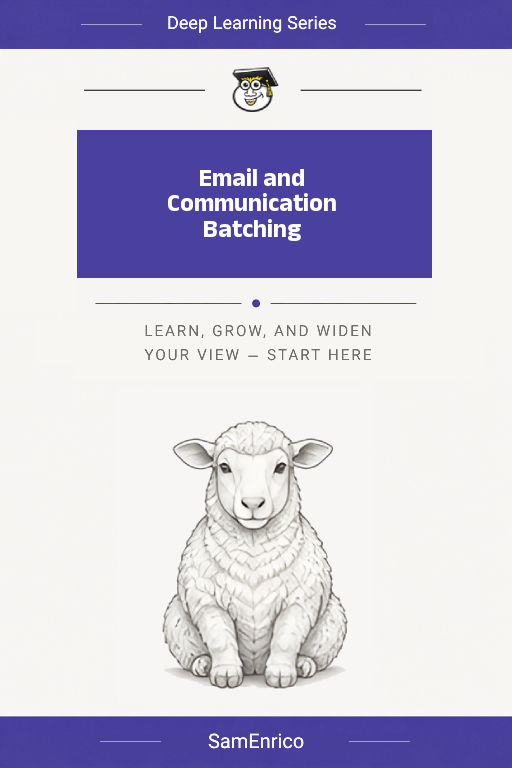
Non-FictionProfessional's Cheat SheetCommunication
Email and Communication Batching eBook
Limit email and Slack to two 30-minute blocks dail
Limit email and Slack to two 30-minute blocks daily instead of constant context switching.
Formats
Free sample
Chapter 1: The Thief in Your Pocket--The heart monitor beeped in steady, reassuring rhythm. The surgical team was thirty-seven minutes into a complex aortic repair. The patient, a fifty-two-year-old father of three, was stable. Then a nurse’s pager vibrated. Not the hospital’s emergency system—that one had a distinctive, ear-piercing shriek.
This was a Slack notification, forwarded from her personal phone, which she had foolishly left in her scrubs pocket. She glanced down for less than two seconds. In that moment, the lead surgeon asked for a clamp. She reached for the wrong size. The delay cost ninety seconds.
By the time the correct clamp was retrieved, the patient’s blood pressure had dropped catastrophically. They stabilized him. But the postoperative bleeding required a second surgery. He survived—barely. The nurse was fired.
The hospital banned personal devices in operating rooms the following week.This is a true story. The nurse’s name has been withheld to protect her from online harassment, but the incident is documented in a 2022 patient safety report from a major Midwest teaching hospital. The report’s language is clinical: “Distraction from non-clinical digital communication contributed to delayed instrument retrieval.” What the report does not say is that the Slack message was about a potluck. Someone wanted to know if the nurse was bringing napkins or plates.If a two-second glance at a notification about napkins can nearly kill a patient undergoing surgery, what is it doing to your productivity, your creativity, and your career?This chapter is not about surgery. It is about the quiet, cumulative catastrophe happening on millions of office screens every day.
You are not performing heart surgery. You are updating a spreadsheet, drafting a proposal, reviewing a contract, or debugging code. The stakes are lower. But the mechanism is identical. A notification arrives.
You glance. You reorient. You lose the thread. Then you do it again. And again.
And again. By Friday afternoon, you have lost nearly an entire workday to the cognitive equivalent of glancing at a pager about napkins.You are not lazy. You are not undisciplined. You are not uniquely distractible. You are operating inside a work environment that has been deliberately engineered to capture and fragment your attention.
The solution is not more willpower. The solution is a system. And that system begins with understanding exactly what you are up against.The Toggle Tax: How Four Hours Disappear Every Week Let us start with a number that should terrify you: 1,200.That is how many times the average knowledge worker switches between apps every single day, according to a 2021 study by Qatalog and the Cornell University Ideation Lab. Researchers installed tracking software on the computers of 450 office workers across marketing, engineering, finance, and human resources. They measured every time a worker moved from email to Slack, from Slack to their browser, from their browser to a document, from that document back to email.
The average participant switched apps 1,200 times across a nine-hour workday. That is one switch every twenty-seven seconds.Here is what that looks like in practice. You are writing a quarterly report. You need a piece of data from a colleague. Instead of making a note and continuing, you open Slack.
You type your question. While waiting for a reply, you notice a message in a different channel about a meeting reschedule. You click into that channel. You check your calendar. You realize the new meeting conflicts with a deadline.
You open your email to ask the meeting organizer to move it. While in email, you see a newsletter headline about a competitor. You click the link. Ten minutes later, you are reading an article entirely unrelated to the quarterly report. Your colleague replies on Slack.
You switch back. But you have lost your train of thought.This is not a failure of discipline. This is a failure of design. Every switch carries a toll. The Qatalog study quantified that toll: workers collectively lose nearly four hours every week to the cognitive friction of reorienting themselves after switching apps.
Four hours. A half-day. Twenty full workdays per year. The equivalent of an entire month of vacation time—wasted not on rest, but on the mental equivalent of shaking an Etch A Sketch and starting over.The researchers called this the “Toggle Tax.” You pay it every time you move from one digital context to another. The tax is higher when the contexts are unrelated (switching from a spreadsheet to a chat about weekend plans costs more than switching from a spreadsheet to a presentation about the same spreadsheet).
The tax compounds when you switch frequently, because your brain never fully settles into any single context. You are not multitasking. You are task-switching. And task-switching is a lie we tell ourselves to feel productive while actually accomplishing less.The Twenty-Three-Minute Problem If the Toggle Tax tells you how much time you are losing, a landmark study from the University of California, Irvine, tells you why those losses are so difficult to recover.In 2004—before Slack, before smartphones, before the term “context switching” entered the business lexicon—researchers Gloria Mark and Victor Gonzalez studied the work habits of information workers at a technology company. They shadowed employees for three days, recording every single interruption and every single task transition.
The results were staggering. The average employee worked on a single task for only eleven minutes before being interrupted or switching voluntarily. After an interruption, it took an average of twenty-three minutes to return to the original task with the same level of focus.Twenty-three minutes.That is not the time to complete the task. That is the time just to get back to the same depth of concentration you had before the interruption. You spend twenty-three minutes rebuilding a cognitive state you already achieved.
And then, on average, you are interrupted again within eleven minutes. The math is brutal. If you are interrupted at 10:00 AM, you regain focus around 10:23 AM. Then you are interrupted again around 10:34 AM. You spend the rest of the morning in a state of shallow, fragmented attention—present enough to reply, absent enough to produce nothing of value.The UC Irvine study has been replicated multiple times in the intervening two decades.
The numbers have worsened. A 2019 follow-up by Mark and her colleagues found that the average time on a single task had dropped to forty seconds for workers who kept their email and chat applications open continuously. Forty seconds. A single paragraph. A single formula in a spreadsheet.
A single line of code. Then shift. Then shift again.This is the Twenty-Three-Minute Problem. It is the reason you can spend an entire day at your desk, answer dozens of messages, attend three meetings, and still feel at 5:00 PM that you accomplished nothing. You accomplished nothing because you never stayed in one cognitive space long enough to accomplish anything.
You were a pinball, bouncing between contexts, lighting up little indicators of activity while accumulating no real progress.The Forty Percent Rule: What You Are Actually Losing The Toggle Tax and the Twenty-Three-Minute Problem are measurements of time. But time is not the only thing you lose. You also lose quality.The American Psychological Association has…
This is the end of the free sample. Get the eBook to keep going. Buy now
About this book
Details
- Author
- Gallardo Rory
- Publisher
- SamEnrico
- Language
- English
- Genre
- Non-Fiction, Professional's Cheat Sheet, Communication
- Released
- 2026-06-01
- Pages (approx.)
- 145
- Available as
- eBook, Audiobook

Read better in the ZLOADR app
Your eBooks on your phone or tablet. Sign in with your SamEnrico account and start reading.
More by Gallardo Rory
 Elizabeth Foreign BalanceGallardo Rory$11.99
 Senior Giving Back GuideGallardo Rory$11.99
 Design Thinking for Sales EnablementGallardo Rory$11.99
 Psychological Safety GuideGallardo Rory$11.99
 Teresas Letters Spiritual CounselGallardo Rory$11.99
 Night Worker Social LifeGallardo Rory$11.99
 Menstrual Cycle and WeightGallardo Rory$11.99
 Nuts And Seeds GuideGallardo Rory$11.99
 The Last Stand of the Iron RunnerGallardo Rory$11.99
 The Last Waltz: How a Forgotten Ballroom Saved a WarGallardo Rory$11.99
 How to Produce Total Vegetation ControlGallardo Rory$11.99
 How to Produce Industrial Storage AccessoriesGallardo Rory$11.99
You may also like
 Hong Kong Handover 1997Dunn Johnnie$11.99
 Zumba For Postnatal Recovery CourseNeal Christian$11.99
 Zumba for BeginnersLadner Nikia$11.99
 YouTube Comment Mining GuideHumes Pandora$12.99
 Worry Box MeditationCarlin Rudy$11.99
 Workplace Stress MeditationNguyen Lynn$11.99
 Workplace Stress and Sleep RepairHawley Ivory$11.99
 Workplace Perfectionism CureDelaney Jeffry$11.99
 Workplace Injustice Anger GuideWallen Isabelle$11.99
 Work Addiction and Burnout LinkGreenwood Ester$11.99
 Women in Yoga and WellnessBeattie Galina$11.99
 Women in Stand Up ComedyChun Evangeline$11.99