
Non-FictionBusiness BriefAccessibility
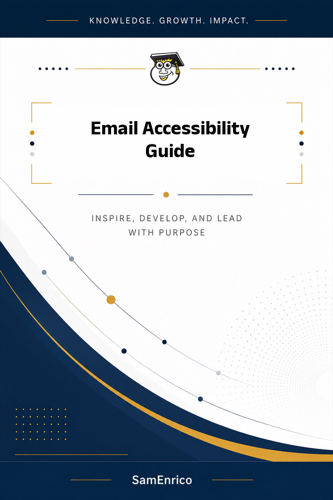
Email Accessibility Guide eBook
Make messages readable for screen readers and visu
Make messages readable for screen readers and visually impaired.
Formats
Free sample
Chapter 1: The $8 Trillion Door...--You are about to read a sentence that will change how you see every email you send for the rest of your career.More than one billion people around the world—fifteen percent of the global population—live with some form of disability. Together, they control over eight trillion dollars in annual disposable income. That is larger than the GDP of every country on earth except the United States and China. And yet, the vast majority of marketing emails are designed in a way that systematically, predictably, and avoidably excludes them.This is not a niche concern. It is not a “nice to have” feature that your compliance officer whispered about in a quarterly review.
It is the single largest untapped audience in the history of digital marketing, and you have been leaving money on the table every single time you hit “send.”But here is the part that should keep you awake tonight: inaccessible emails don’t just lose revenue. They create legal liability. They damage brand reputation. And they tell over a billion people, silently but unmistakably, that you do not care whether they can read your message.This chapter is not about guilt. It is not about compliance checkboxes or performative inclusivity.
It is about understanding why accessibility matters—not as an obligation, but as an opportunity. By the time you finish these pages, you will see your email program differently. You will understand the three distinct types of disability that affect how people read your messages. You will know exactly how much money you are currently losing. And you will be ready to do something about it.Let us begin with a story.The Email That Never Arrived A few years ago, a marketing director for a mid-sized e-commerce company—let us call her Maria—discovered something that nearly ended her career.Maria was not new to email.
She had been running campaigns for over a decade. She knew about open rates, click-through rates, and deliverability. She had never thought about accessibility because, in her words, “no one had ever complained.”Then her company was acquired by a European parent organization. As part of the due diligence, an accessibility audit was conducted. The results were brutal.Of the 847 email templates Maria’s team had built over the previous eighteen months, exactly zero passed even the most basic accessibility screening.
Her most successful campaign—a beautifully designed promotional email with layered images, custom fonts, and animated GIFs—was completely illegible to anyone using a screen reader. The headline was an image with no alt text. The call-to-action button was an image with no alt text. The product grid was a table without role="presentation", causing the screen reader to announce “Table with three columns, Table with three rows” before every single product.When Maria finally listened to her own email using Voice Over on an i Phone, she sat in silence for a full minute. What she heard was not a marketing message.
It was chaos.“Image. Image. Link. Table with three columns. Image.
Button. Image. Click here. Image.”She had no idea what the email was selling. Neither did the estimated fourteen percent of her subscribers who used assistive technology.Maria’s story has a happy ending—she rebuilt her email program from scratch, became an accessibility advocate, and eventually presented her turnaround at a major industry conference.
But her story is also a warning. She assumed that because no one complained, no one was harmed. That is almost never true.People with disabilities rarely complain about inaccessible emails. They simply delete them and move on to a brand that respects their time and attention. You are not being told about the problem because your customers have already given up on you.The Three Disability Models You Must Understand Before we go any further, we need to talk about how disability actually works.
Most people think of disability as a fixed, permanent condition—someone who is blind, someone who uses a wheelchair, someone who is Deaf. That is one part of the story, but it is not the whole story.The most useful framework for email accessibility comes from a concept called the “Permanent, Temporary, Situational” model. It was popularized by Microsoft’s Inclusive Design toolkit, and it will change how you think about every design decision you make.Permanent disabilities are what most people imagine when they hear the word “disability.” These include blindness, low vision, deafness, mobility impairments that require keyboard-only navigation, and cognitive conditions like dyslexia. Approximately fifteen percent of the global population has a permanent disability. That is one in seven people.
If your email list has ten thousand subscribers, roughly fifteen hundred of them have a permanent disability. If you are not designing for them, you are ignoring fifteen hundred people every single time you send a campaign.Temporary disabilities are exactly what they sound like—conditions that affect someone for a limited period of time. A broken arm that makes it impossible to use a mouse. Eye surgery that leaves someone sensitive to bright light and unable to read small text. A concussion that makes it difficult to process complex sentences.
At any given moment, a significant percentage of your audience is experiencing a temporary disability. They need the same accommodations as someone with a permanent disability, but they may not even think of themselves as “disabled.” They are just frustrated that your email is hard to use.Situational disabilities are the most overlooked category, and they are also the most common. These are limitations created by the environment, not by the person’s body. A parent holding a baby in one arm can only use a phone with their thumb—that is a situational mobility impairment. Someone reading email on a phone in bright sunlight struggles with low contrast—that is a situational visual impairment.
A person listening to email while driving relies entirely on audio—that is a situational auditory and cognitive impairment. Situational disabilities affect virtually everyone at some point. When you make your emails accessible to people with permanent disabilities, you also make them better for everyone else.Here is the key insight that separates successful accessibility programs from failed ones: you do not need to know which of your subscribers has a disability. You do not need to segment your list. You do not need to ask anyone to self-identify.
You simply need to build emails that work for everyone, regardless of their permanent, temporary, or situational context.The Financial Case: Why $8 Trillion Is Not Hyperbole Let us talk about money, because that is what ultimately drives decisions in most organizations.The World Health Organization and the World Bank jointly estimate that over one billion people—fifteen percent of the global population—live with some form of disability. That is not a fringe group. That is larger than the entire population of Europe.But population size alone does not tell the full story. The disability community also controls an estimated eight trillion dollars in annual disposable income. This figure includes not only the earnings of people with disabilities but also the household income of families who make purchasing decisions with accessibility in mind.To put eight…
This is the end of the free sample. Get the eBook to keep going. Buy now
About this book
Details
- Author
- Keefe Rosario
- Publisher
- SamEnrico
- Language
- English
- Genre
- Non-Fiction, Business Brief, Accessibility
- Released
- 2026-06-06
- Pages (approx.)
- 113
- Available as
- eBook, Audiobook

Read better in the ZLOADR app
Your eBooks on your phone or tablet. Sign in with your SamEnrico account and start reading.
More by Keefe Rosario
 Snapchat Map Comparison GuideKeefe Rosario$11.99
 Lithuanian RES Incentive UpdateKeefe Rosario$11.99
 Benzo Withdrawal Insomnia SolutionKeefe Rosario$11.99
 The Day the Sky Fell: The Great Meteor Procession of 1860Keefe Rosario$11.99
 The Billionaire Who Gave It All Away: The Untold Story of Chuck FeeneyKeefe Rosario$11.99
 Understanding Hypotrichosis Mental Retardation Lopes TypeKeefe Rosario$17.99
 Home-Based Craft Product BusinessKeefe Rosario$11.99
 UK Green Incentives WorkbookKeefe Rosario$12.99
 Bionic Reading Tools GuideKeefe Rosario$12.99
 How to Start a Hobby in Napoleonic war reenactmentKeefe Rosario$11.99
You may also like
 Hong Kong Handover 1997Dunn Johnnie$11.99
 Zumba For Postnatal Recovery CourseNeal Christian$11.99
 Zumba for BeginnersLadner Nikia$11.99
 YouTube Comment Mining GuideHumes Pandora$12.99
 Worry Box MeditationCarlin Rudy$11.99
 Workplace Stress MeditationNguyen Lynn$11.99
 Workplace Stress and Sleep RepairHawley Ivory$11.99
 Workplace Perfectionism CureDelaney Jeffry$11.99
 Workplace Injustice Anger GuideWallen Isabelle$11.99
 Work Addiction and Burnout LinkGreenwood Ester$11.99
 Women in Yoga and WellnessBeattie Galina$11.99
 Women in Stand Up ComedyChun Evangeline$11.99