
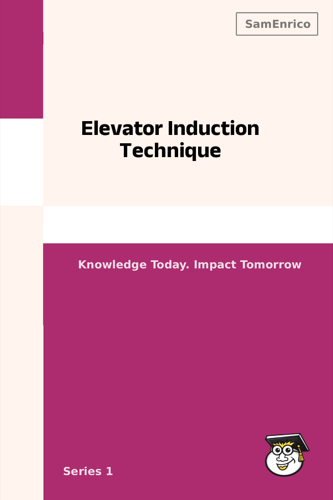
Elevator Induction Technique eBook
Ride a mental elevator into self hypnosis trance u
by Willis Dawn
Ride a mental elevator into self hypnosis trance using this creative workbook.
Formats
Free sample
Chapter 1: Permission to Descend--–- You are about to learn a skill that your brain already knows how to do.That sentence may sound like a paradox. How can you learn something you already know? But consider this: you have already experienced hypnosis. Not once, not twice, but hundreds of times. Every time you have driven a familiar route and arrived at your destination with no memory of the last several miles, you were in a spontaneous hypnotic trance.
Every time you have become so absorbed in a movie that the outside world disappeared, you were in trance. Every time you have woken up in the morning and remained suspended in that delicious state between sleeping and waking—aware but not yet active—you were in trance.Hypnosis is not a mysterious power bestowed upon a chosen few. It is not mind control, stage magic, or a sign of weakness. It is a natural, biological state that your brain enters multiple times per day. The only thing you have been missing is the ability to enter that state on purpose.This book will give you that ability.
And it will do so using a metaphor so simple, so universal, and so deeply wired into your nervous system that you will never forget it: the elevator.Why Most Self-Hypnosis Books Fail Before we build your elevator, we need to clear away some debris. The self-help industry has done you a disservice. It has sold you the idea that changing your mind requires endless effort, willpower, and suffering. It has told you that meditation requires emptying your mind—an impossibility for anyone with a functioning prefrontal cortex. It has handed you scripts written by strangers and asked you to recite them like a robot, hoping that somewhere inside your skull, magic would happen.It didn't work.
Not because you are broken. Because the approach was broken.Most self-hypnosis books are text-heavy, one-size-fits-all, and boring. They treat the reader as a passive receiver of instructions rather than an active creator of their own experience. They assume that if you just read the right words in the right order, your subconscious will obediently comply. That is not how the mind works.Your subconscious mind does not speak in logical sentences.
It speaks in symbols, images, metaphors, and feelings. It does not respond to commands like a trained dog. It responds to invitations, stories, and experiences. This is why the elevator metaphor is so powerful. You already know what an elevator is.
You already know what it feels like to go down. You already have decades of neural circuitry dedicated to understanding vertical descent. We are not teaching you something new. We are activating something ancient.The Critical Factor: Why Your Conscious Mind Gets in the Way Every human being has what hypnotists call the "critical factor." This is the part of your conscious mind that evaluates incoming information for safety, logic, and consistency. It is your internal gatekeeper, and it has kept you alive your entire life.
When someone suggests something that seems dangerous or impossible, the critical factor slams the door shut.The problem is that the critical factor is overzealous. It does not distinguish between physical danger and psychological discomfort. It does not know the difference between "jumping off a cliff" and "trying a new relaxation technique." Anything unfamiliar is treated as potentially threatening.This is why you cannot simply decide to relax. The moment you try, your critical factor wakes up and says, "Why are you trying so hard? Are you doing it right?
This isn't working. You're failing at relaxing—which is absurd because relaxing isn't something you can fail at, yet here you are, failing." This internal monologue is not a sign that you are bad at hypnosis. It is a sign that your critical factor is doing its job.The genius of the elevator induction is that it gives your critical factor something to do. It gives your conscious mind a simple, concrete, non-threatening task: imagine an elevator. Imagine pressing a button.
Imagine going down. Your critical factor happily occupies itself with this task, and while it is distracted, the doors to your subconscious swing quietly open.The Vertical Descent Advantage Why does going down work better than going up or simply relaxing?Neuroscience offers a compelling answer. Your brain has something called the "default mode network"—a set of interconnected brain regions that is most active when you are not focused on the outside world. Daydreaming, mind-wandering, and spontaneous hypnosis all involve the default mode network. Research has shown that the expectation of downward movement triggers a relaxation response that is measurably different from the expectation of upward movement or stationary relaxation.In practical terms: when you ride an elevator down in your imagination, your body responds as if it were really descending.
Your heart rate slows. Your breathing deepens. Your muscles release tension. Your brain waves shift from beta (active thinking) to alpha (relaxed awareness) to theta (deep hypnosis and meditation). This is not wishful thinking.
This is psychophysiology.The elevator induction works faster than traditional progressive muscle relaxation because it engages spatial memory and anticipation. Your brain does not have to work hard to understand "relax your toes, now your feet, now your ankles"—that takes time and effort. But your brain understands "going down" instantly. You have ridden thousands of elevators in your life. Each ride has left a trace.
We are simply going to activate those traces on purpose.What This Book Is and What This Book Is Not Let us be clear about what you are holding.This is not a textbook. You will not find dense academic language or footnotes to obscure journals. The science is real, but it is delivered in plain English.This is not a collection of scripts. You will not be told to repeat someone else's words like a parrot. You will build your own language, your own images, your own elevator.This is not a passive read.
You cannot simply consume these pages and expect transformation. This is a workbook. Every chapter contains exercises, drawings, quizzes, and experiments. The book is designed to be written in, drawn on, cut up, and personalized. By the time you finish, your copy will look nothing like anyone else's—and that is exactly the point.This book is a set of tools.
The elevator is the primary tool. The call button, the lobby, the button panel, the descent, the renovation floor, the express elevator, the emergency stop—each chapter adds a new tool to your belt. By Chapter 12, you will have a complete system for entering deep trance on demand, rewiring limiting beliefs, managing pain and anxiety, and returning to waking life refreshed and energized.The Myth-Busting Quiz: What You Probably Believe About Hypnosis (That Is Wrong)Before we go any further, let us clear out some misconceptions. Take out a pen or open a note on your phone. Answer the following ten questions as honestly as you can.
There are no wrong answers—only information that will help us understand where you are starting from.True or False: Hypnosis is a form of sleep.True or False: You can get stuck in…
This is the end of the free sample. Get the eBook to keep going. Buy now
About this book
Details
- Author
- Willis Dawn
- Publisher
- SamEnrico
- Language
- English
- Genre
- Non-Fiction, Self-Help, Imagery
- Released
- 2026-06-06
- Pages (approx.)
- 143
- Available as
- eBook, Audiobook

Read better in the ZLOADR app
Your eBooks on your phone or tablet. Sign in with your SamEnrico account and start reading.
More by Willis Dawn
 Palliative Care Financial HelpWillis Dawn$11.99
 Returning Items Addiction CycleWillis Dawn$11.99
 The Teen Mom PPD GuideWillis Dawn$11.99
 Dietary Changes for Menopause SleepWillis Dawn$11.99
 Body Language for DoctorsWillis Dawn$11.99
 Aspirational OKRs GuideWillis Dawn$11.99
 The Green Pioneers: Black Naturalists Who Decoded the WildWillis Dawn$11.99
 The Jinn of the Empty Quarter: Sandborn and the Whispering StormsWillis Dawn$11.99
 Marine Toads: Cane ToadWillis Dawn$11.99
 How to Produce Pencil SharpenersWillis Dawn$11.99
 How to Produce a Crompton Loom WorksWillis Dawn$11.99
 A Beginners Guide to Street racing (Volume 1)Willis Dawn$11.99
You may also like
 Hong Kong Handover 1997Dunn Johnnie$11.99
 Zumba For Postnatal Recovery CourseNeal Christian$11.99
 Zumba for BeginnersLadner Nikia$11.99
 YouTube Comment Mining GuideHumes Pandora$12.99
 Worry Box MeditationCarlin Rudy$11.99
 Workplace Stress MeditationNguyen Lynn$11.99
 Workplace Stress and Sleep RepairHawley Ivory$11.99
 Workplace Perfectionism CureDelaney Jeffry$11.99
 Workplace Injustice Anger GuideWallen Isabelle$11.99
 Work Addiction and Burnout LinkGreenwood Ester$11.99
 Women in Yoga and WellnessBeattie Galina$11.99
 Women in Stand Up ComedyChun Evangeline$11.99