
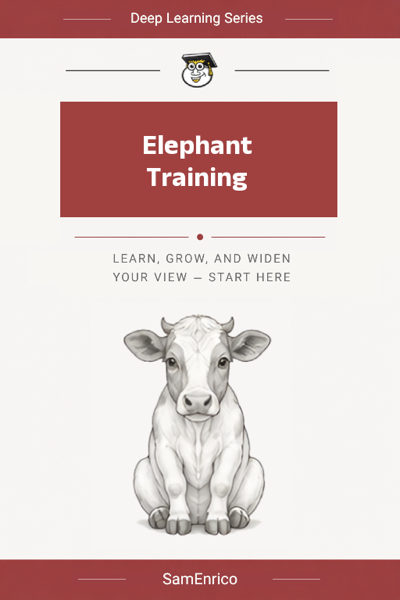
Non-FictionInformativeEducational
Elephant Training eBook
A Coursebook on Elephant Training
A Coursebook on Elephant Training
Formats
Free sample
Chapter 1: The Question We Feared...--For two thousand years, we have been asking the wrong question. The question we have asked—the question that has filled libraries, fueled colonial expeditions, and justified the ankus in the trembling hands of a thousand mahouts—is this: How do we make an elephant obey?It is the wrong question.Not because obedience is useless. A nine-thousand-pound animal that does not obey is a nine-thousand-pound disaster waiting to happen. Every trainer who has ever stood in the path of a charging bull knows that obedience is not a luxury; it is a wall between the living and the dead. But obedience is a result, not a method.
And when we obsess over the result without understanding the animal that produces it, we build our training on sand.The right question—the question the best trainers have always asked, though they have not always known how to answer it—is this: How does an elephant learn?This book is an attempt to answer that question. Not with recipes or tricks or the kind of certainty that comes from never having been knocked to the ground by a musth bull who decided you looked like a threat. But with something rarer and more useful: a framework for understanding the elephant as a thinking, feeling, learning being, and a set of principles for building a relationship that serves both the trainer and the trained.But before we can talk about how elephants learn, we need to talk about how we have failed to teach them. Because the history of elephant training is not a story of steady progress from darkness to light. It is a story of alternating brilliance and brutality, of traditions that understood the elephant’s soul and systems that tried to break it.
And unless we understand that history—the good, the bad, and the truly horrifying—we will repeat it. We always do.The Oldest Manual The earliest known text on elephant training is the Matanga Lila, or "The Sport of Elephants," a Sanskrit manuscript dating from somewhere between the 4th and 12th centuries CE. No one knows exactly when it was written. The oldest surviving manuscripts are from the 16th century, but the traditions it records are far older. Elephants had been captured and trained in India for at least a thousand years before the Matanga Lila was copied onto palm leaves.The Matanga Lila is a strange document.
Read one section, and you find yourself in the presence of profound wisdom. The text classifies elephants into four castes—Bhadra (gentle), Manda (dull), Mrga (wild), and Sankirna (mixed)—and prescribes different training regimens for each. It describes in loving detail the ideal daily routine: morning bathing with coconut husks and ash, massage of the feet with mustard oil, a diet of rice balls and sugarcane, and evening tethering in a clean, well-drained enclosure. The elephant, in the Matanga Lila, is treated as a being of dignity and complexity, one whose "favorable marks" (whorls of hair, patterns of wrinkles, the shape of the trunk tip) reveal its temperament and destiny.But read another section of the same text, and you find something else entirely. The Matanga Lila also contains detailed instructions for pitfall trapping—digging a camouflaged pit, driving a wild herd toward it, and extracting the fallen elephant with ropes and tame decoys.
The text does not flinch from describing the injuries that result: broken legs, crushed ribs, eyes swollen shut from the fall. It treats these not as tragedies but as acceptable costs. The captured elephant, once it has healed (or not), is then subjected to a "breaking" process of sleep deprivation, starvation, and repeated jabbing with the ankus—the pointed hook that remains, to this day, the most infamous tool in elephant management.The Matanga Lila, in other words, is not a single coherent philosophy. It is a library of techniques accumulated over centuries, some wise and some cruel, all preserved because they worked—if "worked" means "produced a functional elephant." The ancient Indians did not ask whether the elephant suffered. They asked whether the elephant carried the howdah.This is the first lesson of elephant training history, and it is a lesson we keep forgetting: a tradition can be both sophisticated and brutal.
The same culture that produced the Matanga Lila also produced the Arthashastra, a treatise on statecraft that recommends blinding enemy elephants as a military tactic. The same mahouts who sang lullabies to their elephants also jabbed them with hooks. We do not have to choose between romanticizing the past and condemning it. We can do both. We must do both.The Colonial Catastrophe If the Matanga Lila represents the ancient world's ambivalent relationship with elephants—simultaneously reverent and utilitarian—the British colonial period represents something simpler: pure, unapologetic extraction.The British arrived in India in the 17th century as traders and left as rulers.
Along the way, they discovered that elephants were useful. Very useful. Elephants could haul artillery through terrain that would swallow a horse. Elephants could drag teak logs out of forests that no cart could enter. Elephants could carry a maharaja in a howdah so heavy it would break a camel's back.
And elephants, unlike horses, did not panic at the sound of gunfire—at least, not once they were trained.The British did not invent the Keddah system of wild elephant capture. The Keddah—a massive funnel of logs and vegetation that narrows to a small corral—had been used in Sri Lanka and Bengal for centuries. But the British industrialized it. Where a local ruler might capture a dozen elephants in a year, the British East India Company captured hundreds. The process was brutally efficient: drive a herd into the funnel, close the gate, and then wait.
The elephants, confined and terrified, would be subjected to "the process"—a regime of sleep deprivation, starvation, and rhythmic prodding with the ankus until their spirits broke.We have firsthand accounts. The British were not ashamed of what they did; they wrote about it with the same clinical detachment they applied to steam engines and cotton gins. Here is a British officer describing a Keddah capture in Bengal in 1845:The elephants, after three days without food or rest, become lethargic. The trained decoys are introduced, and the wild animals, seeing their calmness, begin to calm themselves. The mahouts enter the enclosure with the ankus and select the largest bull.
He is hobbled, and the process of "training" begins. It is a matter of time before he accepts the rope."Accepts the rope." Not learns—accepts. Accepts because the alternative is death. Accepts because his body has given up even when his mind has not. Accepts because he has entered what modern psychology calls learned helplessness: the state in which an animal stops trying to escape from aversive stimuli because it has learned, through repeated failure, that escape is impossible.We will return to learned helplessness in Chapter 7, when we discuss the psychology of "breaking." For now, it is enough to note that the British Keddah system was not training.
It was torture. And it produced elephants who were not trained but broken—animals who had been reduced to compliance by…
This is the end of the free sample. Get the eBook to keep going. Buy now
About this book
Details
- Author
- Littlefield Kimberley
- Publisher
- SamEnrico
- Language
- English
- Genre
- Non-Fiction, Informative, Educational
- Released
- 2026-06-03
- Pages (approx.)
- 139
- Available as
- eBook, Audiobook

Read better in the ZLOADR app
Your eBooks on your phone or tablet. Sign in with your SamEnrico account and start reading.
More by Littlefield Kimberley
 Fireplace Sleep VisualizationLittlefield Kimberley$11.99
 Comparison in Chronic IllnessLittlefield Kimberley$11.99
 Pelvic Floor Laser TherapyLittlefield Kimberley$11.99
 The Reject Diet Mentality GuideLittlefield Kimberley$11.99
 Slow Eating Pace LongevityLittlefield Kimberley$11.99
 Ashoka's Redemption: The Blood of Kalinga (261 BC)Littlefield Kimberley$11.99
 Non Resident LLC Audit DefenseLittlefield Kimberley$12.99
 Nairobi Startup EventsLittlefield Kimberley$12.99
 The Breeder's Guide to Dartmoor HorsesLittlefield Kimberley$11.99
 How to Become a Light-fixture ServicerLittlefield Kimberley$11.99
You may also like
 Hong Kong Handover 1997Dunn Johnnie$11.99
 Zumba For Postnatal Recovery CourseNeal Christian$11.99
 Zumba for BeginnersLadner Nikia$11.99
 YouTube Comment Mining GuideHumes Pandora$12.99
 Worry Box MeditationCarlin Rudy$11.99
 Workplace Stress MeditationNguyen Lynn$11.99
 Workplace Stress and Sleep RepairHawley Ivory$11.99
 Workplace Perfectionism CureDelaney Jeffry$11.99
 Workplace Injustice Anger GuideWallen Isabelle$11.99
 Work Addiction and Burnout LinkGreenwood Ester$11.99
 Women in Yoga and WellnessBeattie Galina$11.99
 Women in Stand Up ComedyChun Evangeline$11.99