
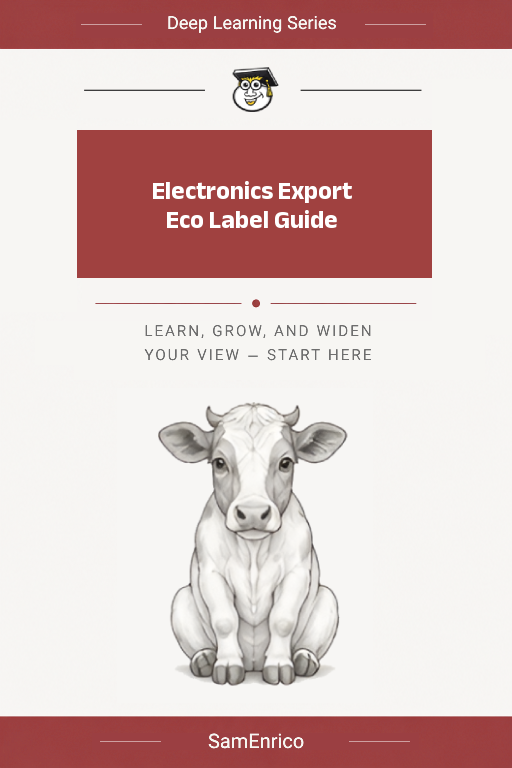
Electronics Export Eco Label Guide eBook
Details TCO Certified, EPEAT, and Energy Star for
Details TCO Certified, EPEAT, and Energy Star for electronics exporters, including substance restrictions and recyclability requirements.
Formats
Free sample
Chapter 1: The Container That Never Left--–- The 2:47 AM phone call that changed everything for a $50 million electronics exporter—and why your next shipment is at even greater risk.The phone rang at 2:47 AM Shanghai time. On the other end was a logistics manager in Rotterdam, and his voice carried the particular strain of someone delivering news that would cost someone else a great deal of money."Your container was flagged," he said. "Customs held it for document review."Li Wei, export director for a mid-sized electronics manufacturer I will call Future Power, sat up in bed. His company had been shipping monitors to Europe for seven years without a single customs delay. They had CE marking.
They had Ro HS compliance. They had paid extra for Energy Star certification on every model."What's missing?" Li asked."They're asking for proof of TCO certification and EPEAT registration."Li had never heard of TCO. He thought EPEAT might be a type of yoga mat.That container sat on the Rotterdam dock for six weeks. By the time Future Power scrambled to understand the requirements, contract a testing lab, and generate the necessary documentation, their buyer had already canceled the order and signed with a Korean competitor who had all their certifications in order.The total loss: 2.7millioninproduct,2.7 million in product, 2.7millioninproduct,180,000 in storage and demurrage fees, and the entire European distribution relationship that had taken five years to build.This book exists because that story is about to become the norm, not the exception.Between December 2025 and January 2027, three major regulatory and certification shifts will converge. The US government is tightening its EPEAT requirements for federal procurement.
The European Union is phasing in its Ecodesign for Sustainable Products Regulation (ESPR) with mandatory Digital Product Passports. And the entire electronics industry is grappling with new restrictions on PFAS—"forever chemicals"—that are embedded in everything from cable jacketing to semiconductor manufacturing.The exporters who survive this transition will be the ones who understand three certification systems: TCO Certified, EPEAT, and Energy Star. Not as abstract compliance exercises, but as strategic tools for market access.The ones who ignore these changes will join Future Power in the growing graveyard of exporters who learned about ecolabels the hard way—when their container was already on the water.The Myth of Voluntary Compliance For most of the past two decades, environmental certifications for electronics occupied a strange middle ground. They were technically voluntary, but large buyers—particularly governments and multinational corporations—increasingly demanded them. This created a comfortable fiction: you could choose to certify, or you could choose to sell to less demanding customers.That fiction expired in 2022.In that year, the European Union revised its Green Public Procurement (GPP) criteria for IT hardware.
The new rules mandated that 55 percent of all tenders for computers, monitors, and imaging equipment must include ecolabel criteria as a technical specification. Not a suggestion. Not a preference. A requirement.The math is brutal. If you export electronics to the EU and you do not hold the relevant ecolabels, you are automatically disqualified from more than half of all government tenders.
And because large private buyers often mirror government standards, the actual market exclusion is closer to 65 to 70 percent of the institutional market.The United States followed a similar path, though through a different mechanism. The Federal Acquisition Regulation (FAR) does not mandate ecolabels outright. Instead, it gives preferential treatment to products registered with EPEAT, the Electronic Product Environmental Assessment Tool. In practice, this preference is so strong that winning a federal contract without EPEAT registration is virtually impossible. The General Services Administration, which manages federal purchasing, has explicitly stated that EPEAT is the "preferred means" of meeting environmental requirements for electronics.Between the EU and the US, we are talking about approximately $200 billion in annual electronics procurement that now effectively requires ecolabel certification as a condition of bidding.But here is where most exporters get confused.
They hear "ecolabel" and think of Energy Star. And Energy Star is important—critically so for energy efficiency. But Energy Star alone will not save you.The Three Labels and Their Deadly Gaps To understand why Future Power lost their container, we need to understand the three certification systems that govern electronics exports. Each serves a different purpose. Each has different strengths.
And each has critical gaps that the others fill.Energy Star: The Efficiency Standard Energy Star is the oldest and most widely recognized of the three labels. It is administered by the US Environmental Protection Agency and focuses exclusively on energy efficiency during product use.For a monitor, Energy Star version 8.0 requires on-mode power consumption of no more than (6 × diagonal inches + 40) watts. For a 24-inch monitor, that means maximum power of 184 watts. Sleep mode must draw no more than 0.5 watts. Computers face Total Energy Consumption (TEC) limits that vary by form factor, with sleep mode capped at 2.0 watts and idle at 30 watts for most configurations.These are demanding standards.
Meeting them requires careful design of power supplies, display backlights, and processor power management. Many products fail Energy Star not because they are inefficient overall, but because they have one weak mode—usually sleep or idle—that pushes them over the limit.However, Energy Star has three critical weaknesses that exporters must understand.First, it covers only energy use. Nothing else. A product could be built with leaded solder, PVC cables treated with phthalates, and plastic casings loaded with brominated flame retardants, and still earn Energy Star certification. The label tells you nothing about materials, recyclability, chemical safety, or supply chain ethics.Second, for most product categories, Energy Star accepts manufacturer self-testing using EPA-approved test methods.
This is not third-party verification. While this keeps costs low—typically 0to0 to 0to1,000 per product family—it also means that customs officials and sophisticated buyers increasingly discount Energy Star claims. They have seen too many self-declarations that were, to put it charitably, optimistic.Third, and most important for exporters, Energy Star alone will not satisfy government procurement requirements in either the EU or the US. The EU GPP requires multi-attribute criteria that go far beyond energy. The US FAR gives preference to EPEAT, not Energy Star.This is not to say Energy Star is useless.
It is essential for the US consumer market and for Asian markets like Japan and South Korea that have their own energy labeling requirements. It is also harmonized with TCO Certified's energy criteria, meaning that proper energy testing can serve both certifications simultaneously. But Energy Star is a foundation, not a complete house.EPEAT: The US Government's Choice EPEAT—the Electronic Product Environmental Assessment Tool—was developed by the Green Electronics Council with funding from the US EPA. It is a registry system, not a certification in the traditional sense. Manufacturers self-declare compliance with a set of criteria, and those declarations are published on the EPEAT registry for buyers to review.The critical distinction is that EPEAT is primarily for institutional buyers in the United States.
Federal agencies, state governments, universities, and large corporations use EPEAT as their procurement standard. Outside the US, EPEAT has limited traction, though some multinational buyers use it globally for consistency.EPEAT organizes its criteria into…
This is the end of the free sample. Get the eBook to keep going. Buy now
About this book
Details
- Author
- Hutchison Chae
- Publisher
- SamEnrico
- Language
- English
- Genre
- Non-Fiction, Business Brief, Electronics Compliance
- Released
- 2026-06-01
- Pages (approx.)
- 142
- Available as
- eBook, Audiobook

Read better in the ZLOADR app
Your eBooks on your phone or tablet. Sign in with your SamEnrico account and start reading.
More by Hutchison Chae
 Creator Bookkeeping BasicsHutchison Chae$11.99
 Brand Adaptation For Foreign MarketsHutchison Chae$11.99
 Public Speaking Imposter SyndromeHutchison Chae$11.99
 The Teen Neurodivergent Confidence GuideHutchison Chae$11.99
 The Food Addiction Family GuideHutchison Chae$11.99
 The Star Keepers of Ethiopia: The Royal Astronomers of AksumHutchison Chae$11.99
 Concrete ForemanHutchison Chae$11.99
 Search Console URL ParametersHutchison Chae$12.99
 Understanding Prieur–griscelli SyndromeHutchison Chae$17.99
 How to Become a Compound MixerHutchison Chae$11.99