
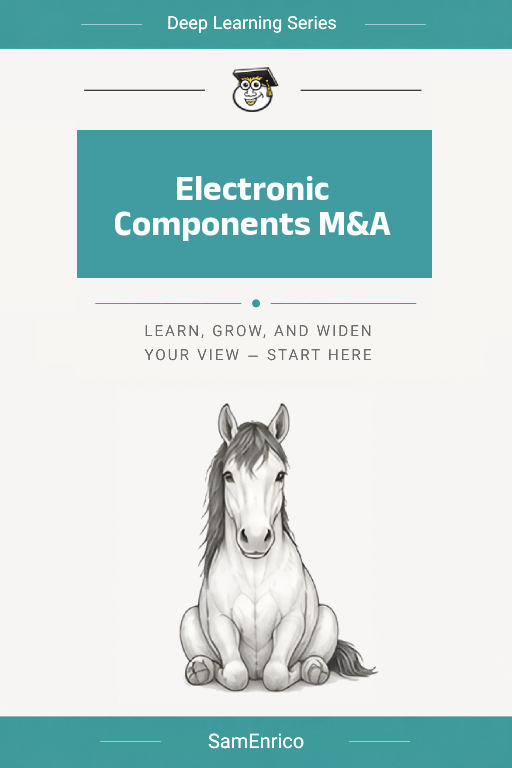
Non-FictionStrategic AtlasElectronics M&A
Electronic Components M&A eBook
Map connector, sensor, and passive component targe
Map connector, sensor, and passive component targets for TE Connectivity, Amphenol, Molex, and Samtec.
Formats
Free sample
Chapter 1: The Plastic Emperor...--–- In a windowless conference room on the third floor of a nondescript office building in Wallingford, Connecticut, a sixty-two-year-old engineer named Adam Norwitt did something that would reshape a $250 billion industry. He picked up a plastic connector — the kind that costs seventeen cents in volume, the kind that nobody notices until it fails — and he held it up to a boardroom of skeptical bankers. "This," he said, "is why we will win."The year was 2025. Norwitt was not a tech visionary in the Steve Jobs mold. He did not wear turtlenecks or speak in grand metaphors about changing the world.
He was a connector man — specifically, the CEO of Amphenol Corporation, the second-largest manufacturer of electronic connectors on the planet. And on that day, he was asking for permission to spend $10.5 billion of his company's money to acquire the connectivity assets of Comm Scope, a struggling telecommunications equipment maker.The bankers were confused. Comm Scope was known for wireless infrastructure — cell towers, antennas, the hardware that puts your phone calls through. Amphenol was known for connectors — the plastic-and-metal shells that join wires together. Why would a connector company buy a wireless company?
Was Norwitt trying to build a phone network? Did he want to compete with Ericsson and Nokia?No. Norwitt was playing a much deeper game. He was betting that the future of artificial intelligence — the trillion-dollar boom in data centers, the explosion of 800-gigabit and 1.6-terabit links — would be won or lost not in Silicon Valley server farms, but in the humble, overlooked world of optical fiber interconnects. And he was betting that his competitors — TE Connectivity, Molex, and the scrappy upstart Samtec — had not yet realized how quickly the ground was shifting beneath their feet.This book is about that bet, and about the war that followed.
It is a book about four companies that most people have never heard of, fighting for control of a component that most people have never thought about. But the stakes are enormous. Every electric vehicle, every AI data center, every guided missile, every heart monitor, every airplane, every factory robot — every single one depends on electronic connectors. And whoever controls the connectors controls the flow of electrons. Whoever controls the flow of electrons controls the modern world.The Invisible Infrastructure Let us begin with a confession: before researching this book, I did not think about connectors.
I suspect you did not either. They are not glamorous. They do not appear in Apple keynotes. No venture capitalist has ever pitched a "disruptive connector startup" with a straight face. They are the plumbing of electronics — the PVC pipes and copper joints of the digital age — and like real plumbing, they only attract attention when they fail.But here is the secret that the four companies in this book understand: connectors are the one component that every electronic device cannot avoid.
A computer can work without a disk drive (cloud storage). A phone can work without a headphone jack (Bluetooth). A car can work without a CD player (streaming). But no device can work without connectors. Every circuit board, every wire harness, every sensor, every power supply — they all terminate in connectors.
They are the choke point. They are the tax that every electron must pay.And for the past twenty-five years, the industry that makes these connectors has been undergoing a transformation as dramatic as anything in software or semiconductors — just quieter, and with less money, and with fewer magazine covers.In the year 2000, the electronic connector industry was a fragmented mess. There were hundreds of manufacturers, many of them family-owned, most of them specializing in a single niche: automotive connectors in Germany, RF connectors in Japan, board-to-board connectors in Silicon Valley. The largest player, a Swiss-American company called TE Connectivity (then known as Tyco Electronics), held perhaps twelve percent of the global market. The number two player, a Japanese firm called Hirose Electric, held about six percent.
The rest was scattered across dozens of smaller firms, each defending a tiny castle.Then the consolidation began.The Rise of the Aggregators The story of connector M&A is really the story of two opposing strategies: the Amphenol way and the TE way. They are as different as two approaches to the same problem can be, and understanding their difference is the key to understanding everything that follows.The Amphenol Way — named for the company that perfected it — is aggressive, opportunistic, and relentlessly financial. Amphenol treats M&A the way a private equity firm treats a portfolio: buy undervalued assets, cut costs, improve margins, and repeat. Between 2000 and 2025, Amphenol completed more than eighty acquisitions. Eighty.
That is not a typo. Some years, they bought five or six companies. They bought connector makers, cable assemblers, sensor manufacturers, RF component designers — anything that touched the flow of electrons. They did not care about brand legacy or engineering culture. They cared about EBITDA margins and customer overlap.The result was astonishing.
Amphenol rose from the sixth-largest connector company in the world to the second — and by 2026, it was breathing down TE's neck for the number one spot. Its stock price increased more than twenty-fold during Norwitt's tenure as CEO. And its culture became one of relentless, unsentimental efficiency. If you worked for a company that Amphenol acquired, you learned quickly: adapt or leave.The TE Way is almost the opposite. TE Connectivity (the name stands for "Tyco Electronics," though the company has long since shed the Tyco brand) was born from a series of massive, transformational mergers.
In 1999, Tyco International — a conglomerate known for aggressive dealmaking — acquired the connector division of AMP Incorporated, then the industry leader. In 2007, Tyco Electronics was spun off as an independent company. In 2011, it changed its name to TE Connectivity. And through it all, TE maintained a strategy of organic engineering dominance supplemented by large, carefully chosen acquisitions.Where Amphenol bought dozens of small companies, TE bought a handful of large ones. Where Amphenol integrated ruthlessly, TE allowed acquired units to maintain their engineering cultures.
Where Amphenol's CEO came from a finance background (Norwitt started his career at a leveraged buyout firm), TE's leadership came from engineering. The result was a company that dominated automotive connectors, held strong positions in aerospace and industrial markets, and invested heavily in research and development — but that sometimes moved too slowly to catch the fast-changing trends that Amphenol targeted.Between these two giants, a third player — Molex — waited in the wings. Molex had been a family-owned connector manufacturer for most of its history, founded in 1938 by Frederick Krehbiel in a Chicago basement. But in 2013, the Krehbiel family made a decision that would reshape the competitive landscape: they sold the company to Koch Industries, the massive private conglomerate owned by the Koch brothers. Overnight, Molex gained access to patient, long-term capital — the kind that does not care about quarterly earnings reports.
And slowly, then suddenly, Molex began to spend.The Samtec Exception And then there is Samtec. If the other three companies are elephants — large, powerful, slow to turn — Samtec is a cheetah. It is private. It is smaller. It is run by its founder (or his descendants).
And its entire culture revolves around a single, almost irrational commitment to speed: "Sudden Service," they call it. Ship in…
This is the end of the free sample. Get the eBook to keep going. Buy now
About this book
Details
- Author
- Shrader Lamont
- Publisher
- SamEnrico
- Language
- English
- Genre
- Non-Fiction, Strategic Atlas, Electronics M&A
- Released
- 2026-06-01
- Pages (approx.)
- 157
- Available as
- eBook, Audiobook

Read better in the ZLOADR app
Your eBooks on your phone or tablet. Sign in with your SamEnrico account and start reading.
More by Shrader Lamont
 Finance Essay PromptsShrader Lamont$11.99
 Smart Watch Distraction Management HandbookShrader Lamont$11.99
 Jamaican BPO Tax Incentive GuideShrader Lamont$11.99
 Corporate Boardroom Anger ProtocolShrader Lamont$11.99
 The Strength Training Testosterone GuideShrader Lamont$11.99
 The Charge of the Light Brigade: Courage and Catastrophe at BalaclavaShrader Lamont$11.99
 YouTube Community Tab GuideShrader Lamont$12.99
 Bird Survey Crew LeadShrader Lamont$11.99
 Understanding PoliosophobiaShrader Lamont$17.99
 How to Become a Nurse-midwifeShrader Lamont$11.99
You may also like
 Hong Kong Handover 1997Dunn Johnnie$11.99
 Zumba For Postnatal Recovery CourseNeal Christian$11.99
 Zumba for BeginnersLadner Nikia$11.99
 YouTube Comment Mining GuideHumes Pandora$12.99
 Worry Box MeditationCarlin Rudy$11.99
 Workplace Stress MeditationNguyen Lynn$11.99
 Workplace Stress and Sleep RepairHawley Ivory$11.99
 Workplace Perfectionism CureDelaney Jeffry$11.99
 Workplace Injustice Anger GuideWallen Isabelle$11.99
 Work Addiction and Burnout LinkGreenwood Ester$11.99
 Women in Yoga and WellnessBeattie Galina$11.99
 Women in Stand Up ComedyChun Evangeline$11.99