
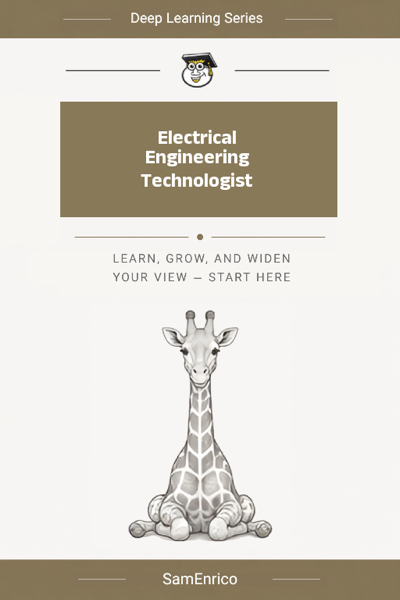
Non-FictionInformativeEducational
Electrical Engineering Technologist Audiobook
A Coursebook on Electrical Engineering Technologis
A Coursebook on Electrical Engineering Technologist
Formats
Free sample
Chapter 1: The Intuition First...--–- Most new technologists make the same mistake. They reach for a calculator before they reach for a wire. They memorize Ohm’s Law but cannot feel it in their fingertips when a circuit goes wrong. This chapter exists to rewire that instinct. Before we derive a single equation, before we simulate a single node, we will build something real and measure something true.
The goal is not mathematical perfection. The goal is electrical intuition. By the time you finish these pages, you will trust your multimeter more than your calculator, and you will understand why the theoretical world and the physical world never perfectly align.The Great Divide: Theory Versus Reality Electrical engineering textbooks love ideal components. They present perfect voltage sources that never sag, resistors with exact labeled values, and wires with zero resistance. These abstractions are necessary for learning the mathematics, but they become dangerous when a technologist believes them.In the theoretical world, a voltage divider with two 1kΩ resistors produces exactly 5.00V from a 10.00V source.
In the real world, that same divider gives you 4.97V. Why? Because the 10V supply sags under load. Because the resistors have ±5% tolerance, meaning one might be 980Ω and the other 1020Ω. Because your multimeter, when set to its 10MΩ input impedance, draws a tiny current that changes the circuit it is trying to measure.The technologist’s mindset accepts these discrepancies as features, not bugs.
Every difference between calculation and measurement is a clue. A 4.97V reading instead of 5.00V tells you something about the circuit’s health. A reading that drifts tells you about thermal effects. A reading that jumps tells you about a loose connection.This chapter builds the foundation for that diagnostic mindset. We will start with the simplest possible circuits and learn how to measure them correctly.
We will intentionally create faults and observe their signatures. By the end, you will no longer see a voltage divider as a math problem. You will see it as a system of real components with real imperfections that you can probe, test, and trust.Ohm’s Law: The One Equation You Cannot Escape Every electrical technologist must internalize Ohm’s Law to the point of reflex. The equation itself is simple: voltage equals current times resistance, or V = I × R. But its three algebraic forms each reveal a different relationship:– V = I × R…
This is the end of the free sample. Get the Audiobook to keep going. Buy now
About this book
Details
- Author
- Painter Laticia
- Publisher
- SamEnrico
- Language
- English
- Genre
- Non-Fiction, Informative, Educational
- Released
- 2026-05-04
- Pages (approx.)
- 160
- Available as
- eBook, Audiobook

Listen in the VoxFlicks app
Audiobooks and audio dramas wherever you go. Sign in with your SamEnrico account and press play.
More by Painter Laticia
 Stress And Dental CariesPainter Laticia$11.99
 Humor Loci EnhancementPainter Laticia$11.99
 Remote Review Recording LawsPainter Laticia$11.99
 Intimate Partner Trigger GuidePainter Laticia$11.99
 The AI Industry Capital GuidePainter Laticia$11.99
 The Phantom of Talavera: Wellington’s Ghostly GambitPainter Laticia$11.99
 How to Start a Paint and Varnish (retail) Business (Beginners Guide)Painter Laticia$11.99
 Mentor Relationship First 90 DaysPainter Laticia$12.99
 Oil and Gas ESG Peer ComparisonPainter Laticia$12.99
 Understanding ParacoccidioidomycosisPainter Laticia$17.99
You may also like
 Hong Kong Handover 1997Dunn Johnnie$11.99
 Zumba For Postnatal Recovery CourseNeal Christian$11.99
 Zumba for BeginnersLadner Nikia$11.99
 YouTube Comment Mining GuideHumes Pandora$12.99
 Worry Box MeditationCarlin Rudy$11.99
 Workplace Stress MeditationNguyen Lynn$11.99
 Workplace Stress and Sleep RepairHawley Ivory$11.99
 Workplace Perfectionism CureDelaney Jeffry$11.99
 Workplace Injustice Anger GuideWallen Isabelle$11.99
 Work Addiction and Burnout LinkGreenwood Ester$11.99
 Women in Yoga and WellnessBeattie Galina$11.99
 Women in Stand Up ComedyChun Evangeline$11.99