
Non-FictionHealth & WellnessGeriatric
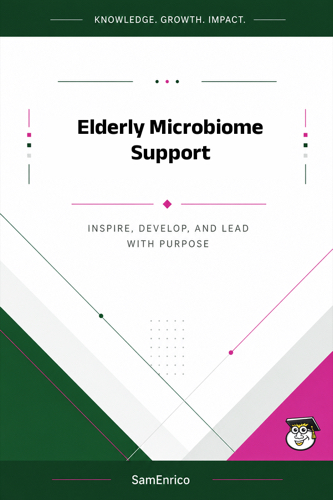
Elderly Microbiome Support eBook
Maintain gut diversity to prevent frailty and cogn
Maintain gut diversity to prevent frailty and cognitive decline in older age.
Formats
Free sample
Chapter 1: The Inflammaging Fire--The first time Margaret realized something was seriously wrong, she wasn’t in a hospital bed or a doctor’s office. She was in her own living room, sitting in her favorite armchair, trying to stand up to answer the telephone. Her legs would not cooperate. They felt heavy, disconnected, as if they belonged to someone else. She was seventy-eight years old, had never smoked, walked three times a week around her neighborhood, and took a multivitamin every morning.
By all conventional measures, she was aging “well.” Yet on that ordinary Tuesday afternoon, with the phone ringing insistently in the kitchen, Margaret sat trapped in her own body for nearly two full minutes before she could lever herself upright using both armrests and a nearby walking stick.That moment was not, as her doctor would later suggest, “just normal aging.” It was the visible tip of a very deep, very silent iceberg. And at the bottom of that iceberg—unseen, undiagnosed, and entirely overlooked—was a microbial war raging inside her gut.Margaret had never heard the term “inflammaging.” Neither had her primary care physician, who ran the standard blood tests (all “normal”), checked her thyroid (fine), and prescribed a vitamin D supplement (always a safe bet). But what those standard tests missed was the low-grade, persistent, smoldering fire that had been burning inside Margaret’s body for years. Not the dramatic, painful inflammation of a sprained ankle or a infected tooth. Something far more insidious: a fire so slow and so quiet that it never registered as “sick,” yet slowly, steadily, was consuming her muscle mass, clouding her memory, and stiffening her blood vessels.This chapter is about that fire.
It is about how your gut—specifically, the thin, fragile layer of mucus lining your intestines—becomes the kindling. It is about how bacterial fragments escape through microscopic gaps in that mucus, enter your bloodstream, and trigger a lifelong immune response that your body was never designed to sustain. And it is about why the standard medical markers for inflammation, the ones your doctor glances at once a year, are almost entirely useless for detecting this particular fire.By the end of this chapter, you will understand why frailty is not an inevitable consequence of aging but rather a predictable outcome of a collapsed ecosystem. More importantly, you will have the tools to measure your own inflammaging level, long before it shows up as an inability to rise from a chair.The Silent Fire That Has No Name Inflammation is not, by itself, a bad thing. Your body uses inflammation as a precise, powerful weapon against real threats.
When you cut your finger, local inflammation sends blood, immune cells, and healing factors to the wound. When you catch a virus, inflammation raises your body temperature to slow viral replication. This is acute inflammation—rapid, targeted, and self-limited. It hurts for a few days and then resolves.Inflammaging is the opposite of that. It is chronic, systemic, and diffuse.
It has no single source and no single solution. It is the biological equivalent of a smoldering landfill fire underground: you cannot see the flames, but you can smell the smoke everywhere. And that smoke, over years and decades, damages every organ it touches.The term “inflammaging” was first coined by gerontologist Claudio Franceschi in the year 2000, after decades of observing that nearly all age-related diseases share a common biological thread: elevated baseline inflammation. Heart disease, dementia, sarcopenia, frailty, depression, even some cancers—all are driven, accelerated, or triggered by chronic low-grade inflammation. Yet for most of medical history, this phenomenon had no name and no diagnostic code.
It simply was not measured.That is beginning to change. Over the past fifteen years, a growing body of research has traced the source of inflammaging to a single, surprising location: the gut. Not the gut as a digestive tube, but the gut as an ecosystem. And specifically, the gut as a barrier between the inside of your body and the outside world.The Mucus Shield: Your Body's First Line of Defense Imagine, for a moment, that your intestinal tract is a long, hollow tube running from your mouth to your anus. Technically, everything inside that tube is still outside your body.
Food, bacteria, toxins—none of it has truly entered you until it crosses the single layer of cells that line the tube and passes into your bloodstream. That single layer, called the intestinal epithelium, is barely thicker than a sheet of paper. And protecting that delicate layer is a coating of mucus.Mucus is not merely a slippery lubricant, though it serves that function as well. It is a dynamic, living barrier composed of glycoproteins called mucins, which are produced continuously by specialized cells in the intestinal lining. In a healthy young adult, this mucus layer is thick, resilient, and constantly regenerating.
It traps bacteria, preventing them from reaching the epithelial cells. It neutralizes toxins. It provides a habitat for beneficial microbes that, in turn, help maintain the mucus layer in a virtuous cycle of mutual protection.But here is the problem: that mucus layer thins with age. Not because of any single disease, but simply because the cells that produce mucins become less efficient over time. They respond more slowly to damage.
They replace mucus more slowly. And in many elderly individuals, especially those eating a low-fiber Western diet, the mucus layer becomes so thin that it no longer forms a complete barrier.Think of it as a coat of paint on a wooden fence. A fresh coat, three millimeters thick, repels water, resists insects, and protects the wood for years. But after decades of sun, rain, and neglect, that same coat of paint becomes a thin, cracked, translucent film. It still looks like paint from a distance, but it no longer functions as paint.
Water seeps through. Insects penetrate. The wood rots from within.Your aging mucus layer is that cracked paint. And seeping through it are trillions of bacterial fragments.LPS: The Bacterial Bomb in Your Bloodstream Among the thousands of molecules that leak through a thinned mucus barrier, one stands out as particularly dangerous: lipopolysaccharide, or LPS. LPS is a large molecule that forms the outer membrane of Gram-negative bacteria—a vast category that includes E.
coli, Salmonella, and many other species both harmful and harmless. When these bacteria are alive and contained within the gut, LPS poses no threat. It is simply a structural component of their cell walls. But when bacteria die, or when fragments of their cell walls break off, LPS becomes a free agent. And when LPS crosses the gut barrier into the bloodstream, it is recognized by your immune system as a foreign invader.This recognition is not subtle.
Your immune system has evolved over hundreds of millions of years to treat LPS as an emergency signal. Specialized receptor proteins called Toll-like receptor 4 (TLR4) are scattered on the surface of immune cells throughout your body. When a single molecule of LPS binds to TLR4, it triggers a cascade of inflammatory signals that would be appropriate for a life-threatening bacterial infection. Cytokines are released. Fever pathways are activated.
Immune cells are mobilized.But here is the crux of inflammaging: in the elderly with a leaky gut, LPS is not…
This is the end of the free sample. Get the eBook to keep going. Buy now
About this book
Details
- Author
- Sommer Shanell
- Publisher
- SamEnrico
- Language
- English
- Genre
- Non-Fiction, Health & Wellness, Geriatric
- Released
- 2026-06-09
- Pages (approx.)
- 153
- Available as
- eBook, Audiobook

Read better in the ZLOADR app
Your eBooks on your phone or tablet. Sign in with your SamEnrico account and start reading.
More by Sommer Shanell
 Defensive Driving for Rage ReductionSommer Shanell$11.99
 Catherine the Great Art Collection CurationSommer Shanell$11.99
 Smoke Free Home Environment GuideSommer Shanell$11.99
 Weekly Review for Investors CourseSommer Shanell$11.99
 The Mold That Conquered the World: How a Hidden Fungus Changed Medicine ForeverSommer Shanell$11.99
 Island of the Lost: The Mysterious Disappearance of the SS BaychimoSommer Shanell$11.99
 How to Start a Cutting Blades for Machines or Mechanical Appliances Business (Beginners Guide)Sommer Shanell$11.99
 Trade Credit Insurance GuideSommer Shanell$12.99
 Smart Invoice Processing ManualSommer Shanell$12.99
 Understanding Bd SyndromeSommer Shanell$17.99
 IT Field Services TechnicianSommer Shanell$11.99
You may also like
 Hong Kong Handover 1997Dunn Johnnie$11.99
 Zumba For Postnatal Recovery CourseNeal Christian$11.99
 Zumba for BeginnersLadner Nikia$11.99
 YouTube Comment Mining GuideHumes Pandora$12.99
 Worry Box MeditationCarlin Rudy$11.99
 Workplace Stress MeditationNguyen Lynn$11.99
 Workplace Stress and Sleep RepairHawley Ivory$11.99
 Workplace Perfectionism CureDelaney Jeffry$11.99
 Workplace Injustice Anger GuideWallen Isabelle$11.99
 Work Addiction and Burnout LinkGreenwood Ester$11.99
 Women in Yoga and WellnessBeattie Galina$11.99
 Women in Stand Up ComedyChun Evangeline$11.99