
Non-FictionBiographyPhilosophy
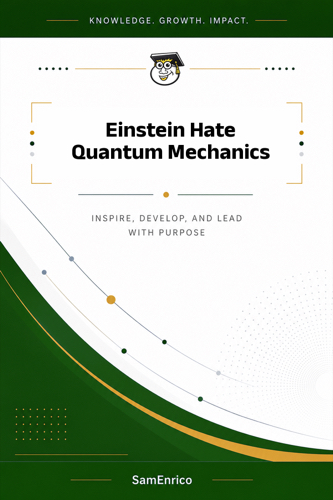
Einstein Hate Quantum Mechanics
Explore Einstein's famous quote 'God does not play
by Logan Blanca
Explore Einstein's famous quote 'God does not play dice' and his quantum objections.
Formats
About this book
Free sample
Chapter 1: The Obscure Revolutionary...--–- In the summer of 1905, a 26-year-old patent clerk named Albert Einstein sat in a small apartment at Kramgasse 49 in Bern, Switzerland, listening to his newborn son cry in the next room. The boy was sick. Money was scarce. Einstein's wife, Mileva, was exhausted and resentful. And yet, between changing diapers and reviewing patent applications for electromagnetic devices he would never build, Einstein was quietly tearing down the foundations of classical physics.No university would hire him.
His Ph D dissertation had been rejected twice. His own father had died just three years earlier, convinced his son was a failure. The professors who knew Einstein thought him talented but insubordinate—too clever by half, too willing to question the unquestionable. And yet, in that cramped apartment, using nothing but his mind, a fountain pen, and stacks of cheap paper, Einstein published four papers in a single year that would forever change humanity's understanding of space, time, matter, and light.One of those papers—the one that would win him the Nobel Prize sixteen years later—argued something so radical that even Max Planck, the elder statesman of German physics, could not fully accept it. Einstein claimed that light itself consists of discrete particles.
He called them "light quanta." Today we call them photons.The irony, as this book will explore across twelve chapters, is devastating: the man who invented the quantum particle would spend the final three decades of his life fighting against the quantum revolution he had started. He did not hate quantum mechanics. He loved it too much to let it be wrong. But to understand his rebellion, we must first understand his birth as a revolutionary. This chapter tells that story.The Miracle Year The year 1905 is called Einstein's Annus Mirabilis—his "Miracle Year"—but the term is misleading.
Miracles imply divine intervention or inexplicable luck. What happened in Bern was neither. It was the product of obsessive focus, unconventional thinking, and a willingness to trust physical intuition over mathematical elegance, even when the mathematics seemed to work.Einstein had graduated from the…
This is the end of the free sample. Get the eBook to keep going. Buy now
Contents
- Chapter 1
- Chapter 2
- Chapter 3
- Chapter 4
- Chapter 5
- Chapter 6
- Chapter 7
- Chapter 8
- Chapter 9
- Chapter 10
- Chapter 11
- Chapter 12
Details
- Author
- Logan Blanca
- Publisher
- SamEnrico
- Language
- English
- Genre
- Non-Fiction, Biography, Philosophy
- Released
- 2026-06-08
- Pages (approx.)
- 127
- Available as
- eBook, Audiobook

Read better in the ZLOADR app
Your eBooks on your phone or tablet. Sign in with your SamEnrico account and start reading.
More by Logan Blanca
 Daily Review for Salespeople ManualLogan Blanca$11.99
 The Payday Trigger CourseLogan Blanca$11.99
 North American Talent CorridorLogan Blanca$11.99
 PNF Stretching Techniques CourseLogan Blanca$11.99
 Soul of the Underground: The Unsung Heroes of the 1970s Black Radio RevolutionLogan Blanca$11.99
 Love in the Shadow of Vesuvius: Letters from Pompeii’s Last DaysLogan Blanca$11.99
 Cohort Luxury Spending PatternsLogan Blanca$12.99
 One Page Franchise Marketing SystemLogan Blanca$12.99
 Understanding Baraitser–rodeck–garner SyndromeLogan Blanca$17.99
 How to Start a Hobby in House makingLogan Blanca$11.99
 Forex and Global Currency MarketsLogan Blanca$11.99
You may also like
 Hong Kong Handover 1997Dunn Johnnie$11.99
 Zumba For Postnatal Recovery CourseNeal Christian$11.99
 Zumba for BeginnersLadner Nikia$11.99
 YouTube Comment Mining GuideHumes Pandora$12.99
 Worry Box MeditationCarlin Rudy$11.99
 Workplace Stress MeditationNguyen Lynn$11.99
 Workplace Stress and Sleep RepairHawley Ivory$11.99
 Workplace Perfectionism CureDelaney Jeffry$11.99
 Workplace Injustice Anger GuideWallen Isabelle$11.99
 Work Addiction and Burnout LinkGreenwood Ester$11.99
 Women in Yoga and WellnessBeattie Galina$11.99
 Women in Stand Up ComedyChun Evangeline$11.99