
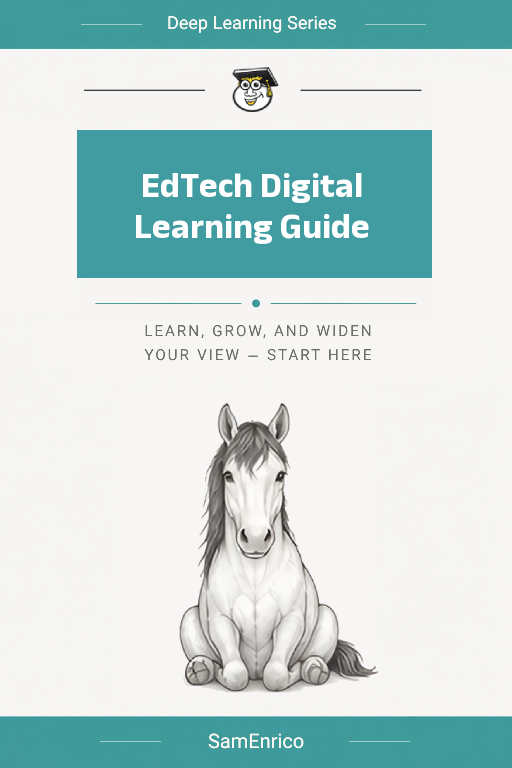
Non-FictionForecast & OutlookEdTech
EdTech Digital Learning Guide eBook
Project upskilling platforms, language learning ap
by Whelan Gigi
Project upskilling platforms, language learning apps, and corporate training for workforce development.
Formats
Free sample
Chapter 1: The Half-Life of Knowing--–- Every morning, Sofia Rodriguez opens her laptop and feels a quiet dread she cannot name. At thirty-four, she is a senior marketing manager at a mid-sized logistics firm, a job she earned through a decade of night classes, certifications, and relentless hustle. Her resume is two pages of impressive bullet points: Google Analytics certified, Salesforce advanced administrator, Six Sigma Green Belt. Last year, she led a campaign that increased customer engagement by twenty-three percent. Her performance reviews are impeccable.
Yet for the past six months, she has watched with growing unease as the company's new AI-powered campaign tool does in thirty seconds what used to take her team three days. No one has threatened her job. No one has mentioned layoffs. But Sofia knows something has shifted. She is no longer the expert in the room.
The machine is.This chapter is for Sofia. It is for the warehouse supervisor who learned Excel in 2015 and now watches new hires run circles around him with Python scripts. It is for the HR generalist who mastered Workday but has never heard of an API. And it is for the executive who wonders why his most expensive training programs produce so little visible change. We begin here, at the beginning, because before you can build a new skill stack, you must first understand why your old one is slowly turning to sand.The concept we need to confront is simple, uncomfortable, and unavoidable: the half-life of professional skills is shrinking.
In medicine, the half-life of a drug is the time it takes for half of its active substance to leave the body. In the world of work, the half-life of a skill is the time it takes for half of its practical value to become obsolete. A generation ago, an engineer could graduate from university and practice effectively for thirty years with only minor updates. A decade ago, that window shrank to ten to fifteen years. Today, according to research from IBM’s Institute for Business Value, the half-life of a learned technical skill is now approximately five years.
For skills in data science, digital marketing, and supply chain automation, the half-life can be as short as two and a half years.Let that sink in. If you learned a new software platform last year, half of what you learned may be irrelevant by the time you finish reading this book. Not because you are a poor learner, but because the ground is moving beneath all of us.The Collapse of the Static Resume For most of the twentieth century, the career arc was linear and predictable. You chose a profession, earned a degree or trade certification, secured an entry-level position, and accumulated experience. Promotions came with tenure.
The resume was a record of what you had done, and its value increased steadily until retirement. This model assumed that the knowledge you acquired at twenty would serve you at fifty. It assumed that institutions would train you, that industries would change slowly, and that the title on your business card was a reliable signal of your competence.All three assumptions have shattered.The first casualty is the idea that a single credential guarantees lifelong employability. A 2023 analysis by the Burning Glass Institute found that nearly forty percent of skills required for occupations changed between 2019 and 2023 alone. The COVID-19 pandemic accelerated digital transformation by roughly seven years, compressing a decade of change into twelve months.
Companies that had been discussing cloud migration for years suddenly executed it in weeks. Warehouse operators who had never considered automation installed robotic picking systems. Call centers that relied on human agents deployed AI chatbots. The workers who survived these transitions were not necessarily the most senior or the most credentialed. They were the ones who could learn fast and discard old habits faster.The second casualty is the resume itself as a reliable predictor of future performance.
Recruiters have known for years that past performance is a weak indicator of future success in rapidly changing environments. But now the data is irrefutable. A candidate who mastered SEO in 2018 may be completely unprepared for the AI-generated search landscape of 2025. A project manager who excelled at Waterfall methodologies may struggle with agile, cross-functional, AI-augmented teams. The resume tells you where someone has been.
It says almost nothing about whether they can adapt to where the work is going.Consider the case of Marcus Chen, a manufacturing supervisor we will follow throughout this book. Marcus spent fifteen years at an automotive parts plant, rising from assembly line worker to shift supervisor. He knew every machine, every safety protocol, every supplier relationship. Then the plant installed digital twin simulation software—a virtual replica of the factory floor that allowed engineers to test changes before implementing them. Marcus’s manager asked him to learn the system.
Marcus, who had never written a line of code, felt a familiar spike of anxiety. But unlike many of his peers, he did not retreat to the comfort of his existing expertise. He found a local community college offering a six-week certificate in digital twin fundamentals. He spent twenty minutes each morning on an upskilling platform called Inspigo, completing bite-sized modules on simulation logic. Within four months, Marcus was leading the plant’s digital transformation team.
His resume still listed his fifteen years of manufacturing experience. But the real signal of his value was not his seniority. It was the new badge on his Linked In profile: Digital Twin Certified.Marcus embodies what this chapter calls dynamic employability—the ability to continuously retire obsolete knowledge and acquire new skills in response to changing work demands. Dynamic employability has four components: awareness of what you do not know, willingness to unlearn, capacity to learn rapidly in short bursts, and the humility to seek feedback from both humans and machines. Notice that none of these components appear on a traditional resume.
You cannot list “awareness of unknown unknowns” in a bullet point. Yet in the modern workforce, these traits matter more than any credential.The Portfolio Career Revolution The death of the static resume is also the birth of something new: the portfolio career. A portfolio career is not merely a job with multiple responsibilities. It is a professional identity built on a collection of skills, projects, and micro-credentials rather than a single job title or employer. The portfolio careerist expects to work across industries, roles, and sometimes employment statuses (full-time, freelance, contract) over the course of a career.
They do not ask “What is my job?” They ask “What problems can I solve with my current skill stack?”The rise of portfolio careers is driven by three interconnected forces. First, automation is eliminating routine tasks across every industry. A 2021 study from Mc Kinsey Global Institute estimated that by 2030, up to thirty percent of work activities in the United States could be automated. But automation does not simply destroy jobs. It decomposes them into tasks, some of which are automated and some of which are augmented.
The graphic designer who once spent hours masking images now uses AI to do it in seconds, freeing time for creative direction. The accountant who reconciled spreadsheets…
This is the end of the free sample. Get the eBook to keep going. Buy now
About this book
Details
- Author
- Whelan Gigi
- Publisher
- SamEnrico
- Language
- English
- Genre
- Non-Fiction, Forecast & Outlook, EdTech
- Released
- 2026-06-01
- Pages (approx.)
- 142
- Available as
- eBook, Audiobook

Read better in the ZLOADR app
Your eBooks on your phone or tablet. Sign in with your SamEnrico account and start reading.
More by Whelan Gigi
 The Stress Hormone Imbalance PrimerWhelan Gigi$11.99
 LGBTQ Youth Suicide Survivor StoryWhelan Gigi$11.99
 Horse Phobia Stable Visit GuideWhelan Gigi$11.99
 Roblox Addiction Parenting GuideWhelan Gigi$11.99
 Depreciation for Data CentersWhelan Gigi$11.99
 Bifrost's Last Bridge: The Collapse of the Gods' HighwayWhelan Gigi$11.99
 How to Become a Self-sealing-fuel-tank RepairerWhelan Gigi$11.99
 Understanding Marfanoid HypermobilityWhelan Gigi$17.99
 Goal Setting Across Time ZonesWhelan Gigi$12.99
 Model Cars Including Radio-controlled CarsWhelan Gigi$11.99
You may also like
 Hong Kong Handover 1997Dunn Johnnie$11.99
 Zumba For Postnatal Recovery CourseNeal Christian$11.99
 Zumba for BeginnersLadner Nikia$11.99
 YouTube Comment Mining GuideHumes Pandora$12.99
 Worry Box MeditationCarlin Rudy$11.99
 Workplace Stress MeditationNguyen Lynn$11.99
 Workplace Stress and Sleep RepairHawley Ivory$11.99
 Workplace Perfectionism CureDelaney Jeffry$11.99
 Workplace Injustice Anger GuideWallen Isabelle$11.99
 Work Addiction and Burnout LinkGreenwood Ester$11.99
 Women in Yoga and WellnessBeattie Galina$11.99
 Women in Stand Up ComedyChun Evangeline$11.99