
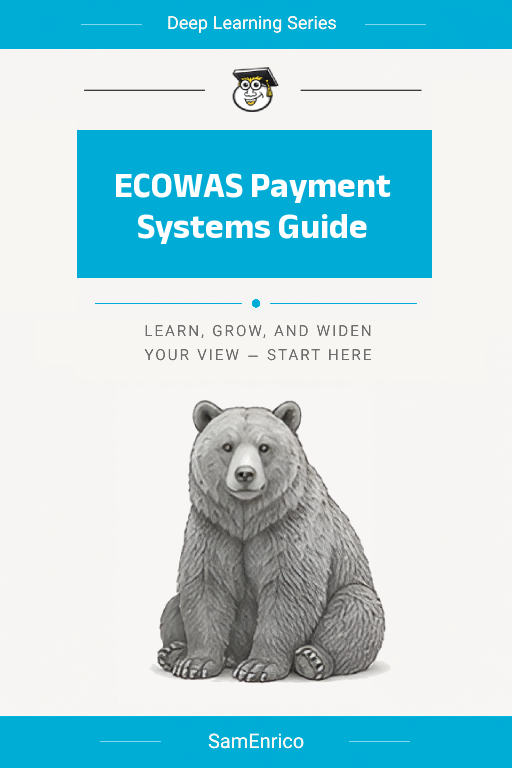
Non-FictionBusiness BriefFintech Guide
ECOWAS Payment Systems Guide eBook
Navigate cross-border payments within ECOWAS regio
by Prater Hai
Navigate cross-border payments within ECOWAS region. West African monetary integration and settlement.
Formats
Free sample
Chapter 1: The Two Africas...--–- Aminata Diallo wakes at 4:30 AM in her Dakar apartment, as she has done every Tuesday for seventeen years. By 5:00 AM, she is at the Sandaga market, where she sells high-quality West African textiles—wax prints, kente cloth, and bogolan mudcloth—to buyers from across the region. Her best customer, a wholesaler from Lagos named Chukwudi, has been asking for the same thing for three months: faster payments. "Aminata, I send you the money on Monday. You confirm receipt on Thursday.
By then, the price of Naira has moved, the price of CFA has moved, and my profit is gone. Can you fix this?" Aminata cannot fix it. Neither can her bank. Neither, it turns out, can the governor of the Central Bank of West African States (BCEAO), because the problem is not her bank. The problem is the two Africas.Every day, 50 million West Africans attempt to move money across the borders of the Economic Community of West African States (ECOWAS).
They are traders like Aminata, sending goods from Dakar to Lagos. They are families, sending remittances from Accra to Bamako. They are businesses, paying suppliers from Abidjan to Cotonou. And every day, the vast majority of them lose money—not because they are bad at business, but because the payment system itself is broken. The region is divided into two monetary zones that do not speak the same financial language.
One zone, the West African Economic and Monetary Union (WAEMU, also known by its French acronym UEMOA), consists of eight Francophone countries that share a common currency, the CFA franc, which is guaranteed by the French Treasury and pegged to the Euro. The other zone, the West African Monetary Zone (WAMZ), consists of six Anglophone countries (plus Guinea, a Francophone country that opted out of the CFA system), each with its own national currency—the Nigerian Naira, the Ghanaian Cedi, the Gambian Dalasi, the Sierra Leonean Leone, the Liberian Dollar, and the Guinean Franc. These currencies are not convertible with each other. They are not guaranteed by any external authority. They float independently, which means their value changes by the hour.This chapter is about that divide.
It is about why a trader in Abidjan has a fundamentally different experience of cross-border payments than a trader in Lagos. It is about the concept of the "Monetary Passport"—a framework for assessing your settlement risk based on which countries you are sending money between. And it is about the painful truth that until you understand the two Africas, every payment you make across an ECOWAS border will cost you more than it should.The Geography of West African Money To understand why cross-border payments in West Africa are so difficult, you must first understand the map. ECOWAS was founded in 1975 with 15 member states (Burkina Faso, Benin, Cabo Verde, Côte d'Ivoire, The Gambia, Ghana, Guinea, Guinea-Bissau, Liberia, Mali, Niger, Nigeria, Senegal, Sierra Leone, and Togo). Mauritania left in 2000, leaving 15.
The founding vision was ambitious: economic integration, free movement of people and goods, and eventually, a single currency and a common central bank. Fifty years later, the single currency still does not exist. What exists instead are two monetary unions that operate in parallel, with vastly different rules, risks, and realities.The CFA Franc Zone (WAEMU/UEMOA)Eight countries—Benin, Burkina Faso, Côte d'Ivoire, Guinea-Bissau, Mali, Niger, Senegal, and Togo—form the WAEMU. They share the CFA franc, a currency that has existed since 1945, when it was created for French colonies in Africa. The "CFA" originally stood for "Colonies Françaises d'Afrique" (French Colonies of Africa).
Today, it stands for "Communauté Financière d'Afrique" (Financial Community of Africa), though the political legacy remains contested. The key features of the CFA franc are threefold.First, the CFA franc is pegged to the Euro (previously the French franc) at a fixed rate of 1 Euro = 655.957 CFA. This peg has remained stable for decades, providing predictability that businesses in Francophone West Africa have come to rely on. When a Senegalese exporter invoices a buyer in France, she knows exactly how much she will receive in CFA francs. When an Ivorian importer buys machinery from Germany, he knows exactly how much it will cost in CFA francs.
This predictability is the single greatest advantage of the CFA system.Second, the CFA franc is guaranteed by the French Treasury. The BCEAO (Central Bank of West African States) and its counterpart in Central Africa, the BEAC, are required to deposit 50% of their foreign exchange reserves with the French Treasury. In exchange, France guarantees the unlimited convertibility of the CFA franc. This means that any holder of CFA francs—whether a bank, a business, or an individual—can exchange them for Euros at the fixed rate, without limit, and France will honor that exchange. This guarantee is the reason why CFA francs are considered "hard currency" while other West African currencies are not.Third, the BCEAO operates a centralized monetary policy for all eight WAEMU countries.
The bank sets interest rates, controls the money supply, and regulates commercial banks across the zone. This centralization has costs—member countries have given up independent monetary policy—but it also has benefits. When a bank in Senegal needs to settle a payment with a bank in Côte d'Ivoire, the transaction happens within a single currency zone, using a single central bank, with no forex risk and minimal delay.The WAMZ Countries (The Floating Currencies)The other nine ECOWAS countries (Cabo Verde is the ninth, though it uses the Cape Verdean Escudo, which is pegged to the Euro but not part of the CFA system) are not part of the WAEMU. Instead, they are members of the West African Monetary Zone (WAMZ), a separate initiative launched in 2000 with the goal of creating a second common currency that would eventually merge with the CFA franc to form a single ECOWAS currency. That has not happened.
What exists instead is a collection of national currencies, each with its own central bank, its own exchange rate regime, and its own level of volatility.The most important of these currencies is the Nigerian Naira. Nigeria is the largest economy in West Africa by a wide margin, accounting for approximately 60% of ECOWAS GDP. The Naira is also the most volatile major currency in the region. Since the Central Bank of Nigeria (CBN) floated the Naira in 2023 after years of controlled exchange rates, the currency has depreciated by more than 50% against the dollar, creating enormous uncertainty for anyone doing business across the Nigerian border. A trader who invoices in Naira today may find that the value of that invoice has dropped by 2% by tomorrow—not because the goods changed, but because the currency moved.The Ghanaian Cedi is similarly volatile, though less extreme.
Ghana is a major exporter of cocoa, gold, and oil, and its currency tends to move with commodity prices. When oil prices rise, the Cedi strengthens; when they fall, the Cedi weakens. This makes the Cedi a "commodity currency," predictable in its unpredictability. The Gambian Dalasi, Sierra Leonean Leone, and Liberian Dollar are smaller, less liquid, and even more volatile. These currencies often suffer from shortages of foreign…
This is the end of the free sample. Get the eBook to keep going. Buy now
About this book
Details
- Author
- Prater Hai
- Publisher
- SamEnrico
- Language
- English
- Genre
- Non-Fiction, Business Brief, Fintech Guide
- Released
- 2026-06-01
- Pages (approx.)
- 154
- Available as
- eBook, Audiobook

Read better in the ZLOADR app
Your eBooks on your phone or tablet. Sign in with your SamEnrico account and start reading.
More by Prater Hai
 Raise Denial Anger Management WorkbookPrater Hai$11.99
 Single Parent Financial SurvivalPrater Hai$11.99
 The Interruption Management BlockingPrater Hai$11.99
 The Nobel ObsessionPrater Hai$11.99
 Tom Snyder Space CadetPrater Hai$11.99
 The Battle of Lepanto: Guns, Galleys, and the Birth of Naval SupremacyPrater Hai$11.99
 Monday.com GuidePrater Hai$12.99
 General Office ClerkPrater Hai$11.99
 Understanding Q FeverPrater Hai$17.99
 How to Start a Peracetic Acid Business (Beginners Guide)Prater Hai$11.99
You may also like
 Hong Kong Handover 1997Dunn Johnnie$11.99
 Zumba For Postnatal Recovery CourseNeal Christian$11.99
 Zumba for BeginnersLadner Nikia$11.99
 YouTube Comment Mining GuideHumes Pandora$12.99
 Worry Box MeditationCarlin Rudy$11.99
 Workplace Stress MeditationNguyen Lynn$11.99
 Workplace Stress and Sleep RepairHawley Ivory$11.99
 Workplace Perfectionism CureDelaney Jeffry$11.99
 Workplace Injustice Anger GuideWallen Isabelle$11.99
 Work Addiction and Burnout LinkGreenwood Ester$11.99
 Women in Yoga and WellnessBeattie Galina$11.99
 Women in Stand Up ComedyChun Evangeline$11.99