
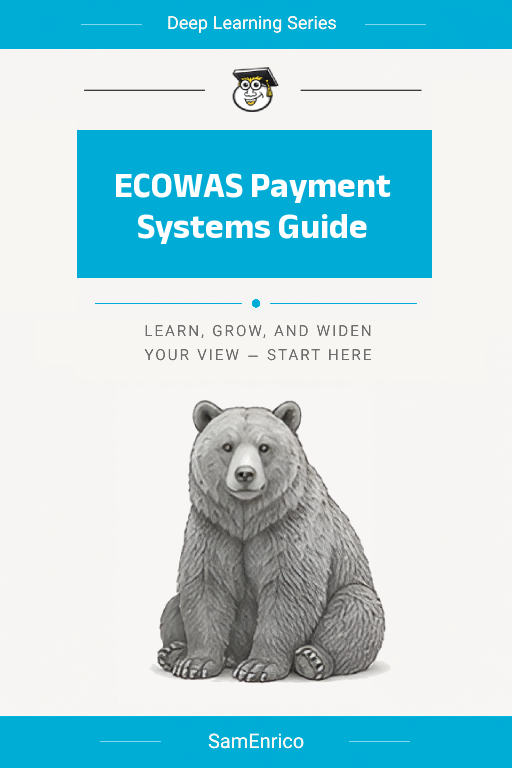
Non-FictionBusiness BriefFintech Guide
ECOWAS Payment Systems Guide Audiobook
Navigate cross-border payments within ECOWAS regio
by Prater Hai
Navigate cross-border payments within ECOWAS region. West African monetary integration and settlement.
Formats
Free sample
Chapter 1: The Two Africas...--–- Aminata Diallo wakes at 4:30 AM in her Dakar apartment, as she has done every Tuesday for seventeen years. By 5:00 AM, she is at the Sandaga market, where she sells high-quality West African textiles—wax prints, kente cloth, and bogolan mudcloth—to buyers from across the region. Her best customer, a wholesaler from Lagos named Chukwudi, has been asking for the same thing for three months: faster payments. "Aminata, I send you the money on Monday. You confirm receipt on Thursday.
By then, the price of Naira has moved, the price of CFA has moved, and my profit is gone. Can you fix this?" Aminata cannot fix it. Neither can her bank. Neither, it turns out, can the governor of the Central Bank of West African States (BCEAO), because the problem is not her bank. The problem is the two Africas.Every day, 50 million West Africans attempt to move money across the borders of the Economic Community of West African States (ECOWAS).
They are traders like Aminata, sending goods from Dakar to Lagos. They are families, sending remittances from Accra to Bamako. They are businesses, paying suppliers from Abidjan to Cotonou. And every day, the vast majority of them lose money—not because they are bad at business, but because the payment system itself is broken. The region is divided into two monetary zones that do not speak the same financial language.
One zone, the West African Economic and Monetary Union (WAEMU, also known by its French acronym UEMOA), consists of eight Francophone countries that share a common currency, the CFA franc, which is guaranteed by the French Treasury and pegged to the Euro. The other zone, the West African Monetary Zone (WAMZ), consists of six Anglophone countries (plus Guinea, a Francophone country that opted out of the CFA system), each with its own national currency—the Nigerian Naira, the Ghanaian Cedi, the Gambian Dalasi, the Sierra Leonean Leone, the Liberian Dollar, and the Guinean Franc. These currencies are not convertible with each other. They are not guaranteed by any external authority. They float independently, which means their value changes by the hour.This chapter is about that divide.
It is about why a trader in Abidjan has a fundamentally different experience of cross-border payments than a trader in Lagos. It is about the concept of the "Monetary Passport"—a framework for assessing your settlement risk…
This is the end of the free sample. Get the Audiobook to keep going. Buy now
About this book
Details
- Author
- Prater Hai
- Publisher
- SamEnrico
- Language
- English
- Genre
- Non-Fiction, Business Brief, Fintech Guide
- Released
- 2026-06-01
- Pages (approx.)
- 154
- Available as
- eBook, Audiobook

Listen in the VoxFlicks app
Audiobooks and audio dramas wherever you go. Sign in with your SamEnrico account and press play.
More by Prater Hai
 Raise Denial Anger Management WorkbookPrater Hai$11.99
 Single Parent Financial SurvivalPrater Hai$11.99
 The Interruption Management BlockingPrater Hai$11.99
 The Nobel ObsessionPrater Hai$11.99
 Tom Snyder Space CadetPrater Hai$11.99
 The Battle of Lepanto: Guns, Galleys, and the Birth of Naval SupremacyPrater Hai$11.99
 Monday.com GuidePrater Hai$12.99
 General Office ClerkPrater Hai$11.99
 Understanding Q FeverPrater Hai$17.99
 How to Start a Peracetic Acid Business (Beginners Guide)Prater Hai$11.99
You may also like
 Hong Kong Handover 1997Dunn Johnnie$11.99
 Zumba For Postnatal Recovery CourseNeal Christian$11.99
 Zumba for BeginnersLadner Nikia$11.99
 YouTube Comment Mining GuideHumes Pandora$12.99
 Worry Box MeditationCarlin Rudy$11.99
 Workplace Stress MeditationNguyen Lynn$11.99
 Workplace Stress and Sleep RepairHawley Ivory$11.99
 Workplace Perfectionism CureDelaney Jeffry$11.99
 Workplace Injustice Anger GuideWallen Isabelle$11.99
 Work Addiction and Burnout LinkGreenwood Ester$11.99
 Women in Yoga and WellnessBeattie Galina$11.99
 Women in Stand Up ComedyChun Evangeline$11.99