
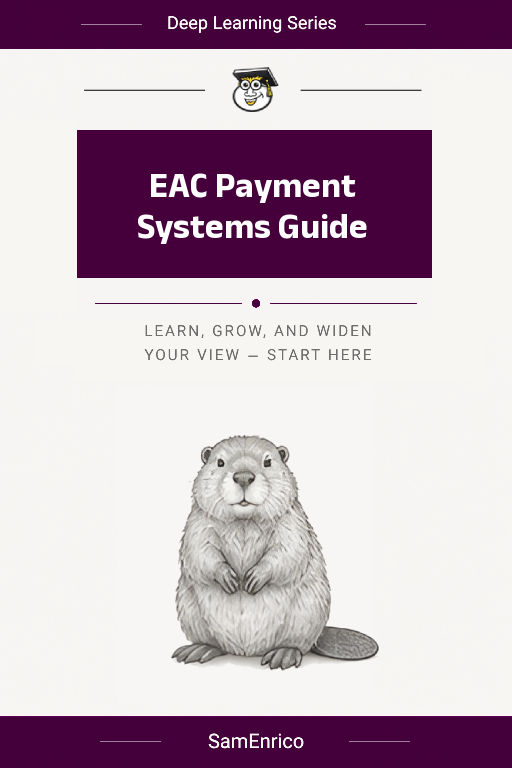
EAC Payment Systems Guide eBook
Navigate cross-border payments in East African Com
Navigate cross-border payments in East African Community. Regional integration and settlement options.
Formats
Free sample
Chapter 1: The Speed Trap--–- On paper, the East African Community looks like a payment processor’s dream. Seven countries. Three hundred million people. A customs union that has existed since 2005. A common market since 2010.
A monetary union protocol signed with great ceremony in 2013, complete with ambitious deadlines and ministerial communiqués. The official narrative, repeated in countless development reports and central bank press releases, promises a region where money flows as freely as goods – where a trader in Mombasa can pay a supplier in Kigali with the same ease as paying a neighbor across the street.The reality, as anyone who has actually tried to move money across an EAC border knows, is something else entirely.Imagine this scene. It is Tuesday morning at the Busia border post, the chaotic artery connecting Kenya and Uganda. A truck carrying forty tons of maize from Uganda’s eastern grain belt has just cleared customs. The Ugandan seller, a cooperative of smallholder farmers, needs payment before releasing the goods.
The Kenyan buyer, a milling company in Eldoret, has the cash – in Kenyan shillings, sitting in a Nairobi bank account. The transaction should be simple. The two countries share a border, a history, and even overlapping mobile money networks. But Tuesday comes and goes. Wednesday passes.
On Thursday, the milling company’s finance manager receives a terse message from their bank: the cross-border transfer has been delayed pending additional compliance documentation. The maize sits at the border. The farmers wait. The truck accrues demurrage charges of $150 per day. By the time the payment finally settles on Friday – three full days later – the transaction has cost 8.5% in hidden fees, unfavorable exchange rates, and lost time.This is not an edge case.
This is the everyday reality of cross-border payments in the East African Community. And it is the central paradox this book exists to resolve.The Integration Paradox The EAC is simultaneously the most integrated economic bloc in Africa and one of the most frustrating environments for moving money across borders. The community has achieved what the Economic Community of West African States (ECOWAS) and the Southern African Development Community (SADC) have only dreamed of: a functioning customs union, relatively free movement of labor, and a genuine political commitment to deeper integration. Citizens of EAC partner states can travel on national identity cards. Goods move with lower tariffs than almost anywhere else on the continent.
The headquarters in Arusha hums with technical working groups harmonizing everything from sanitary standards to competition policy.Yet send one hundred dollars from Nairobi to Dar es Salaam, and the friction is astonishing. The same banks that operate seamlessly across Kenyan counties become balkanized at the border. The mobile money that allows a vegetable seller in Kisumu to pay a farmer in Kakamega in seconds cannot reliably move the same value across Lake Victoria to Mwanza. The postal network that delivers letters from Kampala to Kigali cannot settle the payment for the goods described in those letters.This book argues that the disconnect is not accidental. It is structural.
The EAC was built by central bankers and trade ministers focused on macroeconomic convergence – inflation targets, fiscal deficits, gross reserve ratios. These matter, certainly. But they are not the same as building a functional, day-to-day payment system for the businesses and individuals who actually trade across borders. The monetary union protocol runs to over one hundred pages. It specifies the convergence criteria for public debt and the statute of the proposed East African Central Bank.
It barely mentions how a small trader might settle an invoice in Ugandan shillings from a Kenyan shilling account.The consequence is what this book calls the Speed Trap: the perverse situation where the official, compliant, regulated payment channels are often the slowest and most expensive, while the fastest and most reliable channels exist in the informal economy, outside any regulatory framework. Businesses are caught between the Scylla of regulatory compliance and the Charybdis of operational speed. Choose the formal system, and you accept three-day settlement and hidden costs. Choose the informal system, and you accept legal risk and counterparty exposure.Seven Countries, Seven Speeds The EAC today comprises seven partner states: Kenya, Tanzania, Uganda, Rwanda, Burundi, South Sudan, and the two newest members – the Democratic Republic of Congo (joined 2022) and Somalia (joined 2023). The original five (Kenya, Tanzania, Uganda, Rwanda, Burundi) have been integrating for over two decades.
The new entrants bring vast territory and populations, but also vastly different financial infrastructures.To understand payment systems in the EAC, you must abandon the idea of a single regional market. There is no unified payments space. There are seven national systems with varying degrees of interoperability, overlaid with private sector solutions that cross some borders but not others, all regulated by seven different central banks with seven different priorities and risk appetites.The differences are not minor. They are fundamental.Kenya operates the region’s most advanced financial ecosystem. The central bank’s real-time gross settlement system (KEPSS) processes high-value transactions efficiently.
The mobile money network, anchored by M-Pesa, has achieved near-universal adoption. Kenyan commercial banks maintain correspondent relationships with major international banks. Cross-border payments originating in Nairobi are the fastest and cheapest in the region – though “fastest” is relative, as the Busia maize example demonstrates.Rwanda has pursued a different path: centralized, state-directed, and methodical. The National Bank of Rwanda has invested heavily in digital infrastructure, including a national payment switch that connects banks, mobile money operators, and the central bank. Cross-border payments in and out of Rwanda are highly reliable but often require manual compliance checks that add 24 to 48 hours to settlement times.
The trade-off is safety: Rwanda’s AML/CFT regime is the strictest in the region, which means fewer fraudulent transactions but also more friction.Tanzania represents the cautious, state-interventionist model. The central bank maintains tight control over payment systems, mobile money interoperability, and foreign exchange. Cross-border payments are possible but slow, with frequent manual interventions. Tanzanian banks hold fewer Nostro accounts in Kenya than their regional peers, creating liquidity bottlenecks that delay large transfers. The government’s ambivalence toward financial liberalization – a reaction to perceived overreach by foreign investors – has produced a system that is stable but sclerotic.Uganda is the liberal wild card.
The central bank allows market forces to operate with relatively light touch. Mobile money interoperability is advanced. Commercial banks compete aggressively on cross-border fees. But the absence of tight regulation produces volatility: payment systems may be fast one month and unreliable the next, depending on which bank has Nostro liquidity and which compliance officer is reviewing the file. Uganda’s financial sector is a laboratory for market-driven solutions, but laboratories produce both breakthroughs and explosions.Burundi and South Sudan are the region’s financial frontiers – or, more bluntly, its problem children.
Both have experienced political instability, banking sector fragility, and severe dollar shortages. Cross-border payments from these countries often cannot use formal channels at all. A Burundian importer wanting to pay a Kenyan supplier may need to carry physical cash across the border or use informal hawala networks. South Sudan’s banking system has partially collapsed; some commercial banks maintain Nostro accounts in Nairobi, but their balances are…
This is the end of the free sample. Get the eBook to keep going. Buy now
About this book
Details
- Author
- Higgs Caroyln
- Publisher
- SamEnrico
- Language
- English
- Genre
- Non-Fiction, Business Brief, Fintech Guide
- Released
- 2026-05-29
- Pages (approx.)
- 156
- Available as
- eBook, Audiobook

Read better in the ZLOADR app
Your eBooks on your phone or tablet. Sign in with your SamEnrico account and start reading.
More by Higgs Caroyln
 Micromanagement Anger Control CourseHiggs Caroyln$11.99
 Nobel Laureates in Structural BiologyHiggs Caroyln$11.99
 The Self Care Time Blocking GuideHiggs Caroyln$11.99
 Charlie Rose Dark Set LifeHiggs Caroyln$11.99
 Credit Card Debt Escape PlanHiggs Caroyln$11.99
 The Great Sydney Forgery: The Counterfeit King and His Downfall (1920s)Higgs Caroyln$11.99
 Geospatial Data AnalystHiggs Caroyln$11.99
 Twilio PLG GuideHiggs Caroyln$12.99
 Understanding Quadriceps Sparing MyopathyHiggs Caroyln$17.99
 How to Start a Pepper Substitute Business (Beginners Guide)Higgs Caroyln$11.99
You may also like
 Wise for African Exporters GuideNeumann Sylvie$12.99
 USDT for African ExportersPetit Keeley$12.99
 USD Receiving for African ExportersPeak Berenice$12.99
 Stripe for African Exporters GuideSprague Nakia$12.99
 PayPal for African Exporters GuideJorgenson Chana$12.99
 Payment Gateways African ExportersHandy Bibi$12.99
 Multi Currency Accounts AfricaBlunt Lesia$12.99
 Mobile Money Export PaymentsMast Jimmie$12.99
 International Transfer Fee Reduction GuideSoriano Margorie$12.99
 Hedging African Export GuideSpaulding Elly$12.99
 Ghana Dropshipping Payment Processing PlaybookLai Velva$12.99
 GBP Receiving African ExportersLiles Sheron$12.99