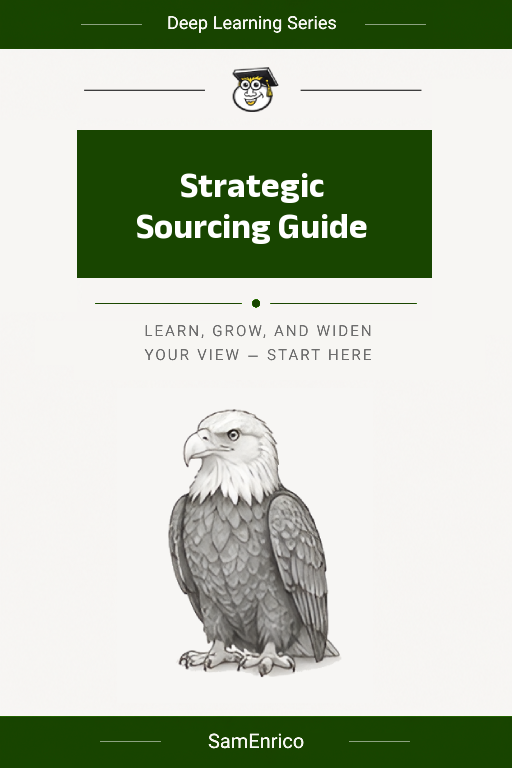
E Sourcing Efficiency Guide eBook
Accelerates RFx events using e-sourcing tools with
Accelerates RFx events using e-sourcing tools with automated supplier invitations, bid comparison, and award recommendations.
Formats
Free sample
Chapter 1: The Sunday Night Confession--–- The cursor blinked on an Excel spreadsheet at 11:47 PM on a Sunday. Forty-seven unread emails sat in the procurement inbox. Three versions of the same bid comparison file existed on the desktop—"FINAL_v3.xlsx," "FINAL_v3_REALLY_FINAL.xlsx," and "FINAL_v4_FOR_REAL_THIS_TIME.xlsx." A Slack message from the VP of Operations, timestamped six hours earlier, read simply: "Need award recommendation by 8 AM tomorrow. Urgent."The procurement manager, let's call her Sarah, had spent her entire weekend doing work that should have taken four hours. She had manually copied supplier pricing from PDF attachments into her master spreadsheet.
She had chased six suppliers who had ignored her RFQ invitation. She had discovered, at 10:15 PM, that two different suppliers had quoted in different currencies, and she had missed it for three days. She had also cried once, briefly, in the bathroom at 4 PM when her daughter asked why she couldn't come to the soccer game.Sarah is not incompetent. Sarah is not lazy. Sarah has a master's degree in supply chain management and twelve years of experience.
Sarah is drowning in a system that was designed for a different era—an era when three suppliers responded to a faxed request, when "fast" meant two weeks instead of four, and when no one had ever heard of AI agents or autonomous sourcing.Sarah's Sunday night is not an exception. It is the rule.This chapter is for Sarah. It is for you, if you have ever felt that quiet, nagging shame that perhaps you are just not good at this job—when the reality is that the job itself has become impossible to do well with the tools you have been given. We are going to name that shame, diagnose its root causes, and then, in the chapters that follow, systematically eliminate it.The Silent Epidemic of Manual Sourcing Let us begin with an uncomfortable truth. The vast majority of procurement organizations today are running sourcing events using workflows that would have been recognizable to a buyer in 1998.
The technology has changed—we have email instead of fax machines, and Excel instead of paper ledgers—but the fundamental process remains manual, fragmented, and exhausting.Consider the typical RFQ event. A buyer needs to source a category of goods—say, IT hardware. She must first draft the requirements, which means copying and pasting from last year's document, updating dates, and hoping she doesn't miss a critical specification. She must then identify suppliers, which means pulling a list from the ERP system, cross-referencing with her personal network, and adding a few names she remembers from industry conferences. She sends invitations via email, attaching a spreadsheet and a PDF, and then begins the waiting game.Three days later, she has received responses from only 40% of the suppliers she invited.
She sends follow-up emails. She makes phone calls. She escalates to her manager, who sends a more strongly worded email. Eventually, she has six responses, each in a different format: one in a beautifully formatted proposal, one in a scanned handwritten quote, one in a spreadsheet with hidden columns, and three in email bodies with pricing buried in paragraphs of text.She now faces the most painful phase: bid comparison. She manually extracts each supplier's pricing into a master spreadsheet.
She calculates totals, but discovers that one supplier quoted in Euros, another in US Dollars, and a third in a strange hybrid of both. She converts currencies manually, hoping the exchange rate she found on Google is accurate enough. She notices that one supplier's quote seems to exclude shipping, while another includes it but doesn't specify how it was calculated. She makes judgment calls. She documents nothing.Days pass.
The VP asks for an update. She says she is "working on it." The VP asks for a recommendation. She feels pressure to choose quickly, so she picks the lowest apparent price, ignoring the fact that the lowest bidder has a history of late deliveries and quality problems. She does this because she is exhausted, because the data is ambiguous, and because no one has given her a better way.The contract is awarded. Six months later, the low-cost supplier has caused three production delays, cost overruns in change orders, and a quiet realization that the "savings" never materialized.
But no one tracks that. The next RFQ begins, and the cycle repeats.This is not a failure of effort. It is a failure of process.The Bottleneck Triad: Why Manual Sourcing Fails Manual sourcing fails for three predictable, interrelated reasons. I call these the Bottleneck Triad, and once you see them, you will see them everywhere.Bottleneck One: Manual Data Entry Every time a human being copies numbers from one place to another, error is introduced. Every time a supplier sends a quote in a PDF, and a buyer retypes those numbers into a spreadsheet, the probability of a mistake approaches certainty.
Studies of manual data entry in procurement contexts show error rates between 1% and 5% per field. That might sound small. But a typical RFQ with twenty line items and six suppliers involves 120 data points. A 2% error rate means approximately two to three errors per event. Those errors compound.
A transposed digit in a unit price becomes a thousand-dollar mistake. A missed footnote about shipping costs becomes a budget blow.Manual data entry also consumes an astonishing amount of time. In a benchmarking study of procurement organizations, the average buyer spent 42% of their total sourcing time on data entry and manipulation. Forty-two percent. That is nearly half of a skilled professional's week spent doing work that a machine could do in milliseconds.Bottleneck Two: Reactive Supplier Chasing The second bottleneck is communication.
When a buyer sends an RFQ to twenty suppliers via email, she has no visibility into who has opened the email, who has read the attachment, who has started working on a response, and who has deleted the message without a second thought. She must chase. She must follow up. She must maintain a separate tracker—usually another spreadsheet—of who responded, who is late, who asked a question, and who has gone silent.This reactive chasing consumes another 25-30% of the average buyer's time. Worse, it creates a psychological tax.
The constant feeling of "I need to follow up with six people today" fragments attention, increases stress, and reduces the cognitive capacity available for actual strategic thinking.Bottleneck Three: Static Bid Comparison The third bottleneck is the most insidious because it masquerades as competence. Spreadsheets, for all their power, are terrible tools for collaborative, auditable, comparative analysis. Every time a spreadsheet is emailed to a stakeholder for review, a new version is created. Every time someone sorts a column to see the lowest price, they lose the context of other columns. Every time a buyer builds a weighted scoring model in Excel, they create a black box that no one else can verify or trust.The static bid comparison bottleneck manifests in predictable symptoms: multiple versions of the "final" file, arguments about whose numbers are correct, hidden rows that accidentally exclude a supplier, formulas that break when someone pastes new data, and a complete absence of…
This is the end of the free sample. Get the eBook to keep going. Buy now
About this book
Details
- Author
- Vaughan Laurence
- Publisher
- SamEnrico
- Language
- English
- Genre
- Non-Fiction, Operational Efficiency Manual, Strategic Sourcing
- Released
- 2026-06-01
- Pages (approx.)
- 132
- Available as
- eBook, Audiobook

Read better in the ZLOADR app
Your eBooks on your phone or tablet. Sign in with your SamEnrico account and start reading.
More by Vaughan Laurence
 Assertiveness With Contractors GuideVaughan Laurence$11.99
 Emotional Intelligence For ExecutivesVaughan Laurence$11.99
 Cosmetic Procedure Aftercare GuideVaughan Laurence$11.99
 French Resistance Code NamesVaughan Laurence$11.99
 The EQ for Law Enforcement GuideVaughan Laurence$11.99
 The Bone Setters of Renaissance Italy: The Forgotten Healers of the Medici CourtVaughan Laurence$11.99
 Strategy Meeting Opening TechniquesVaughan Laurence$12.99
 Managing PrincipalVaughan Laurence$11.99
 How to Start a Pennants Business (Beginners Guide)Vaughan Laurence$11.99